Email Spoofing Myths: What You Get Wrong About Fake Senders
Display names and SPF records do not guarantee sender identity, leaving your inbox vulnerable to sophisticated impersonation attacks that bypass standard filters.

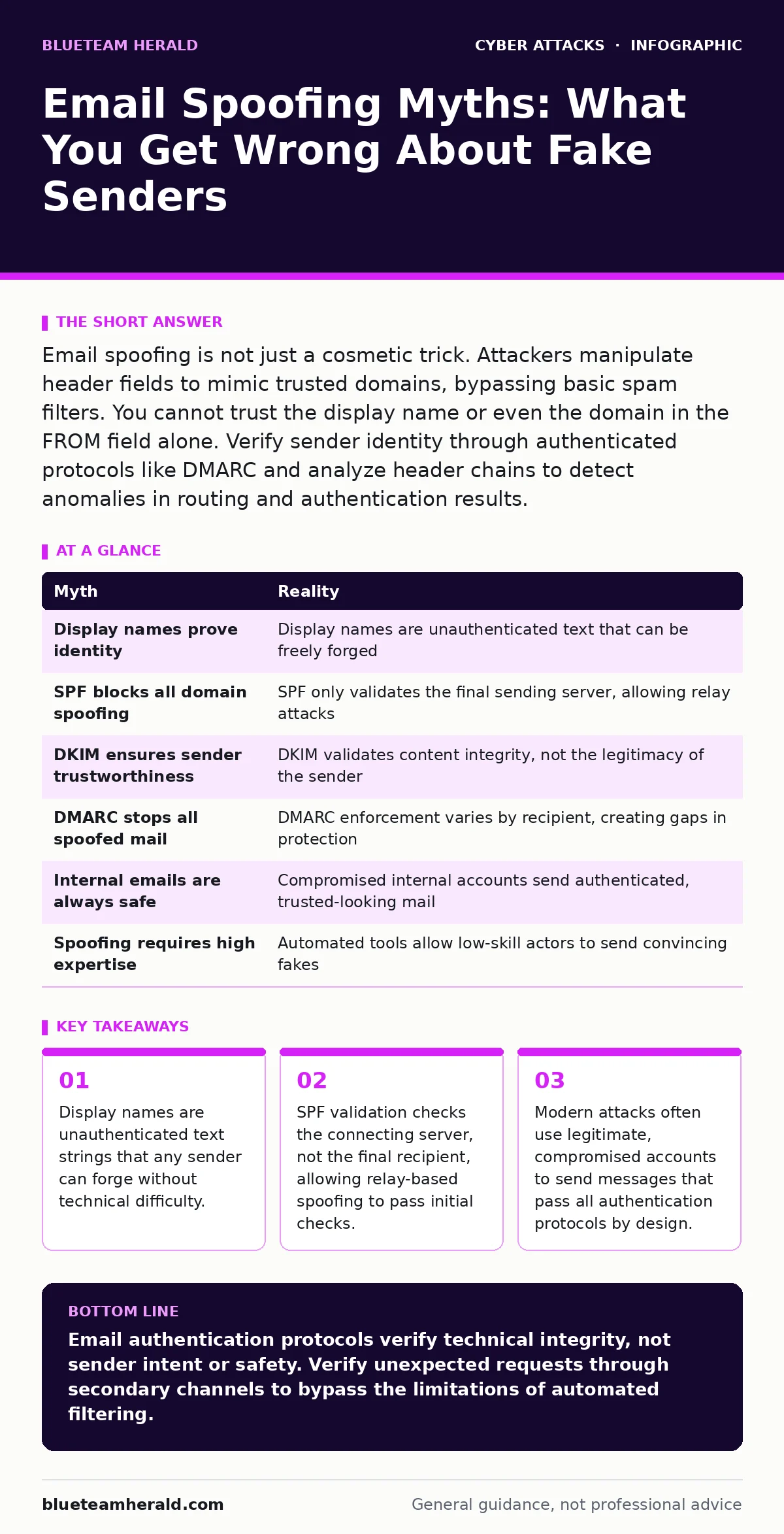
Email spoofing is not just a cosmetic trick. Attackers manipulate header fields to mimic trusted domains, bypassing basic spam filters. You cannot trust the display name or even the domain in the FROM field alone. Verify sender identity through authenticated protocols like DMARC and analyze header chains to detect anomalies in routing and authentication results.
Myth: The Display Name Proves Who Sent the Email
Reality: The display name is merely a cosmetic label that carries no cryptographic weight. Attackers easily craft headers to show "CFO" or "IT Support" while originating from a free provider. You see the name, but the underlying SMTP envelope sender is completely different. This separation allows impersonation without domain ownership. The protocol separates the human-readable label from the machine-readable address, creating a persistent trust gap.
Imagine receiving a message from "Your Bank" that asks for credentials. The display name matches your bank’s branding perfectly. The visual cues trigger immediate trust. This design flaw exists because email protocols prioritize flexibility over security. You must ignore the display name entirely when assessing legitimacy. Instead, inspect the actual email address and the authentication headers. Relying on visual identity is the oldest and most persistent failure in email security.
Myth: SPF Records Prevent All Domain Spoofing
Reality: SPF only validates the server that directly sends the message, not the final path. Attackers use open relays or compromised servers to bounce messages, making the final hop appear legitimate. SPF checks the immediate sender, not the original author. This limitation allows attackers to hide their true origin behind a chain of trusted relays. The record authorizes specific IP addresses, but it does not stop an attacker from using an authorized server to send a forged message.
This mechanism creates a false sense of security for administrators who believe SPF blocks all impersonation. It does not. SPF is a binary check for the last hop. If an attacker compromises a server listed in the SPF record, or uses a permissive relay, the check passes. You must combine SPF with DKIM and DMARC to close this gap. SPF alone leaves a significant window for relay-based attacks. Understanding this limitation prevents over-reliance on a single authentication layer.
Myth: DKIM Guarantees the Sender Did Not Change the Content
Reality: DKIM validates that the message was not altered in transit, not that the sender is trustworthy. A compromised legitimate account can sign emails with a valid key. The signature proves integrity, not identity. Attackers who breach a corporate account gain access to signing keys or send messages from within the authorized infrastructure. The digital signature remains valid because the content matches the signed hash.
You might assume a valid DKIM signature means the email is safe. It only means the email arrived exactly as the sending server transmitted it. If that server was compromised, the signature is a badge of honor for the attacker. This insight changes how you view authenticated mail. Authentication confirms technical validity, not operational safety. You must still verify the context and the request, even when cryptographic proofs are present.
Myth: DMARC Stops All Spoofed Messages from Reaching You
Reality: DMARC policies are enforced by receiving servers, not all of them uniformly. Many organizations set policies to "none" or "quarantine" rather than "reject". Attackers target recipients with lax DMARC enforcement. Even with strict policies, some legitimate senders fail alignment checks, causing false positives. Administritors often relax rules to avoid blocking business-critical communications. This creates inconsistent protection across the internet.
Suppose your organization enforces DMARC reject. You feel secure. However, if the recipient checks mail on a personal device or a third-party service, their provider might not enforce your policy. The protection is local to the receiving infrastructure. You cannot control how others handle your domain. This asymmetry means spoofed messages still slip through to endpoints with weaker gateways. Understanding this distribution of responsibility is key to realistic risk assessment.
Myth: You Can Trust Emails from Internal Addresses
Reality: Internal addresses can be spoofed or compromised to bypass perimeter defenses. Attackers use harvested credentials to log in and send messages that pass all external checks. The message originates from inside the trusted network boundary. This makes it indistinguishable from legitimate staff communications. Perimeter tools often whitelist internal traffic, skipping deep inspection. This assumption of internal trust is a major vulnerability.
Imagine a message from "HR" requesting password resets. It comes from an internal IP and passes SPF and DKIM. You assume it is safe. It might be a compromised account. This scenario highlights the failure of identity-based trust. You must verify unusual requests through out-of-band channels, regardless of the sender’s internal status. Internal spoofing is harder to detect because it lacks external anomalies. It relies entirely on behavioral cues and process verification.
See also: Phishing-Resistant Authentication: Answers to 10 Critical Questions
Myth: Spoofing Requires Technical Expertise to Execute
Reality: Modern phishing kits and cloud services automate the creation of spoofed messages. Attackers use templates and generic infrastructure to send millions of emails with minimal skill. The barrier to entry is low. You do not need to understand SMTP or DNS to craft a convincing fake. The complexity is hidden in the tools. This democratization of attack tools increases the volume and variety of threats.
Suppose you think only advanced groups can spoof your domain. You are wrong. Automated tools allow anyone to generate headers that mimic your structure. The effort is in the volume, not the craft. This shifts the defense burden to detection and user awareness. You must assume spoofing is easy and constant. Defensive measures must be automated and policy-driven, not reliant on technical obscurity. The ease of attack demands robust, automated verification processes.
| Myth | Reality |
|---|---|
| Display names prove identity | Display names are unauthenticated text that can be freely forged |
| SPF blocks all domain spoofing | SPF only validates the final sending server, allowing relay attacks |
| DKIM ensures sender trustworthiness | DKIM validates content integrity, not the legitimacy of the sender |
| DMARC stops all spoofed mail | DMARC enforcement varies by recipient, creating gaps in protection |
| Internal emails are always safe | Compromised internal accounts send authenticated, trusted-looking mail |
| Spoofing requires high expertise | Automated tools allow low-skill actors to send convincing fakes |
Key takeaways
- Display names are unauthenticated text strings that any sender can forge without technical difficulty.
- SPF validation checks the connecting server, not the final recipient, allowing relay-based spoofing to pass initial checks.
- Modern attacks often use legitimate, compromised accounts to send messages that pass all authentication protocols by design.
Email authentication protocols verify technical integrity, not sender intent or safety. Verify unexpected requests through secondary channels to bypass the limitations of automated filtering.
Frequently asked questions
How do I check if an email is spoofed?
Inspect the email headers for SPF, DKIM, and DMARC results. Look for mismatches between the display name and the actual sender address. Verify the routing path for unexpected hops.
Can spoofing be used for business email compromise?
Yes, attackers often spoof executive emails to request urgent transfers. This technique mimics CEO fraud by leveraging authority and urgency to bypass scrutiny.
Does multi-factor authentication prevent email spoofing?
No, MFA protects account access but does not prevent attackers from spoofing your domain. It helps prevent account takeover, which is a different vector.
What is the difference between spoofing and phishing?
Spoofing is the act of falsifying the sender address. Phishing is the broader strategy of deceiving users, often using spoofing as a technical component.
How this guide was produced: written by the BlueTeam Herald editorial team with AI assistance, checked against the public references listed below, and reviewed when the facts change. See our editorial policy or report an error.