Account Takeover Protection: Mechanisms, Trade-offs, and Defense
Account takeover protection relies on detecting behavioral anomalies rather than just verifying static credentials, because stolen passwords often look identical to legitimate ones.

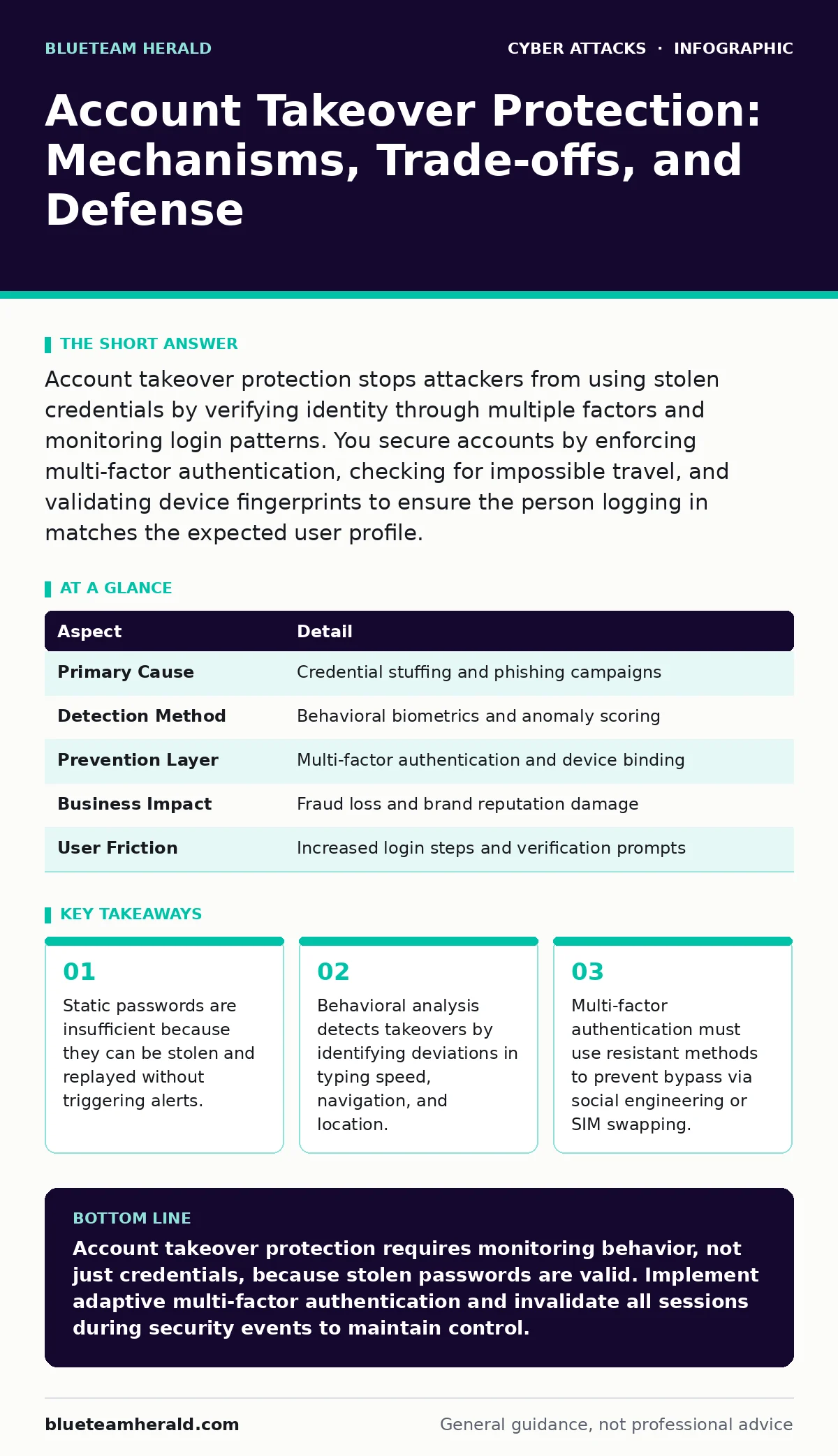
Account takeover protection stops attackers from using stolen credentials by verifying identity through multiple factors and monitoring login patterns. You secure accounts by enforcing multi-factor authentication, checking for impossible travel, and validating device fingerprints to ensure the person logging in matches the expected user profile.
Account Takeover Protection Explained
Account takeover occurs when an attacker gains unauthorized access to a user's online identity. This compromise allows the intruder to perform actions on behalf of the victim, such as transferring funds or accessing private data. Account takeover protection refers to the layered security measures designed to detect and block these unauthorized sessions. The threat affects anyone with a digital identity, from individual consumers to enterprise administrators.
Imagine a library where the only security is a nameplate at the desk. If someone steals your nameplate, they can check out any book. Account takeover is similar: the attacker possesses the "nameplate" (your credentials) and the system initially trusts them. Protection adds layers like facial recognition or a unique keycard that the thief cannot easily replicate.
| Aspect | Detail |
|---|---|
| Primary Cause | Credential stuffing and phishing campaigns |
| Detection Method | Behavioral biometrics and anomaly scoring |
| Prevention Layer | Multi-factor authentication and device binding |
| Business Impact | Fraud loss and brand reputation damage |
| User Friction | Increased login steps and verification prompts |
How Attackers Bypass Static Defenses
Attackers rarely guess passwords randomly. They use credential stuffing, which involves testing millions of username and password pairs leaked from other breaches. Since many users reuse credentials across sites, a breach on one platform compromises accounts on others. This method bypasses simple password strength rules because the credentials are valid, not guessed.
Once inside, attackers often avoid immediate large transactions. They perform small, low-risk actions to establish a pattern of legitimacy. This behavior defeats basic threshold alerts that only flag large purchases. The attacker waits for the account to appear "normal" before executing the primary fraud. This patience makes detection difficult for systems that only look at transaction value.
The Hidden Cost of Friction
Security measures create friction, which is the resistance users feel when completing a task. Every additional step in login increases the chance of user error or abandonment. Organizations often struggle to balance security with user experience. If the protection is too strict, legitimate users cannot access their accounts. If it is too loose, attackers slip through.
Account takeover protection must adapt to risk levels. Low-risk actions, like reading a newsletter, should require minimal verification. High-risk actions, like changing a payment method, demand rigorous checks. This adaptive approach reduces friction for routine tasks while maintaining high security for sensitive operations. Users tolerate friction when it is rare and clearly justified.
What People Usually Get Wrong
Many believe that multi-factor authentication alone solves the problem. This is incorrect if the second factor is weak. SMS-based codes are vulnerable to SIM swapping, where an attacker tricks a carrier into transferring the victim's phone number to a new SIM card. Once the number is ported, the attacker receives all SMS codes.
Another common error is ignoring session management. An attacker who gains access can sometimes maintain control even after the user changes their password. If the system does not invalidate existing sessions, the attacker remains logged in. Proper protection requires terminating all active sessions when a password change or security alert occurs. This ensures the attacker loses access immediately.
Behavioral Signals and Anomalies
Modern account takeover protection relies on behavioral biometrics. These systems analyze how a user interacts with the interface. Typing speed, mouse movement, and touch pressure create a unique digital fingerprint. Deviations from this baseline trigger additional verification. For example, a user who normally types quickly but suddenly pauses for long periods may be under duress or using a script.
Location and device data provide further context. Impossible travel detection flags logins from geographically distant locations within a short timeframe. If a user logs in from New York and then from London ten minutes later, the system blocks the second attempt. This mechanism assumes a single physical person cannot be in two places at once.
See also: Email Spoofing Myths: What You Get Wrong About Fake Senders
Integrating Email Security Layers
Email is often the entry point for account takeover. Attackers use phishing to steal credentials or reset tokens. Understanding how email spoofing works helps prevent these initial compromises. Spoofing involves forging the sender address to make an email appear legitimate. Without proper validation, users trust these messages and click malicious links.
Implementing Sender Policy Framework (SPF) records helps prevent domain spoofing. SPF defines which mail servers are authorized to send email for a domain. This reduces the success rate of phishing attacks that impersonate your organization. While SPF does not stop all phishing, it raises the barrier for attackers trying to mimic trusted sources.
Device Binding and Session Control
Device binding ties an account to specific hardware. When a user logs in from a new device, the system requires extra verification. This prevents attackers from using stolen credentials on unfamiliar machines. However, this approach can frustrate users who frequently switch devices or use shared computers.
Session control manages how long a login remains active. Short session timeouts reduce the window of opportunity for attackers who gain access. If a user leaves their browser open, the session expires after inactivity. This limits the damage if an attacker accesses the browser physically or via malware. Balancing timeout duration with user convenience is critical for effective protection.
Building a Resilient Defense Strategy
Effective account takeover protection requires a holistic approach. No single tool prevents all attacks. You must combine strong authentication, behavioral monitoring, and email security. Regularly review security logs to identify patterns of abuse. Update policies based on emerging threats and user feedback.
Consider the impact of business email compromise, where attackers target executives for financial fraud. This variant of account takeover relies on social engineering rather than technical exploits. Training users to recognize suspicious requests is as important as technical controls. A layered defense reduces the likelihood of successful compromise.
Key takeaways
- Static passwords are insufficient because they can be stolen and replayed without triggering alerts.
- Behavioral analysis detects takeovers by identifying deviations in typing speed, navigation, and location.
- Multi-factor authentication must use resistant methods to prevent bypass via social engineering or SIM swapping.
Account takeover protection requires monitoring behavior, not just credentials, because stolen passwords are valid. Implement adaptive multi-factor authentication and invalidate all sessions during security events to maintain control.
Frequently asked questions
Does changing my password stop an active account takeover?
Changing your password may not stop an attacker if your session remains active. You must also log out of all devices to terminate their access immediately.
Is SMS two-factor authentication secure enough?
SMS is vulnerable to SIM swapping and interception. Use authenticator apps or hardware keys for stronger protection against account takeover attempts.
How do I know if my account has been taken over?
Check for unfamiliar login locations, unknown devices, and unexpected changes to security settings. Review transaction history for small, test purchases.
Can account takeover protection block legitimate users?
Yes, false positives can occur if a user changes devices or locations unexpectedly. Adaptive systems should allow users to verify their identity to regain access.
How this guide was produced: written by the BlueTeam Herald editorial team with AI assistance, checked against the public references listed below, and reviewed when the facts change. See our editorial policy or report an error.