Cloud Logging and Monitoring Best Practices for Detection
Most security failures occur because logs are collected but never correlated, leaving attackers invisible within the noise of normal operations.

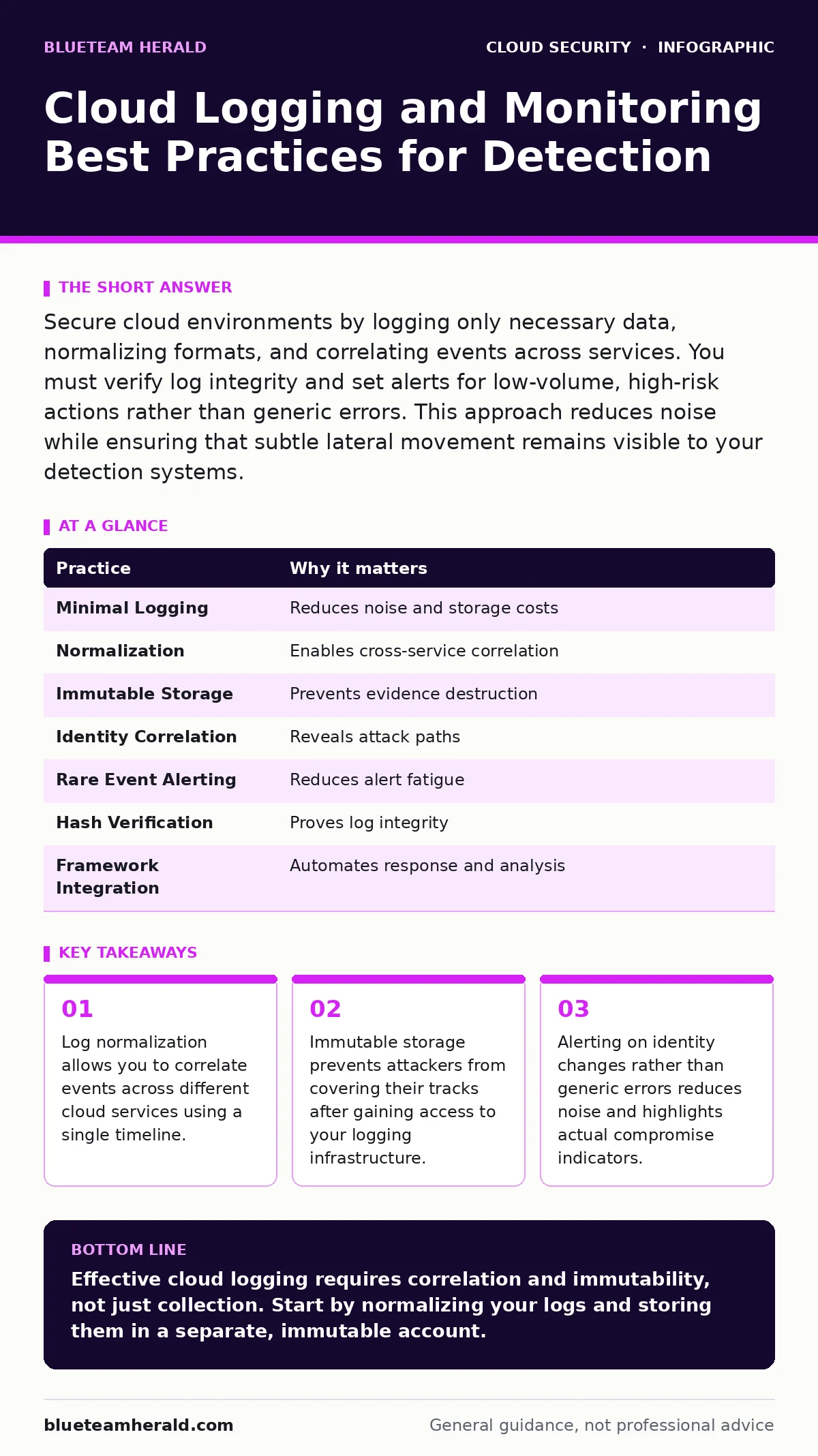
Secure cloud environments by logging only necessary data, normalizing formats, and correlating events across services. You must verify log integrity and set alerts for low-volume, high-risk actions rather than generic errors. This approach reduces noise while ensuring that subtle lateral movement remains visible to your detection systems.
Collect Only What You Can Use
Cloud environments generate massive volumes of data. If you log everything, you create a haystack where needles are impossible to find. You must decide which logs provide value for detection and which only increase storage costs.
Identity and Access Management logs are more valuable than network flow logs in most cloud-native workloads. Network traffic often stays within the provider’s internal backbone, making it invisible to standard packet captures. Identity logs, however, travel through the control plane and are always visible.
Normalize Log Formats Immediately
Different cloud services output logs in different structures. One service might use JSON with nested objects, while another uses simple key-value pairs. If you store these raw formats, you cannot search across services effectively.
Normalization means converting all logs into a single, consistent schema. You define common fields such as timestamp, source IP, user ID, and action type. This allows you to write queries that work across your entire environment.
Without normalization, you must write separate parsers for every service. This increases the chance of missing an attack that spans multiple components. It also makes it harder to integrate with third-party detection tools.
Store Logs in Immutable Storage
Attackers who gain access to your cloud environment will often target logging systems first. They want to delete evidence of their presence. If your logs are stored in the same account or region as your workloads, the attacker can reach them.
Immutable storage prevents deletion or modification of data for a set period. This is often called Write Once, Read Many (WORM). You configure your storage bucket to reject any overwrite or delete commands.
This measure ensures that even if an attacker compromises your management credentials, they cannot erase the history of their actions. It does not prevent the attack, but it preserves the evidence needed for forensics and attribution.
Correlate Identity with Resource Actions
Logs from identity services and logs from resource services are often kept separate. You might see a login event in one system and a database deletion in another. Without correlation, these look like unrelated events.
You must link the identity of the user or service account to the specific resource action. This requires matching the user ID or session token across log sources. Modern identity providers include a unique identifier in every request that can be forwarded to downstream logs.
Correlation reveals the path of an attack. It shows how a low-privilege user escalated to delete a critical database. It turns isolated noise into a coherent narrative.
Alert on Low-Volume, High-Risk Actions
Most alerting systems trigger on high volumes of errors or failed logins. This is noisy and often leads to alert fatigue. Security teams stop paying attention when they receive hundreds of false positives daily.
Instead, alert on actions that are rare but dangerous. These include changes to logging configurations, creation of new administrative users, or deletion of security groups. These actions happen infrequently in a stable environment.
When these actions occur, they stand out clearly against the baseline of normal activity. You investigate fewer alerts, but each one has a higher likelihood of being malicious. This approach requires you to understand your normal operating baseline.
Verify Log Integrity with Hashing
You need to prove that your logs have not been altered. Immutability helps, but cryptographic verification provides stronger assurance. You can hash each log entry and store the hash in a separate, secure location.
A hash is a fixed-length string generated from the log data. Any change to the log data produces a completely different hash. By comparing the current hash to the stored hash, you can detect tampering.
This technique is particularly useful for compliance audits. It provides mathematical proof that the logs you are analyzing are the same logs that were generated at the time of the event. It adds computational overhead, so use it for critical systems only.
Integrate with Existing Security Frameworks
Cloud logging does not exist in a vacuum. It must work with your other security tools. This includes tools for cloud security posture management (CSPM), which check for configuration errors, and cloud detection and response systems, which automate remediation.
If your logs are siloed, your CSPM tool cannot correlate configuration errors with actual exploitation attempts. Your detection system cannot trigger automated responses based on log data. Integration requires standard APIs and shared data models.
You should treat logging as a data pipeline. The output of one tool becomes the input for another. This reduces manual work and increases the speed of response.
| Practice | Why it matters |
|---|---|
| Minimal Logging | Reduces noise and storage costs |
| Normalization | Enables cross-service correlation |
| Immutable Storage | Prevents evidence destruction |
| Identity Correlation | Reveals attack paths |
| Rare Event Alerting | Reduces alert fatigue |
| Hash Verification | Proves log integrity |
| Framework Integration | Automates response and analysis |
Review and Tune Regularly
Logging configurations drift over time. New services are added, and old ones are removed. Your alerting rules become stale. You must review your logging strategy regularly to ensure it remains effective.
Check for gaps in coverage. Are new services logging to the central repository? Are your normalization rules still working? Test your alerts with simulated attacks to ensure they trigger correctly.
This is not a one-time setup. It is an ongoing process. As your environment grows, your logging strategy must evolve to match. Neglecting this step leads to blind spots that attackers will exploit.
Key takeaways
- Log normalization allows you to correlate events across different cloud services using a single timeline.
- Immutable storage prevents attackers from covering their tracks after gaining access to your logging infrastructure.
- Alerting on identity changes rather than generic errors reduces noise and highlights actual compromise indicators.
Effective cloud logging requires correlation and immutability, not just collection. Start by normalizing your logs and storing them in a separate, immutable account.
Frequently asked questions
How do I choose which logs to collect?
Prioritize logs that show identity actions and configuration changes. Network logs are less useful in cloud-native environments where traffic stays internal.
What is the cost of immutable storage?
It is slightly higher than standard storage due to compliance features. However, the cost is negligible compared to the risk of losing evidence during an incident.
Can I use open-source tools for normalization?
Yes, many open-source agents can parse and forward logs to a standard format. You must configure them to handle the specific output of each cloud service.
How often should I test my alerts?
Test them monthly. Simulate common attack scenarios to ensure your alerts trigger and reach the right people.
How this guide was produced: written by the BlueTeam Herald editorial team with AI assistance, checked against the public references listed below, and reviewed when the facts change. See our editorial policy or report an error.