Cloud Security Posture Management Checklist for Continuous Compliance
Automated configuration audits prevent drift by catching misconfigurations before attackers exploit them, turning static snapshots into continuous verification.

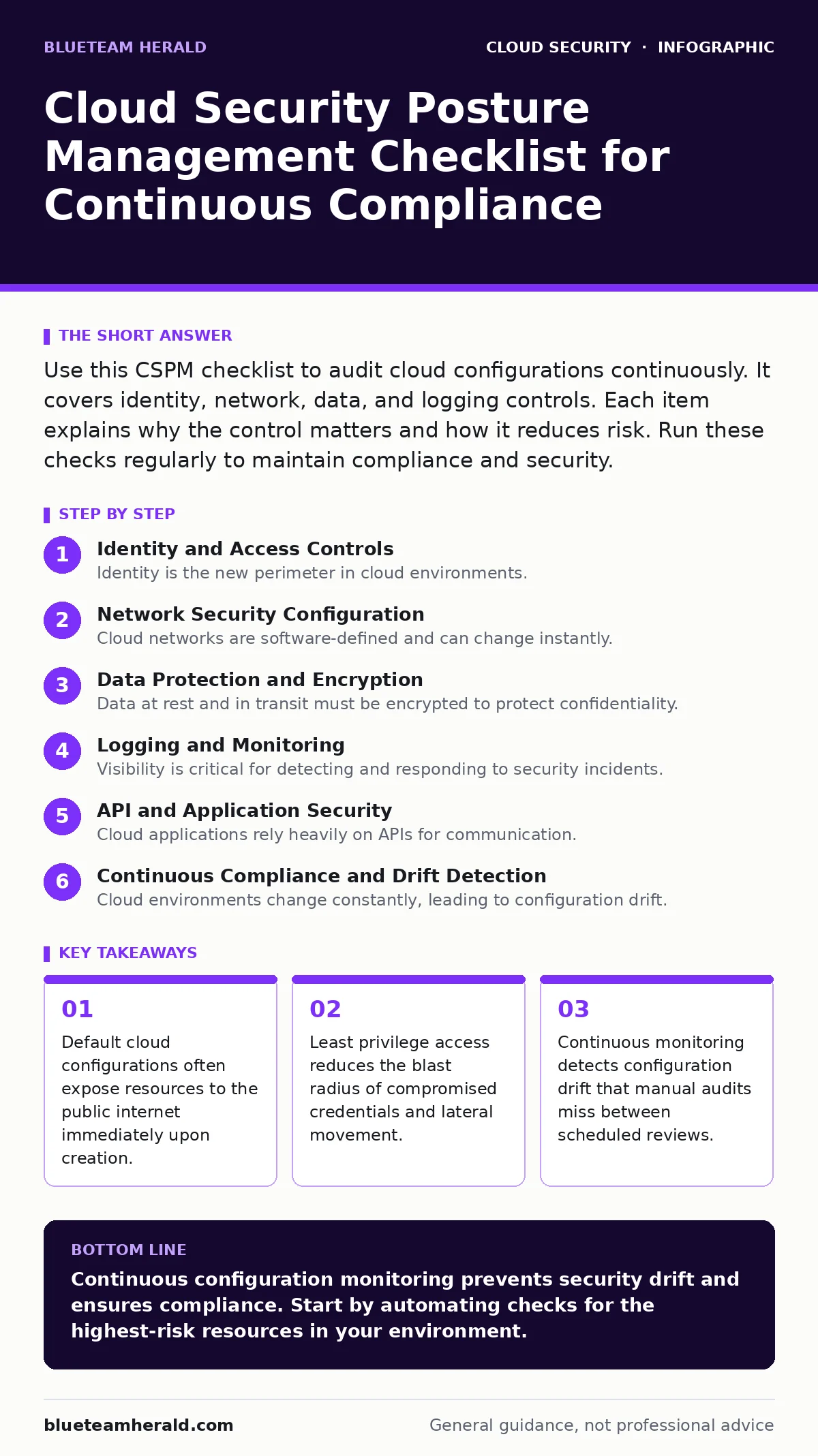
Use this CSPM checklist to audit cloud configurations continuously. It covers identity, network, data, and logging controls. Each item explains why the control matters and how it reduces risk. Run these checks regularly to maintain compliance and security.
Identity and Access Controls
Identity is the new perimeter in cloud environments. You must verify that access controls are strict and reviewed regularly. Misconfigured permissions are the primary entry point for attackers who gain initial access.
- Enforce multi-factor authentication for all administrative accounts: Prevents credential theft from granting immediate access to sensitive resources.
- Review and remove unused IAM roles and policies: Reduces the attack surface by eliminating unnecessary privileges that attackers can exploit.
- Implement least privilege access for service accounts: Limits the damage if a service account is compromised by restricting its capabilities.
- Audit cross-account access permissions: Ensures that trusted partners or other accounts do not have broader access than required.
Proper identity management requires more than just setting initial permissions. You must continuously validate that these permissions remain appropriate as your infrastructure changes. See our guide on cloud IAM policies for detailed configuration examples.
Network Security Configuration
Cloud networks are software-defined and can change instantly. Open ports and misconfigured security groups are common sources of exposure. You need to ensure that network boundaries are clearly defined and enforced.
- Restrict security groups to specific IP ranges or services: Blocks unauthorized access from the public internet to internal resources.
- Disable public internet access for internal databases: Prevents direct exposure of data stores that should only be accessed via application layers.
- Review network ACLs for overly permissive rules: Ensures that traffic filtering is applied at the subnet level as a secondary control.
- Monitor for open security groups: Identifies configurations that allow inbound traffic from any source, a common misconfiguration.
Network misconfigurations often go unnoticed because they do not trigger immediate alerts. Regular audits of your network topology are necessary to catch these issues. Refer to open security groups for common pitfalls in firewall rule creation.
Data Protection and Encryption
Data at rest and in transit must be encrypted to protect confidentiality. Default storage buckets are often publicly readable unless explicitly configured otherwise. You must verify that encryption is enabled and keys are managed securely.
- Enable encryption for all storage buckets and volumes: Protects data from unauthorized access if storage media is lost or stolen.
- Rotate encryption keys regularly: Limits the exposure window if a key is compromised by ensuring old keys are invalidated.
- Block public access to object storage containers: Prevents accidental exposure of sensitive files to the general public.
- Audit database access logs for unusual activity: Helps detect unauthorized attempts to read or modify unsecured cloud databases.
Encryption alone does not protect data if access controls are weak. You must combine encryption with strict access policies to ensure comprehensive protection. See unsecured cloud databases for strategies to harden database configurations.
Logging and Monitoring
Visibility is critical for detecting and responding to security incidents. Without proper logging, you cannot track changes or identify suspicious activity. You must ensure that logs are collected, stored securely, and monitored for anomalies.
- Enable logging for all cloud services and resources: Provides a complete audit trail for investigating security incidents and compliance requirements.
- Centralize logs in a secure, immutable storage location: Prevents attackers from deleting evidence of their activity after a breach.
- Configure alerts for critical configuration changes: Notifies you immediately when someone modifies security settings or access controls.
- Regularly review logs for unauthorized access attempts: Helps identify potential threats before they escalate into full-scale breaches.
Logging generates significant volume and cost. You must balance the need for visibility with storage costs and performance impacts. See cloud logging and monitoring for best practices in log management.
API and Application Security
Cloud applications rely heavily on APIs for communication. Insecure APIs can expose sensitive data or allow unauthorized actions. You must ensure that APIs are properly authenticated, authorized, and monitored.
- Validate all API inputs for malicious content: Prevents injection attacks that could compromise application logic or data integrity.
- Enforce strict authentication and authorization for API endpoints: Ensures that only authorized users and services can access API resources.
- Monitor API traffic for unusual patterns: Detects potential abuse or automated attacks targeting your application interfaces.
- Regularly update API dependencies and libraries: Patches known vulnerabilities that could be exploited by attackers.
API security is often overlooked in favor of traditional perimeter defenses. You must treat APIs as critical assets that require rigorous security controls. See insecure cloud APIs for common vulnerabilities and mitigation strategies.
See also: Cloud-Native Application Protection Platform Misconceptions · Hybrid Cloud Advantages and Disadvantages: Risks and Controls
Continuous Compliance and Drift Detection
Cloud environments change constantly, leading to configuration drift. Manual audits are insufficient for maintaining compliance in dynamic environments. You must automate checks to ensure that configurations remain aligned with security baselines.
- Define and enforce security baselines for all resources: Ensures that new resources are created with secure configurations by default.
- Automate compliance checks against industry standards: Reduces the manual effort required to maintain compliance with regulations like GDPR or HIPAA.
- Remediate non-compliant resources automatically: Prevents small misconfigurations from accumulating into significant security risks.
- Regularly review and update security policies: Ensures that your controls remain effective against evolving threats and business needs.
Configuration drift is inevitable in cloud environments. You must treat compliance as a continuous process rather than a one-time event. See cloud penetration testing for methods to validate the effectiveness of your controls.
Key takeaways
- Default cloud configurations often expose resources to the public internet immediately upon creation.
- Least privilege access reduces the blast radius of compromised credentials and lateral movement.
- Continuous monitoring detects configuration drift that manual audits miss between scheduled reviews.
Continuous configuration monitoring prevents security drift and ensures compliance. Start by automating checks for the highest-risk resources in your environment.
Frequently asked questions
How often should I run CSPM checks?
Run checks daily or in real-time if possible. Cloud configurations change frequently, and delays increase exposure to misconfigurations.
Can CSPM replace cloud penetration testing?
No. CSPM identifies misconfigurations, but penetration testing validates whether those misconfigurations can be exploited. Use both for comprehensive security.
What is configuration drift?
Configuration drift occurs when cloud resources deviate from their intended secure state over time due to manual changes or automated processes.
How do I prioritize remediation efforts?
Prioritize based on risk. Focus on resources that are publicly exposed, contain sensitive data, or have high privileges first.
How this guide was produced: written by the BlueTeam Herald editorial team with AI assistance, checked against the public references listed below, and reviewed when the facts change. See our editorial policy or report an error.