Cloud Penetration Testing: Real Benefits and Hidden Limits
Cloud penetration testing reveals logic flaws that automated scanners miss, but it cannot verify infrastructure compliance or replace continuous monitoring for dynamic environments.

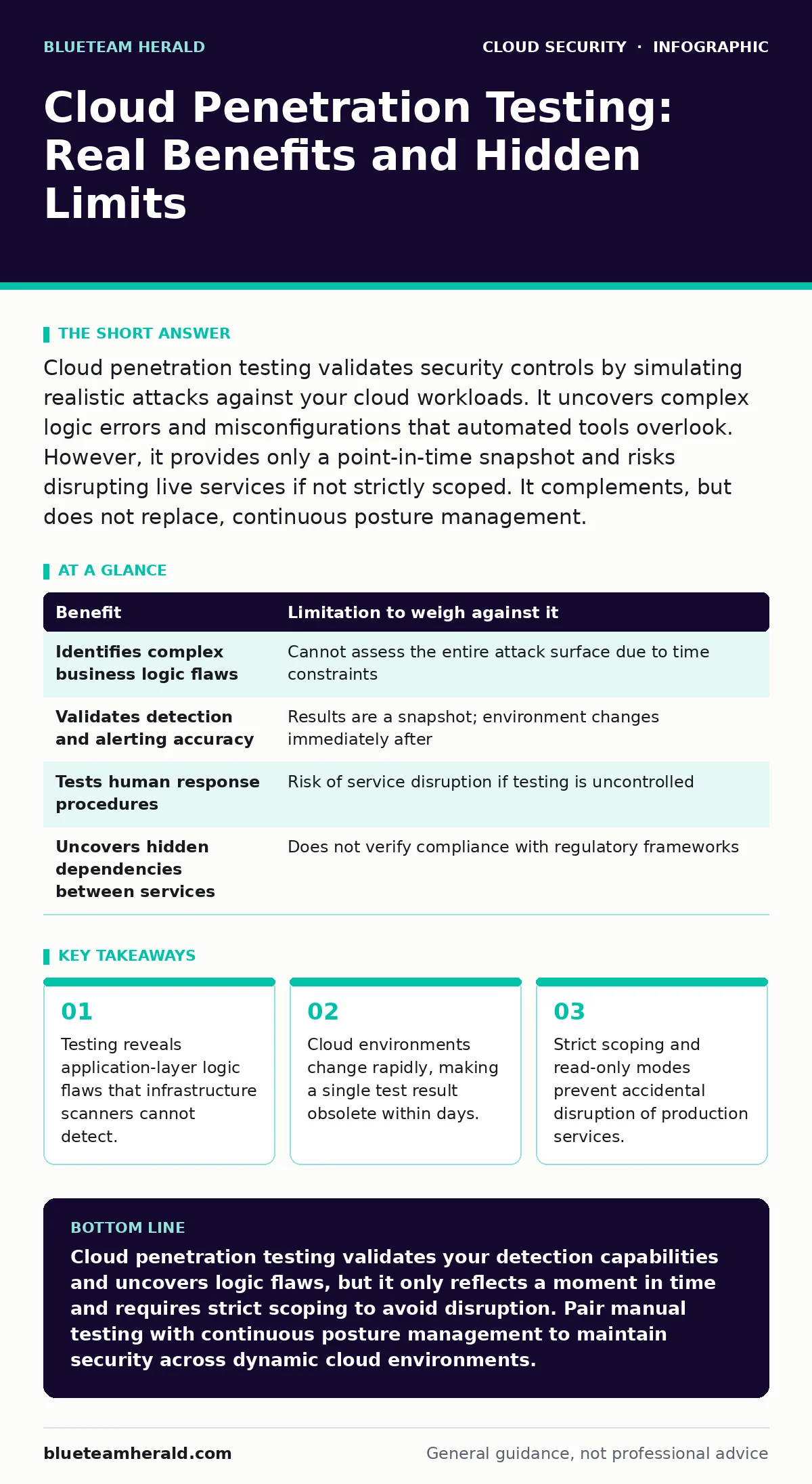
Cloud penetration testing validates security controls by simulating realistic attacks against your cloud workloads. It uncovers complex logic errors and misconfigurations that automated tools overlook. However, it provides only a point-in-time snapshot and risks disrupting live services if not strictly scoped. It complements, but does not replace, continuous posture management.
The Illusion of Static Security
Cloud infrastructure differs fundamentally from traditional data centers. Resources spin up and down automatically. Access policies change via code. This dynamism creates a unique challenge for security validation. A penetration test captures the state of your environment at a specific moment. It cannot guarantee security for the next hour, let alone the next month. You must understand this limitation before planning any assessment. The value lies not in a permanent seal of approval, but in validating your detection and response capabilities.
Imagine a developer deploys a new microservice. It uses a temporary credential that expires in one hour. A penetration tester arrives at 10:00 AM. The credential is valid. They access sensitive data. At 11:00 AM, the credential expires. The vulnerability is "fixed" by time, not by code change. If you run an automated scan at 11:15 AM, it sees nothing. The test was accurate for that hour, but the environment has already moved on. This is why continuous monitoring is necessary.
What Manual Testing Reveals
Automated tools excel at checking for known misconfigurations. They scan for open ports, missing patches, or public storage buckets. They struggle with context. They cannot understand business logic. A penetration tester acts like an attacker with intent. They look for ways to bypass controls that make sense to a human but look normal to a machine. This includes chaining multiple low-risk issues into a high-impact breach.
For example, a tester might find a minor information leak in an API. Alone, it is harmless. But combined with a weak identity policy, it allows privilege escalation. Automated scanners rarely connect these dots. They report issues in isolation. Manual testing simulates the adversary’s path. It validates whether your cloud detection and response systems can spot this chain of events. It proves your alerts trigger correctly when an attacker moves laterally.
| Benefit | Limitation to weigh against it |
|---|---|
| Identifies complex business logic flaws | Cannot assess the entire attack surface due to time constraints |
| Validates detection and alerting accuracy | Results are a snapshot; environment changes immediately after |
| Tests human response procedures | Risk of service disruption if testing is uncontrolled |
| Uncovers hidden dependencies between services | Does not verify compliance with regulatory frameworks |
The Hidden Cost of Disruption
The biggest risk in cloud penetration testing is not finding a vulnerability. It is breaking your production environment. Cloud services are interconnected. A stress test on one service can cascade into a denial of service for another. Aggressive scanning can trigger rate-limiting mechanisms that lock out legitimate users. Some cloud providers may even terminate your account for suspicious activity.
You must define strict rules of engagement. These rules specify what can be tested, when, and how aggressively. Often, you should use read-only techniques. Instead of exploiting a vulnerability, the tester proves it exists by showing they can access the data. They do not modify or delete it. This approach minimizes risk. It also requires deep coordination with your development and operations teams. They need to know when to expect unusual traffic patterns.
When It Is Worth It
Cloud penetration testing is worth the cost when you have complex, custom applications. If your business logic is unique, automated tools will miss the flaws in your logic. Testing validates that your code handles edge cases correctly. It is also worth it when you are integrating new services. New components introduce new attack vectors. A test before going live can catch issues that escaped code review.
It is valuable for validating your incident response plan. Do your teams know what to do when an alert fires? A test provides a controlled environment to practice. You can measure how long it takes to detect and contain a breach. This data is more useful than any theoretical exercise. It reveals gaps in your monitoring and communication processes.
Suppose you have implemented cloud identity governance controls. You believe your least-privilege policies are correct. A penetration tester can attempt to traverse these boundaries. If they succeed, your policies are too permissive. If they fail, you have evidence that your controls work. This validation is critical for high-security environments.
When It Is Not
Cloud penetration testing is not a substitute for continuous monitoring. If you rely solely on periodic tests, you will have blind spots between assessments. For infrastructure that changes daily, a test becomes outdated quickly. In these cases, invest in cloud security posture management (CSPM) instead. CSPM tools run continuously. They check for misconfigurations in real-time. They provide a constant view of your security health.
Testing is also less useful for standardized, off-the-shelf applications. If you run a common web server with default settings, automated scanners are sufficient. They will find known vulnerabilities faster and cheaper than a human tester. Manual testing adds little value here. The return on investment is low. Save your budget for custom applications where logic flaws are the primary risk.
See also: Cloud-Native Application Protection Platform Misconceptions · Hybrid Cloud Advantages and Disadvantages: Risks and Controls
Integrating with Continuous Practices
The most effective security strategy combines manual and automated methods. Use penetration testing to find what scanners miss. Use scanners to find what testers overlook. They are complementary. Integrate the results of both into your remediation workflow. Do not treat them as separate silos.
Consider the role of insecure cloud APIs in your architecture. A tester might find that an API allows excessive data exposure. A scanner might miss this if it does not understand the API’s purpose. By combining both, you get a fuller picture. You can then fix the API design, not just the symptom. This holistic approach strengthens your entire cloud security posture.
The Reality of Scope and Skill
Not all penetration testers understand cloud architecture. Traditional testers may focus on network scanning. They might miss cloud-specific issues like identity misconfigurations or storage bucket leaks. You need testers with specific cloud expertise. They must understand the provider’s security model. They should know how to use the provider’s management consoles and APIs.
When hiring, ask about their cloud experience. Do they understand infrastructure as code? Can they test serverless functions? Do they know how to avoid triggering provider safeguards? These skills are critical. A tester who does not understand the cloud environment will provide poor results. They may miss critical flaws or cause unnecessary disruptions.
Final Considerations for Your Strategy
Cloud penetration testing is a powerful tool, but it is not a silver bullet. It provides deep insights into your application logic and detection capabilities. It does not provide continuous compliance or infrastructure monitoring. Use it wisely. Focus on custom applications and critical business logic. Combine it with automated tools for continuous coverage. This balanced approach gives you the best defense against evolving threats.
Remember that security is a process, not a product. A single test does not make you secure. Continuous improvement does. Use the insights from testing to refine your policies, code, and monitoring. This iterative process builds resilience. It ensures your cloud environment remains secure even as it changes.
Key takeaways
- Testing reveals application-layer logic flaws that infrastructure scanners cannot detect.
- Cloud environments change rapidly, making a single test result obsolete within days.
- Strict scoping and read-only modes prevent accidental disruption of production services.
- Automated posture management must run continuously between manual penetration tests.
Cloud penetration testing validates your detection capabilities and uncovers logic flaws, but it only reflects a moment in time and requires strict scoping to avoid disruption. Pair manual testing with continuous posture management to maintain security across dynamic cloud environments.
Frequently asked questions
How often should I perform cloud penetration testing?
Perform testing annually for baseline validation, and before major releases or significant architectural changes. Continuous automated scanning should run between manual tests.
Can I use the same tester for on-premises and cloud?
Only if they have specific cloud expertise. Traditional network testers often miss cloud-specific identity and configuration flaws.
Does penetration testing replace vulnerability scanning?
No. Scanning finds known issues quickly. Testing finds complex logic flaws. You need both for comprehensive coverage.
What is the biggest risk of cloud penetration testing?
Accidental disruption of production services. Strict scoping and read-only modes mitigate this risk.
How this guide was produced: written by the BlueTeam Herald editorial team with AI assistance, checked against the public references listed below, and reviewed when the facts change. See our editorial policy or report an error.