Incident Response Plan for Cyber Attack: Structure and Execution
Most organizations fail not because they lack tools, but because they lack defined decision rights during the chaotic first hour of a breach.

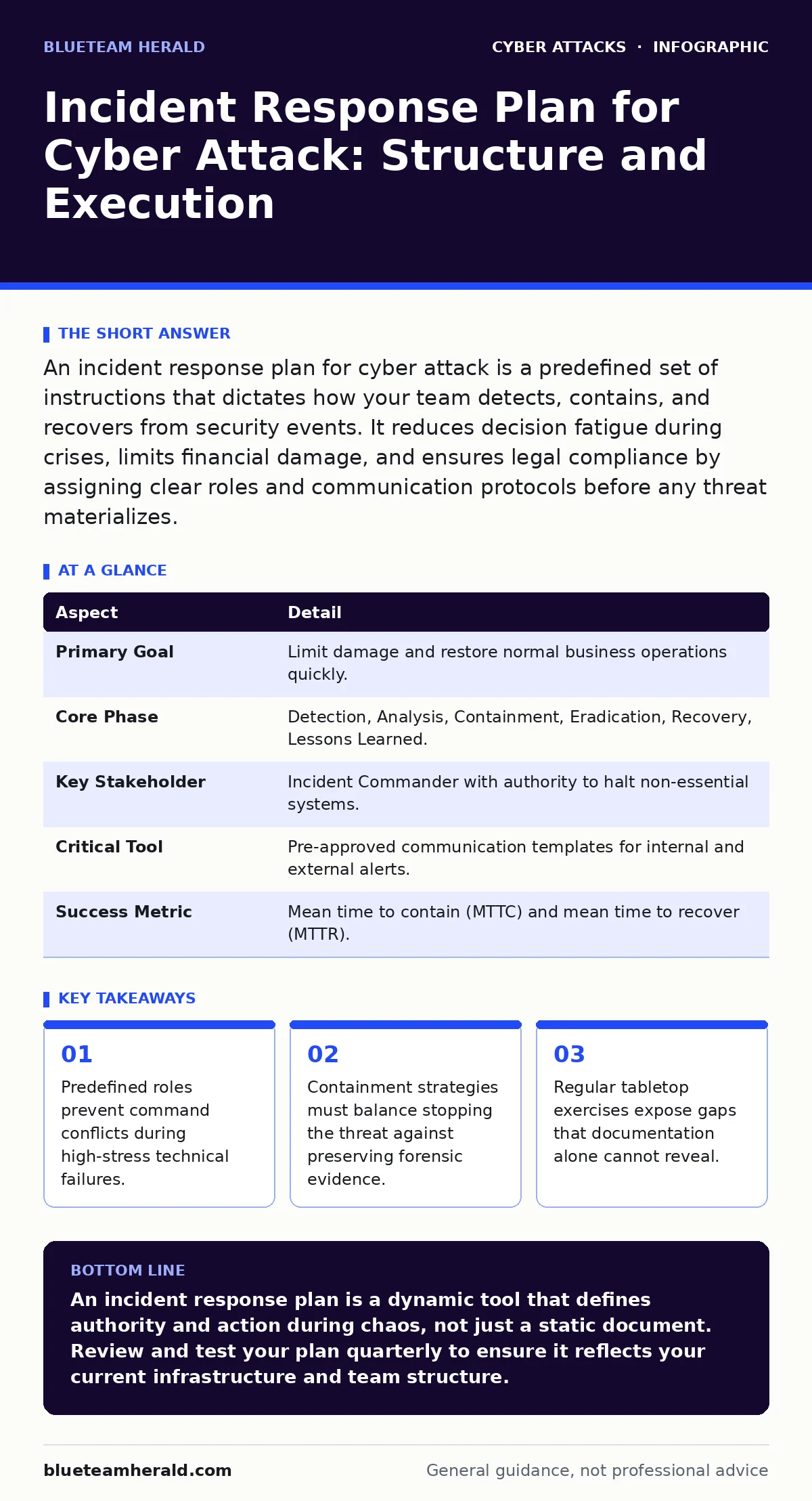
An incident response plan for cyber attack is a predefined set of instructions that dictates how your team detects, contains, and recovers from security events. It reduces decision fatigue during crises, limits financial damage, and ensures legal compliance by assigning clear roles and communication protocols before any threat materializes.
The Anatomy of a Crisis Protocol
Imagine a hospital fire drill. Staff do not wait to debate evacuation routes when alarms sound. They follow pre-mapped paths to ensure patient safety and staff survival. An incident response plan for cyber attack operates on this same principle. It is a documented framework that outlines specific actions to take when a security breach occurs. The plan defines who acts, what tools they use, and how they communicate.
Most teams assume technical skills alone can handle a breach. This assumption fails under pressure. Without a written protocol, responders improvise. Improvisation leads to contradictory actions, lost evidence, and prolonged exposure. The plan serves as a single source of truth that overrides individual judgment during chaos. It transforms a reactive scramble into a coordinated operational procedure.
| Aspect | Detail |
|---|---|
| Primary Goal | Limit damage and restore normal business operations quickly. |
| Core Phase | Detection, Analysis, Containment, Eradication, Recovery, Lessons Learned. |
| Key Stakeholder | Incident Commander with authority to halt non-essential systems. |
| Critical Tool | Pre-approved communication templates for internal and external alerts. |
| Success Metric | Mean time to contain (MTTC) and mean time to recover (MTTR). |
How the Response Lifecycle Functions
The lifecycle begins long before an attack lands. It starts with preparation, where you define what constitutes an incident. Not every anomaly is a breach. You must distinguish between a failed login attempt and a sustained intrusion. This distinction prevents alert fatigue, where teams ignore warnings because most are false positives.
Once an event is identified, the analysis phase determines the scope. Attackers often move laterally through a network. You must identify every compromised system, not just the entry point. Containment follows immediately. This step isolates the threat to prevent further spread. You might disconnect a server from the network or block specific IP addresses.
Eradication removes the root cause. This involves patching vulnerabilities, changing credentials, and removing malicious software. Recovery restores systems from clean backups. The final phase, lessons learned, reviews what worked and what failed. This feedback loop strengthens the plan for future events. Each phase relies on the previous one. Skipping steps creates hidden risks that surface later.
Who Bears the Operational Weight
An incident response plan affects far more than the security team. It impacts legal counsel, human resources, executive leadership, and external partners. Legal teams advise on regulatory notifications and liability. They determine when you must inform customers or authorities. This decision carries significant reputational risk if handled incorrectly.
Human resources may need to address insider threats. If an employee intentionally caused the breach, HR must manage disciplinary actions while preserving evidence. Executive leadership provides resources and makes high-level decisions about business continuity. They decide whether to shut down critical services to stop the spread.
External partners include law enforcement and forensic investigators. You must have pre-negotiated contracts with these entities. Waiting until a breach occurs to find a forensic firm delays containment. Clear lines of authority prevent conflicting instructions. The incident commander holds final decision-making power. This role must be clearly defined in the plan.
What to Do About Common Failures
Many organizations treat the plan as a static document. This approach guarantees failure. Threats evolve, and so must your procedures. You must update the plan after every major change to your infrastructure. New cloud services, remote work policies, and third-party integrations create new attack surfaces.
Regular tabletop exercises are necessary. These simulations test the plan without real-world consequences. Participants role-play their responsibilities during a hypothetical breach. This reveals communication gaps and unclear authority structures. You will discover that your legal team does not know how to contact the incident commander.
The Hidden Cost of Documentation
Maintaining it is the burden. Documentation creates a false sense of security. Teams assume that having a plan means they are prepared. This complacency reduces vigilance. You must cultivate a culture where the plan is a living tool, not a shelf item.
Another hidden cost is the trade-off between speed and thoroughness. Containing a threat quickly might destroy volatile memory evidence. Leaving a system running preserves evidence but allows the attacker to exfiltrate more data. The plan must define this trade-off in advance. You cannot debate ethics while data is being stolen.
Integration with other security measures is vital. Your incident response plan must align with your backup strategies. If backups are not isolated from the main network, ransomware can encrypt them too. You must verify that your recovery procedures actually work. Testing restores is as important as testing detection.
See also: DNS Rebinding Response: Containment, Recovery and Prevention Steps · Ivanti VPN Warning Signs: Detecting Silent Exploitation
Related Security Controls
Your incident response plan for cyber attack does not operate in isolation. It relies on upstream controls to reduce the frequency of incidents. Implementing phishing-resistant authentication significantly reduces the likelihood of credential theft. This measure ensures that stolen passwords cannot be used to access systems.
Multi-factor authentication adds another layer of defense. Even if an attacker obtains a password, they cannot log in without the second factor. This slows down automated attacks and provides time for detection. Intrusion prevention systems can automatically block known malicious traffic. These tools reduce the load on your response team.
Email security protocols like SPF help prevent domain spoofing. By verifying that emails come from authorized servers, you reduce the effectiveness of social engineering attacks. Understanding smishing and other social engineering tactics helps you train staff to recognize initial contact points. Prevention reduces the severity of incidents you must respond to.
What People Usually Get Wrong
The most common error is focusing solely on technical remediation. Teams rush to patch and reboot. They forget to document their actions. This lack of documentation hinders post-incident analysis and legal defense. Every action must be logged with timestamps. This creates a chain of custody for digital evidence.
Another mistake is neglecting external communication. Organizations often wait too long to notify customers. This delay erodes trust and may violate regulations. The plan must include pre-drafted statements for various scenarios. You should have templates for minor breaches and major data losses. Speed and transparency are more valuable than perfect wording.
Finally, teams often ignore the human element. Responders experience stress and fatigue. The plan should include provisions for shift rotations and mental health support. Burnout leads to errors. A tired analyst might miss a critical indicator of compromise. Supporting your team is a security control.
Key takeaways
- Predefined roles prevent command conflicts during high-stress technical failures.
- Containment strategies must balance stopping the threat against preserving forensic evidence.
- Regular tabletop exercises expose gaps that documentation alone cannot reveal.
An incident response plan is a dynamic tool that defines authority and action during chaos, not just a static document. Review and test your plan quarterly to ensure it reflects your current infrastructure and team structure.
Frequently asked questions
How often should I update my incident response plan?
Update it after any significant infrastructure change, every six months, and after every actual incident or simulation to incorporate lessons learned.
Does the plan need to cover insider threats?
Yes, insider threats require different containment strategies than external attacks, often involving HR and legal counsel immediately rather than just IT isolation.
Can I use the same plan for small and large breaches?
You should have tiered response levels. Minor incidents follow a simplified process, while major breaches trigger the full team and executive notification protocols.
Who should be included in the incident response team?
Include IT security, legal counsel, human resources, public relations, and executive leadership to cover technical, legal, and reputational aspects.
How this guide was produced: written by the BlueTeam Herald editorial team with AI assistance, checked against the public references listed below, and reviewed when the facts change. See our editorial policy or report an error.