DNS Rebinding Response: Containment, Recovery and Prevention Steps
DNS rebinding attacks bypass browser security by changing target IP addresses after the initial page loads, requiring network-level isolation rather than browser fixes.

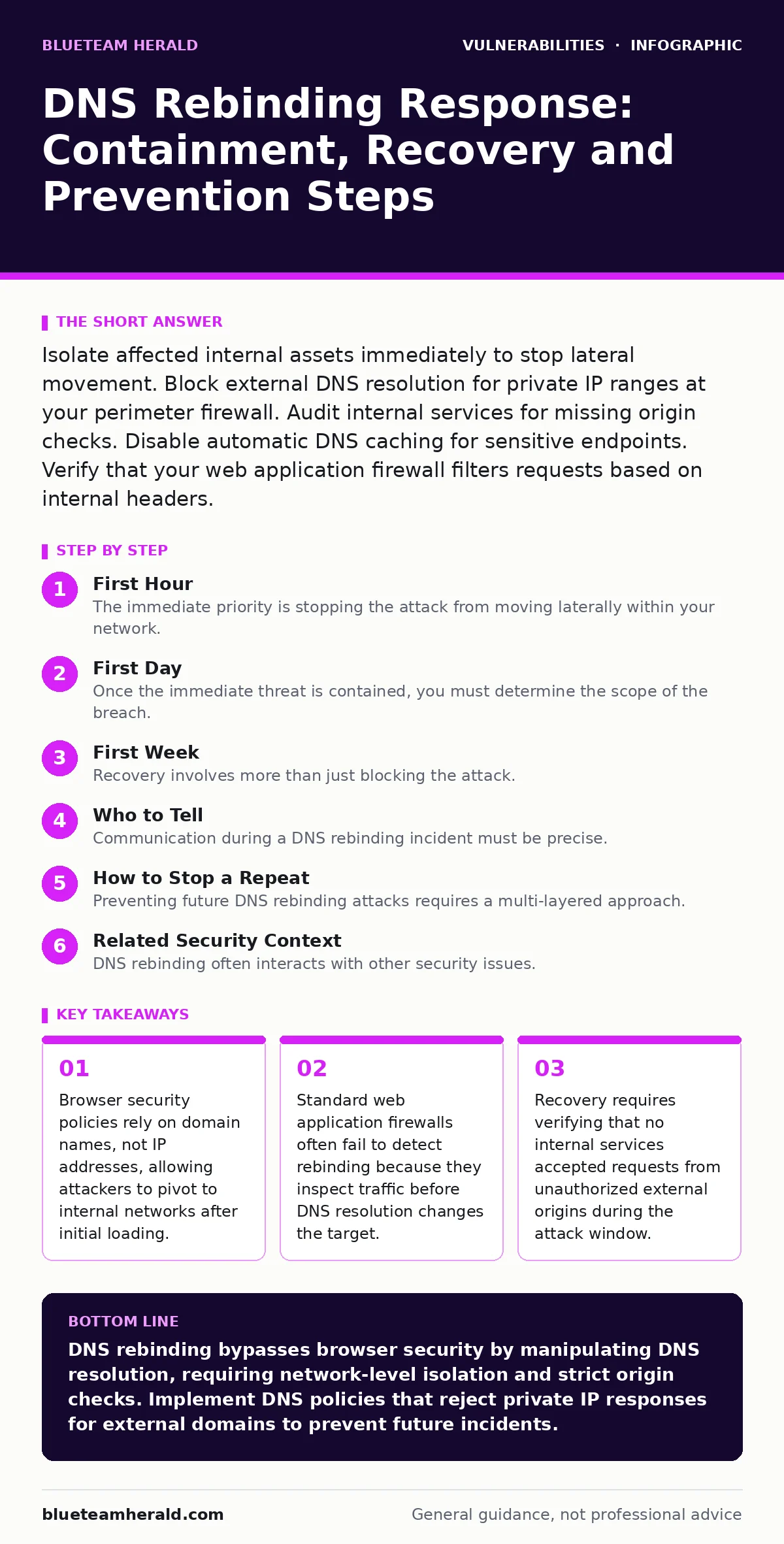
Isolate affected internal assets immediately to stop lateral movement. Block external DNS resolution for private IP ranges at your perimeter firewall. Audit internal services for missing origin checks. Disable automatic DNS caching for sensitive endpoints. Verify that your web application firewall filters requests based on internal headers.
First Hour
The immediate priority is stopping the attack from moving laterally within your network. DNS rebinding exploits the browser’s same-origin policy by changing the IP address associated with a domain name after the page has loaded. The browser believes it is still talking to the external attacker, but it is actually sending requests to internal machines. You must sever the connection between the external attacker and your internal network immediately.
Isolate the compromised segment by disconnecting it from the public internet. Keep the machine running if possible to capture network traffic and process lists. Identify which internal services responded to the rebinding requests. Internal services often lack authentication for local connections, assuming only trusted machines can reach them. This assumption is the core vulnerability that rebinding exploits.
- Isolate the affected network segment from external traffic
- Capture memory dumps from the targeted internal machines
- Log all recent DNS queries for the malicious domain
- Identify which internal services accepted connections from the rebinding source
- Disable DNS caching on internal resolvers for the affected domain
First Day
Once the immediate threat is contained, you must determine the scope of the breach. DNS rebinding is not just a browser issue; it is a network configuration failure. Your internal DNS servers or recursive resolvers likely allowed resolution to private IP ranges. You need to audit your DNS infrastructure to ensure it never returns private addresses for external domains.
Check your web application firewall configurations. Many firewalls filter traffic based on the Host header, which remains constant during a rebinding attack. The firewall sees a request to an external domain and allows it, unaware that the actual TCP connection has shifted to an internal IP. You must configure your firewall to inspect the actual destination IP address, not just the HTTP headers.
Imagine a scenario where an attacker targets an internal printer. The printer’s web interface is accessible on the local network but blocked from the internet. The attacker hosts a page that loads normally, then rebinds to the printer’s IP. The browser sends a command to print a malicious document. The printer executes it, installing malware that spreads to other devices. This lateral movement happens because the printer trusted any request on its local interface.
Review your network access control lists. Ensure that internal services explicitly reject connections from untrusted sources. Many administrators rely on firewalls to block external access, forgetting that internal services themselves should enforce origin checks. This defense-in-depth approach ensures that even if a firewall fails, the service itself remains secure.
First Week
Recovery involves more than just blocking the attack. You must rebuild trust in your network’s integrity. Verify that no internal systems were compromised by checking for unexpected changes in system files, user accounts, or network configurations. DNS rebinding attacks are often a precursor to more severe breaches, so thorough investigation is necessary.
Update your DNS security policies. Implement DNS Security Extensions to prevent cache poisoning, which can facilitate rebinding attacks. Ensure that your internal DNS servers do not forward queries for external domains to public resolvers that might return private IP addresses. This configuration, known as DNS leakage, allows attackers to manipulate responses.
Audit your web applications for proper origin validation. Modern browsers provide headers like Origin and Referer that indicate where a request came from. Your applications should verify that these headers match expected values. However, attackers can spoof these headers, so they should not be the only line of defense. Combine header validation with network-level controls.
Consider the trade-offs of strict DNS policies. Blocking all private IP resolutions can break legitimate internal tools that rely on external DNS services. You must carefully configure your resolvers to allow only specific, trusted external domains to resolve to private addresses. This requires a detailed inventory of your internal network and its dependencies.
Who to Tell
Communication during a DNS rebinding incident must be precise. Inform your network operations team about the specific domains and IP addresses involved. They need to update firewall rules and DNS configurations immediately. Notify your application development team to review their origin checking logic. Developers often assume that browser security policies are sufficient, which is a dangerous misconception in the context of rebinding.
If the attack resulted in data exfiltration, you must notify legal and compliance teams. DNS rebinding can bypass standard data loss prevention tools because the traffic appears to originate from a trusted internal source. Your compliance requirements may mandate notification of affected users or regulatory bodies. Prepare a clear explanation of what happened, avoiding technical jargon that might confuse stakeholders.
Coordinate with your security operations center to monitor for similar attacks. Attackers often use rebinding as part of a larger campaign. Your SOC should be aware of the tactics, techniques, and procedures used in this attack to detect future attempts. Share the findings with your incident response team to improve their playbooks for similar scenarios.
How to Stop a Repeat
Preventing future DNS rebinding attacks requires a multi-layered approach. Start by hardening your DNS infrastructure. Configure your resolvers to reject any response that contains private IP addresses for external domains. This prevents attackers from redirecting browser traffic to internal machines. Use DNSSEC to validate the authenticity of DNS responses, reducing the risk of cache poisoning.
Implement network segmentation. Isolate sensitive internal services from general network traffic. Use firewalls to restrict access to these services based on source IP addresses and ports. Ensure that internal services do not accept connections from untrusted networks, even if the request appears to come from a local interface. This limits the attack surface for rebinding and other network-based attacks.
Educate your development team about the limitations of browser security. Same-origin policy protects against cross-site scripting but not against DNS rebinding. Developers should implement additional checks, such as validating the Host header against a whitelist of allowed domains. Use security headers like Strict-Transport-Security to enforce HTTPS, which can mitigate some rebinding techniques.
Regularly audit your network configurations. Check for misconfigurations that allow external traffic to reach internal services. Use automated tools to scan for open ports and vulnerable services. Ensure that your web application firewall is configured to inspect actual destination IPs, not just HTTP headers. This proactive approach helps identify and remediate vulnerabilities before attackers can exploit them.
See also: Ivanti VPN Warning Signs: Detecting Silent Exploitation · Threat Actors: Practical Defense Strategies for Small Businesses
Related Security Context
DNS rebinding often interacts with other security issues. For example, security misconfigurations in web servers can allow attackers to upload malicious files that execute during the rebinding process. These files might exploit unpatched software vulnerabilities to gain higher privileges on the internal machine. Understanding these connections helps you prioritize your remediation efforts.
Attacks leveraging vulnerabilities in npm packages can introduce rebinding payloads into your web applications. These packages might contain code that modifies DNS resolution or sends requests to internal IPs. Similarly, vulnerabilities in AI model serving frameworks can be exploited if the model accepts input from rebinding sources, leading to data poisoning or model theft.
WebSocket vulnerabilities can compound rebinding attacks by allowing persistent connections to internal services. Attackers can use WebSockets to maintain access even after the initial rebinding attempt is blocked. Attack vectors in CVSS scoring systems often underestimate the impact of rebinding because they focus on direct exploitation rather than network pivoting.
Ivanti VPN vulnerabilities and Windows privilege escalation vulnerabilities are often used in conjunction with rebinding to move laterally within a network. Once an attacker gains access to an internal machine via rebinding, they can exploit these vulnerabilities to escalate privileges and access sensitive data. A holistic view of your security posture is necessary to mitigate these combined threats.
Verification and Testing
After implementing countermeasures, you must verify their effectiveness. Use automated scanning tools to test for DNS rebinding vulnerabilities. These tools simulate the attack by resolving a domain to an external IP and then to an internal IP. Ensure that your firewalls and web application firewalls block these requests.
Conduct regular penetration tests that include DNS rebinding scenarios. Penetration testers can identify weaknesses in your network configuration and application logic that automated tools might miss. Review the test results carefully and remediate any findings promptly. Continuous testing ensures that your defenses remain effective against evolving attack techniques.
Monitor your DNS logs for unusual activity. Look for queries that resolve to private IP addresses or for repeated queries to known malicious domains. Set up alerts for these patterns so you can respond quickly to potential attacks. Proactive monitoring helps you detect and mitigate rebinding attempts before they cause significant damage.
Key takeaways
- Browser security policies rely on domain names, not IP addresses, allowing attackers to pivot to internal networks after initial loading.
- Standard web application firewalls often fail to detect rebinding because they inspect traffic before DNS resolution changes the target.
- Recovery requires verifying that no internal services accepted requests from unauthorized external origins during the attack window.
DNS rebinding bypasses browser security by manipulating DNS resolution, requiring network-level isolation and strict origin checks. Implement DNS policies that reject private IP responses for external domains to prevent future incidents.
Frequently asked questions
Can a VPN prevent DNS rebinding attacks?
A VPN encrypts traffic but does not inherently prevent DNS rebinding. If your DNS resolver allows private IP responses, the attack can still succeed within the VPN tunnel. You must configure your DNS settings separately.
Do all browsers support protections against DNS rebinding?
No, browser protections vary and are often incomplete. Some browsers implement strict origin checks, but attackers can bypass these using techniques like DNS cache poisoning. Network-level defenses are more reliable than browser features.
How do I know if my internal service is vulnerable?
Test your service by sending requests from an external source that resolves to an internal IP. If the service accepts the request without proper authentication or origin validation, it is vulnerable. Use automated scanning tools to identify these weaknesses.
Is DNS rebinding only a risk for web applications?
DNS rebinding primarily targets web applications accessible from browsers, but it can affect any service that trusts DNS-based origin checks. Internal APIs and management interfaces are also at risk if they lack proper network segmentation and authentication.
How this guide was produced: written by the BlueTeam Herald editorial team with AI assistance, checked against the public references listed below, and reviewed when the facts change. See our editorial policy or report an error.