OSINT investigation cleanup: containment and recovery steps
Exposing internal assets via open-source intelligence often triggers rapid attacker pivoting before formal containment begins.

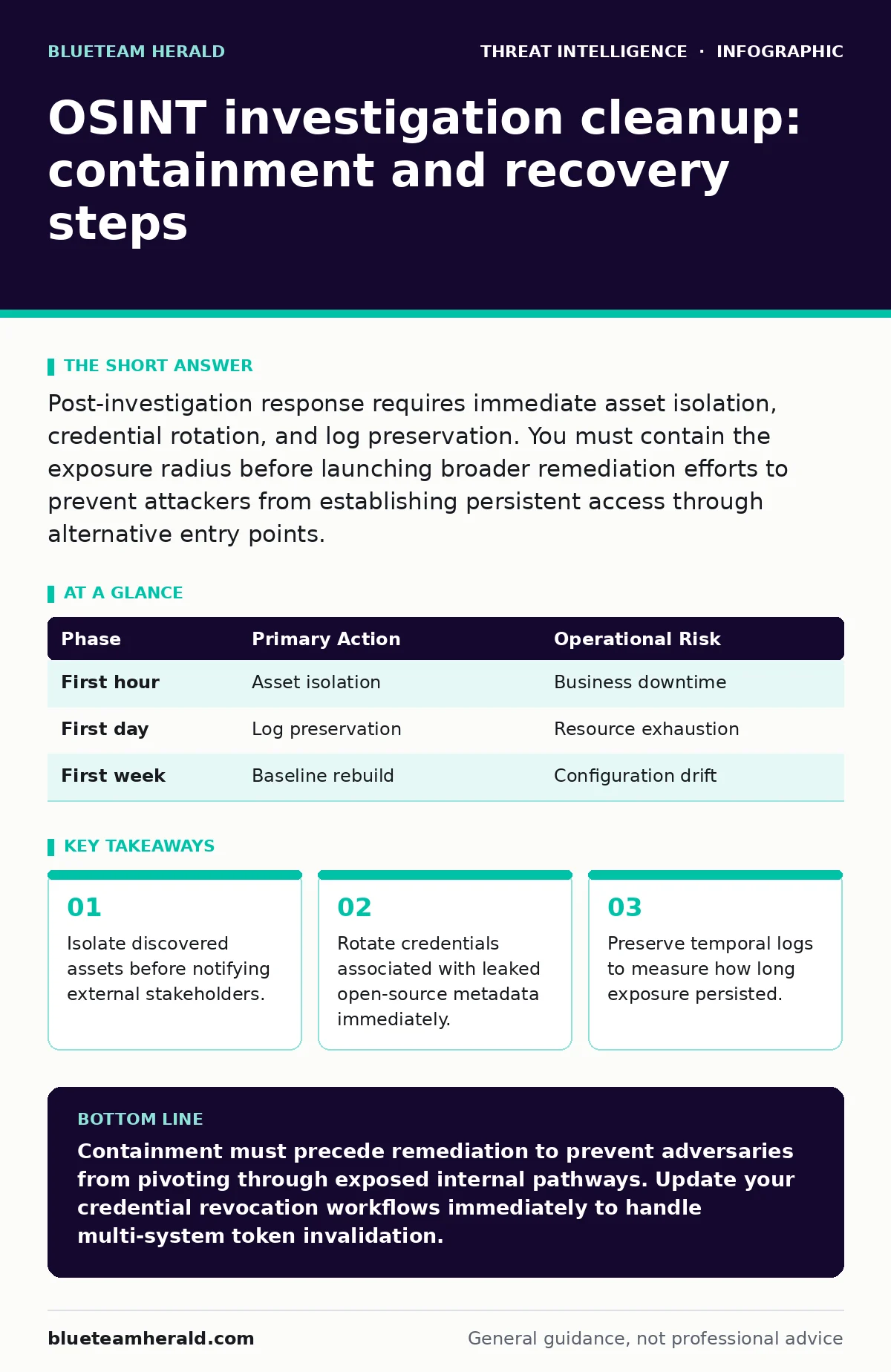
Post-investigation response requires immediate asset isolation, credential rotation, and log preservation. You must contain the exposure radius before launching broader remediation efforts to prevent attackers from establishing persistent access through alternative entry points.
Understanding Post-OSINT Exposure Realities
Uncovering organizational vulnerabilities through open-source intelligence creates an immediate operational dilemma. Security teams often focus entirely on gathering data, leaving them unprepared for the rapid containment actions required once sensitive disclosures appear online. Gathering intelligence without a predefined response plan transforms a routine discovery into an active security incident. Attackers frequently monitor public repositories and data leaks for the exact operational footprints investigators uncover during routine reconnaissance.
First hour
Immediate triage determines whether an exposed asset represents an active breach or a passive information leak. Security professionals must execute specific containment tasks within the initial sixty minutes of discovery.
- Disconnect affected systems from production networks immediately.
- Preserve volatile memory and active connection states for analysis.
- Revoke API keys and authentication tokens found in the discovered data.
- Notify internal incident response leads without broadcasting unverified details.
First day
Detailed forensic examination begins once immediate containment measures stabilize the environment. Investigators must analyze authentication logs to determine if unauthorized actors accessed the exposed resources before discovery. Integrating cyber threat intelligence helps correlate the specific exposure type with known attacker behaviors targeting similar infrastructure. Reviewing historical access records reveals the true duration of the vulnerability, establishing baseline metrics for your mean time to detect.
Extended analysis frequently uncovers secondary exposures linked to the primary finding. Teams often chase isolated data points while ignoring interconnected systems sharing identical configuration flaws. Establishing a comprehensive asset inventory prevents blind spots during this critical twenty-four-hour window. Documenting every recovered artifact ensures compliance readiness and supports subsequent root-cause investigations.
First week
Systematic recovery requires rebuilding compromised components from trusted baseline configurations rather than patching in place. Engineers must invalidate all administrative sessions and deploy updated access control lists across affected segments. Validating network boundary controls ensures that unauthorized external connections cannot re-establish contact with restored services. False positives in threat detection must be filtered out to maintain analyst focus on genuine residual persistence mechanisms.
Rebuilding trust in affected infrastructure demands rigorous post-incident validation testing. Security teams should perform controlled penetration testing against restored services to verify that previous configuration weaknesses no longer exist. Establishing continuous monitoring protocols ensures that similar open-source intelligence leaks trigger automated alerts before adversaries exploit them.
Containment Mechanisms and Trade-offs
Network segmentation limits lateral movement when an exposed asset compromises internal perimeter defenses. Isolating a compromised server stops active data exfiltration but instantly disrupts legitimate business operations relying on that service. Balancing containment speed against operational availability remains the hardest challenge for responders managing public data exposures. Choosing full network isolation guarantees safety at the cost of downtime, while partial isolation risks leaving secondary backdoors active.
See also: Ivanti VPN Warning Signs: Detecting Silent Exploitation · Threat Actors: Practical Defense Strategies for Small Businesses
Recovery and System Restoration
Restoring operational integrity involves more than simply redeploying software codebases from backup repositories. Administrators must assume that stored credentials and cryptographic keys associated with the leaked asset are permanently compromised. Generating fresh cryptographic material prevents adversaries from decrypting historical traffic or forging authentication tokens. Testing restored applications in a quarantined staging environment verifies functionality before returning services to production traffic.
Preventing Repeat Exposures
Addressing the root cause of an open-source intelligence leak requires changing how organizations handle external visibility. Developers need continuous training on how metadata leakage through public code repositories creates severe enterprise risk. Implementing automated monitoring pipelines for external data repositories catches accidental credential disclosures before external researchers or malicious actors find them.
| Phase | Primary Action | Operational Risk |
|---|---|---|
| First hour | Asset isolation | Business downtime |
| First day | Log preservation | Resource exhaustion |
| First week | Baseline rebuild | Configuration drift |
Suppose an internal developer publishes sensitive configuration files to a public repository during a routine project update. Automated scanners might miss the specific contextual risk until an external investigator flags the exposure. Responders must treat the resulting cleanup not as a simple file deletion task, but as a complete identity and access management reset.
Key takeaways
- Isolate discovered assets before notifying external stakeholders.
- Rotate credentials associated with leaked open-source metadata immediately.
- Preserve temporal logs to measure how long exposure persisted.
Containment must precede remediation to prevent adversaries from pivoting through exposed internal pathways. Update your credential revocation workflows immediately to handle multi-system token invalidation.
Frequently asked questions
How do you handle exposed database credentials found during an investigation?
Rotate the database credentials immediately, audit active query logs for unauthorized data access, and invalidate all existing session tokens linked to those service accounts.
What should you do if the exposed asset belongs to a third-party vendor?
Contact the vendor security team immediately through established communication channels, request proof of containment, and temporarily sever API integrations connecting your environment to their service.
Why is shutting down a compromised server immediately sometimes dangerous?
Immediate power disconnection destroys volatile random access memory containing active network connections, encryption keys, and running process artifacts necessary for forensic investigation.
How can organizations stop developers from leaking credentials publicly?
Implement pre-commit hooks that scan code repositories for secret patterns locally before developers can push code to public servers.
How this guide was produced: written by the BlueTeam Herald editorial team with AI assistance, checked against the public references listed below, and reviewed when the facts change. See our editorial policy or report an error.