Mean Time to Detect Explained: Why Speed Matters in Security
Mean time to detect measures the interval between an initial compromise and when your team realizes something is wrong, shaping your entire response strategy.

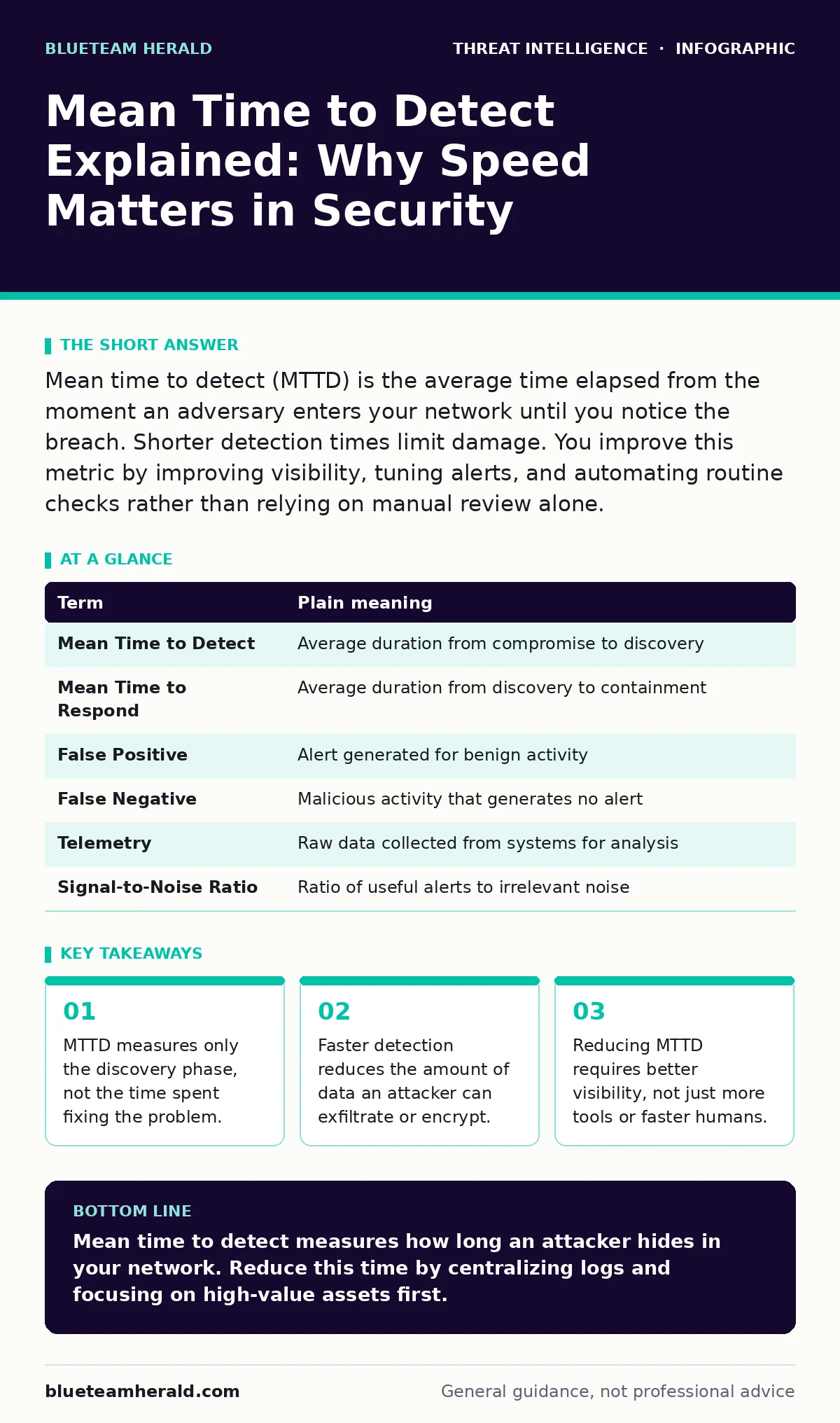
Mean time to detect (MTTD) is the average time elapsed from the moment an adversary enters your network until you notice the breach. Shorter detection times limit damage. You improve this metric by improving visibility, tuning alerts, and automating routine checks rather than relying on manual review alone.
The Library Fire Analogy
Imagine a large public library where a fire starts in the basement archives. The moment the first spark ignites is the start of the incident. The moment the smoke detector alarms is the detection. The time between those two events is your mean time to detect. If the alarm sounds immediately, you contain the fire before it spreads to the main reading room. If it takes hours for a librarian to notice the smell of smoke, the entire building may burn. In cybersecurity, the fire is the attacker, and the smoke detector is your monitoring system.
Defining the Detection Window
Mean time to detect (MTTD) is a metric that quantifies how long an adversary operates undetected within your environment. It starts when the first malicious action occurs and ends when a human or automated system identifies the anomaly. This metric does not include the time required to contain or remediate the issue. That separate phase is called mean time to respond (MTTR). Confusing these two leads to poor planning. You can have a fast detection time but a slow response, which still results in significant damage. Conversely, slow detection guarantees that the attacker has achieved their objectives before you even begin to react.
| Term | Plain meaning |
|---|---|
| Mean Time to Detect | Average duration from compromise to discovery |
| Mean Time to Respond | Average duration from discovery to containment |
| False Positive | Alert generated for benign activity |
| False Negative | Malicious activity that generates no alert |
| Telemetry | Raw data collected from systems for analysis |
| Signal-to-Noise Ratio | Ratio of useful alerts to irrelevant noise |
Why Detection Lag Occurs
Detection fails not because tools are missing, but because visibility is fragmented. Attackers often use living-off-the-land attacks, which means they use legitimate system tools to hide their tracks. If your monitoring only looks at antivirus signatures, you will miss these techniques entirely. Another common issue is alert fatigue.
When your system generates hundreds of irrelevant warnings, analysts ignore the real threats buried within the noise. This is where proper alert triage becomes necessary. You must distinguish between a misconfigured printer and an actual data exfiltration attempt. Without this distinction, your effective MTTD increases because the real threat sits ignored in a queue of hundreds.
The Hidden Cost of Low Visibility
Suppose an attacker uses DNS tunneling to send stolen data out through standard domain name queries. This traffic looks like normal web browsing to a basic firewall. If you do not perform network traffic analysis at the DNS level, you will never see the data leaving. This is a false negative. The cost of this blind spot is not just the lost data, but the continued presence of the attacker.
They now have a persistent channel to command and control servers. To reduce MTTD in this scenario, you need to inspect the payload of DNS requests, not just allow or block the domain. This requires deeper inspection capabilities and more storage for logs. The trade-off is higher infrastructure cost for better visibility.
Improving Your Detection Speed
You cannot speed up human reaction times significantly, but you can speed up data processing. Start by centralizing your logs. If server logs, firewall logs, and endpoint logs live in separate silos, correlating an attack path takes days. Centralization allows automated rules to connect the dots instantly.
For example, correlating a Windows event log monitoring alert for a failed login with a successful login from a different IP address can reveal credential stuffing. This correlation happens in seconds with a security information and event management system. You should also review your Snort and Suricata rules regularly. Outdated rules fail to catch modern variations of known exploits, increasing your MTTD for those specific attack vectors.
See also: Threat Actors: Practical Defense Strategies for Small Businesses
A Practical First Step
- Identify the top three critical systems in your organization.
- Verify that all authentication and file access events for these systems are being sent to a central log repository.
- Create a simple dashboard that highlights any access to these systems outside of normal business hours.
This simple step reduces the search space for analysts. Instead of looking at every log entry, they look at a filtered view of high-risk activity. It may generate false positives initially, but it trains your team to recognize legitimate off-hours work versus suspicious activity. Over time, you refine the rules to reduce noise. This refinement process directly lowers your MTTD because the signal becomes clearer.
The Limits of Automation
Automation speeds up detection, but it cannot replace human intuition. Automated rules catch known patterns. Sophisticated attackers change their tactics to bypass these patterns. This is why human review remains part of the process. You should use automation to handle the high-volume, low-risk alerts. This frees up analysts to investigate the complex, low-volume anomalies that machines might miss. For instance, an analyst might notice a unusual file type being accessed by a service account that rarely interacts with files. An automated rule might not flag this if the file type is allowed. Human context fills the gap that automation leaves open.
Key takeaways
- MTTD measures only the discovery phase, not the time spent fixing the problem.
- Faster detection reduces the amount of data an attacker can exfiltrate or encrypt.
- Reducing MTTD requires better visibility, not just more tools or faster humans.
Mean time to detect measures how long an attacker hides in your network. Reduce this time by centralizing logs and focusing on high-value assets first.
Frequently asked questions
How is MTTD different from MTTR?
MTTD measures the time until you notice the breach, while MTTR measures the time until you stop the breach and restore normal operations.
What is a good MTTD?
There is no universal standard, but shorter is always better. Industry averages vary widely, but the goal is to detect incidents before critical data is lost or systems are fully compromised.
Can automation eliminate MTTD?
No, automation can reduce it to seconds for known threats, but novel attacks will still require human investigation, keeping MTTD above zero for complex incidents.
How this guide was produced: written by the BlueTeam Herald editorial team with AI assistance, checked against the public references listed below, and reviewed when the facts change. See our editorial policy or report an error.