Cyber Range Training Platforms: How Simulated Networks Build Skills
Simulated training environments often teach defenders how to react to intrusions while missing the architectural flaws that allowed the breach initially.

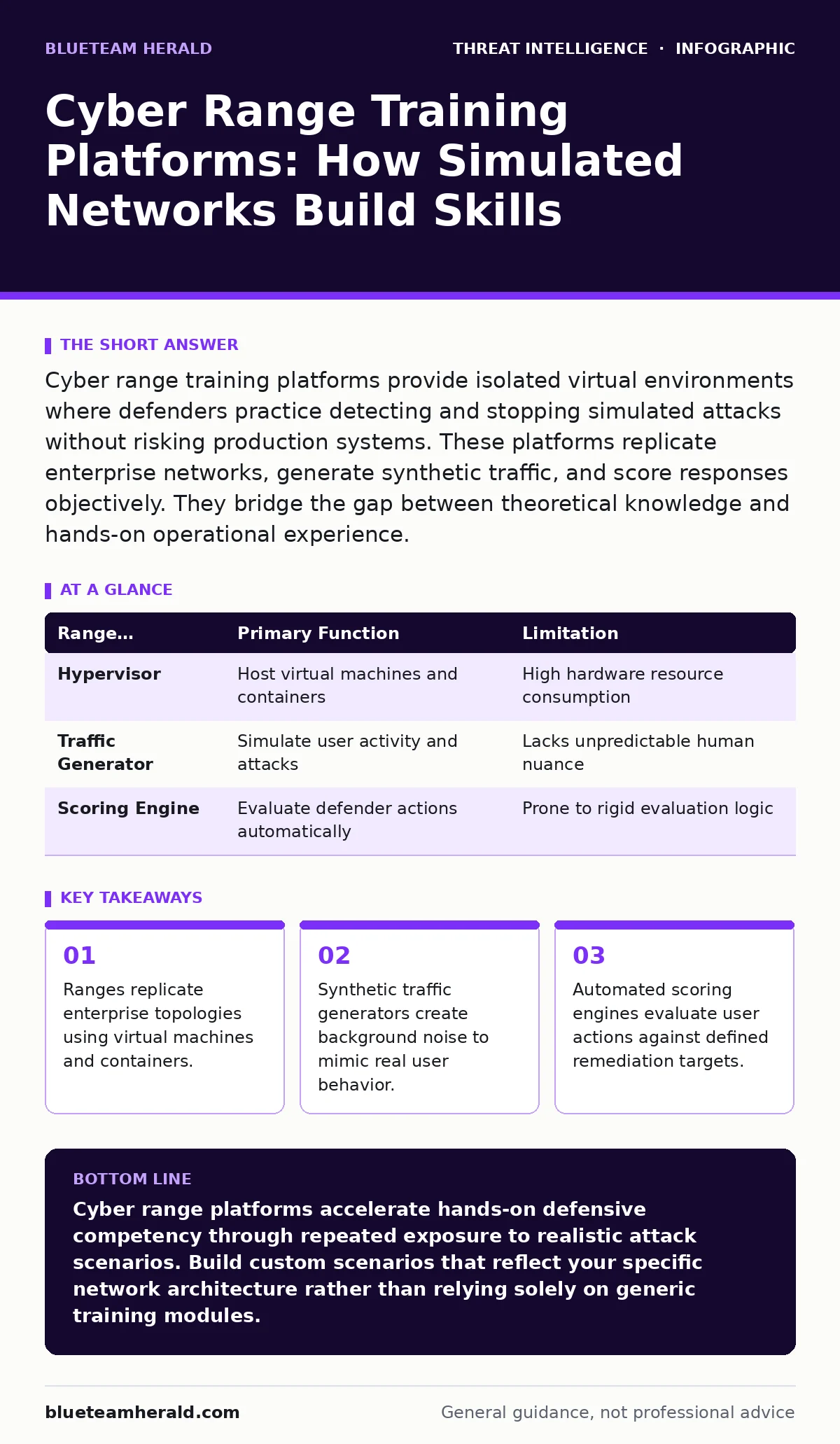
Cyber range training platforms provide isolated virtual environments where defenders practice detecting and stopping simulated attacks without risking production systems. These platforms replicate enterprise networks, generate synthetic traffic, and score responses objectively. They bridge the gap between theoretical knowledge and hands-on operational experience.
What is a cyber range training platform?
Cyber range training platforms are isolated hardware and software environments designed to simulate enterprise network architectures for security practice. These platforms run virtual machines, switches, and firewalls to mimic complex corporate domains complete with Active Directory structures and database servers. You interact with these systems through web interfaces or direct terminal access to investigate intrusions or harden configurations.
How do virtual ranges replicate real enterprise networks?
Virtual ranges replicate real enterprise networks by orchestrating multiple operating systems and routing protocols onto physical hypervisors using software-defined networking. Network designers map out subnets, DMZs, and VLANs to mirror standard corporate layouts. Automated provisioning scripts deploy these topologies rapidly, ensuring that every user receives a fresh, uncompromised copy of the target environment before a session begins.
| Range Component | Primary Function | Limitation |
|---|---|---|
| Hypervisor | Host virtual machines and containers | High hardware resource consumption |
| Traffic Generator | Simulate user activity and attacks | Lacks unpredictable human nuance |
| Scoring Engine | Evaluate defender actions automatically | Prone to rigid evaluation logic |
Why use automated scoring engines instead of human judges?
Automated scoring engines evaluate user actions instantly by checking system state changes, log entries, and service availability against predefined criteria. Human instructors cannot monitor dozens of simultaneous student investigations effectively without technological assistance. Scripted verification checks confirm whether a malicious user account was disabled or a backdoor file was removed.
What limitations do simulated environments have compared to production networks?
Simulated environments lack the chaotic background noise and legacy technical debt found in authentic corporate infrastructures. Enterprise networks feature years of unmapped hardware, erratic user behavior, and complex vendor software that synthetic ranges rarely capture fully. Defenders who train exclusively on clean ranges often struggle when facing messy, undocumented corporate systems during actual incidents.
| Training Environment | Advantage | Trade-off |
|---|---|---|
| Cyber Range | Safe isolation for experimentation | Simplified network complexity |
| Production Network | Authentic operational reality | High risk of catastrophic disruption |
How do traffic generators simulate realistic user behavior?
Traffic generators simulate realistic user behavior by executing scripted browser sessions, file transfers, and email exchanges across the virtual network. These tools inject noise into the system so that analysts must hunt for genuine indicators of compromise amid routine operational chatter. Background activity prevents defenders from simply flagging every single network connection as malicious.
See also: Alert Triage Mistakes and Fixes for Security Analysts
How do purple teaming exercises integrate with range platforms?
Purple teaming exercises integrate with range platforms by placing red team operators and blue team defenders inside the same shared virtual environment simultaneously. Defenders observe attack techniques in real time while red operators explain their methods, bypassing the traditional delays of after-action reporting. This collaborative approach improves detection engineering by pairing attack execution directly with log analysis.
What hidden costs accompany deploying a private cyber range?
Private cyber ranges demand significant ongoing maintenance regarding hardware upkeep, virtual machine template patching, and scenario script updates. Operating systems and security tools age rapidly, requiring constant revision of training materials to prevent scenarios from becoming obsolete. Organizations often underestimate the dedicated engineering hours required to keep a local range functional and engaging.
How do skill levels dictate scenario design in advanced platforms?
Skill levels dictate scenario design by dictating the subtlety of indicators, the volume of background noise, and the complexity of access controls implemented on the target hosts. Beginner scenarios rely on blatant misconfigurations and obvious log alerts, while advanced ranges feature living-off-the-land attacks that blend seamlessly with legitimate administrative tasks. Designers must calibrate these variables carefully to prevent frustration or boredom.
Key takeaways
- Ranges replicate enterprise topologies using virtual machines and containers.
- Synthetic traffic generators create background noise to mimic real user behavior.
- Automated scoring engines evaluate user actions against defined remediation targets.
Cyber range platforms accelerate hands-on defensive competency through repeated exposure to realistic attack scenarios. Build custom scenarios that reflect your specific network architecture rather than relying solely on generic training modules.
Frequently asked questions
Can a cyber range replace on-the-job experience?
Ranges teach specific mechanics and tool usage quickly, but they cannot replicate the political pressures and business context of a real corporate incident.
How many users can train simultaneously on a single range?
User capacity depends entirely on the underlying physical hardware resources and the virtualization density of the chosen platform architecture.
Are open-source range platforms viable for enterprise training?
Open-source options offer deep customizability and cost savings, but they require dedicated engineering talent to deploy, secure, and maintain.
How do instructors prevent participants from cheating during exercises?
Platforms use dynamic flag generation, isolated user instances, and network monitoring to ensure participants solve challenges independently.
How this guide was produced: written by the BlueTeam Herald editorial team with AI assistance, checked against the public references listed below, and reviewed when the facts change. See our editorial policy or report an error.