Threat Actors: Practical Defense Strategies for Small Businesses
Small organizations face the same automated attack tools as large corporations, making automated detection and strict access controls the primary defense mechanism.
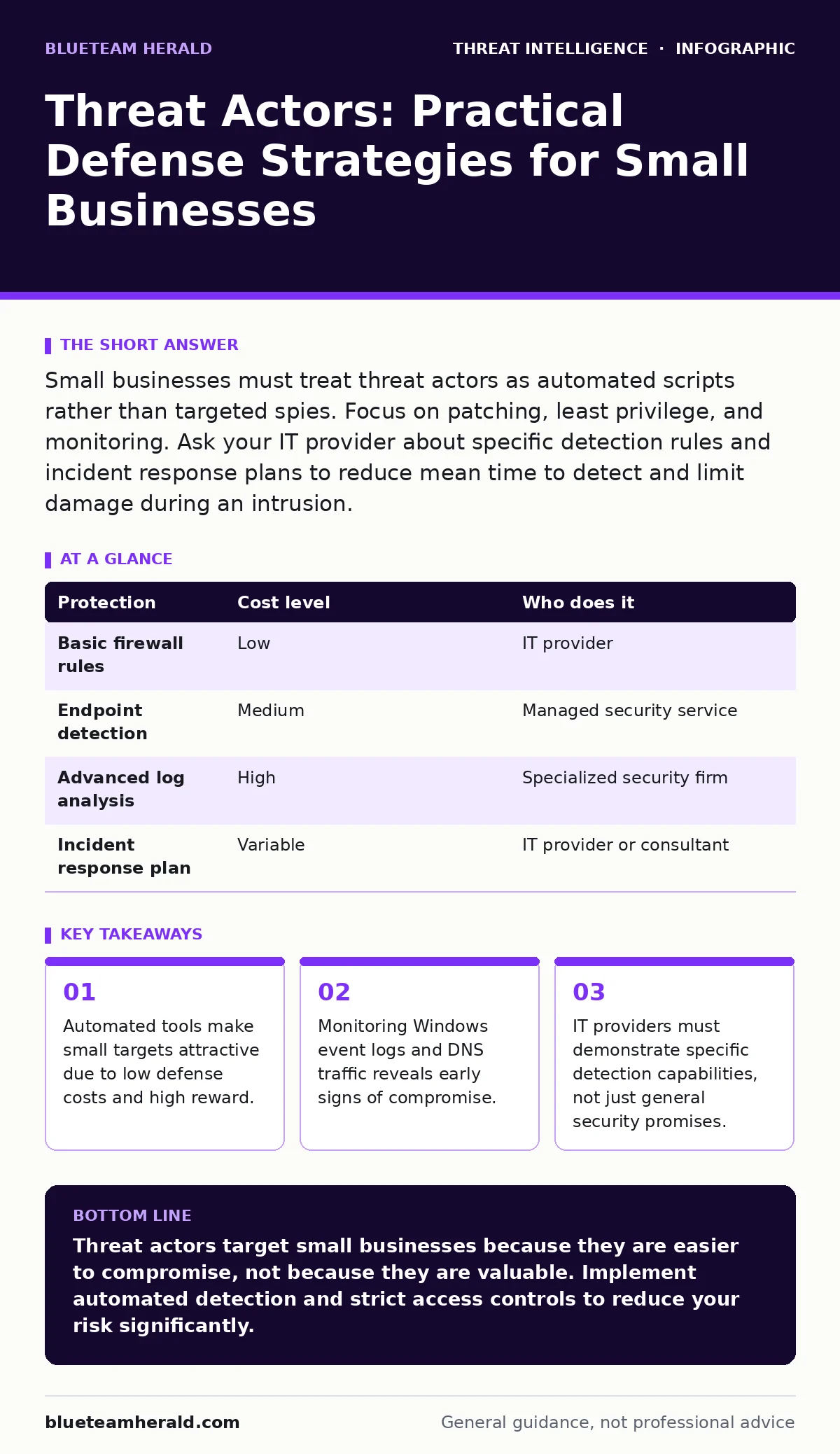
Small businesses must treat threat actors as automated scripts rather than targeted spies. Focus on patching, least privilege, and monitoring. Ask your IT provider about specific detection rules and incident response plans to reduce mean time to detect and limit damage during an intrusion.
Why Small Businesses Face Disproportionate Risk
Threat actors operate with varying levels of sophistication, but the tools they use are widely available. Small businesses often believe they are too small to notice. This assumption creates a dangerous blind spot. Automated attack scripts do not discriminate based on company size. They scan for vulnerable services and exploit them at scale.
The economic model of modern cybercrime favors speed and volume. Attackers use known vulnerabilities to compromise thousands of systems simultaneously. A small organization with weak defenses provides a quick return on investment for the attacker. This dynamic means you face the same initial attack vectors as a multinational corporation. The difference lies in the resources available to defend against these automated processes.
Understanding this reality shifts the focus from preventing targeted espionage to blocking automated intrusion. You must assume your network is constantly probed. Defense strategies should prioritize closing common entry points. This approach reduces the attack surface and increases the effort required for a successful breach.
The Mechanics of Initial Access
Most successful intrusions begin with a simple mistake or an unpatched system. Threat actors use credential stuffing attacks, where they try leaked passwords across multiple services. They also exploit misconfigured cloud storage or remote access tools. These methods require little technical skill but yield high success rates.
You must understand how these initial accesses occur to defend against them. Multi-factor authentication stops credential stuffing by requiring a second form of verification. Regular patching closes the software vulnerabilities that automated scanners detect. Network segmentation limits the damage if an attacker gains initial access.
Consider how DNS tunneling can bypass traditional firewalls. Attackers encode stolen data in DNS queries, which often pass through security filters unnoticed. Monitoring unusual DNS traffic patterns helps detect this exfiltration method. This technical detail is often overlooked in basic security plans but provides a clear signal of compromise.
Practical Detection and Monitoring
Detection relies on observing normal behavior and identifying deviations. You need visibility into what happens on your network. Windows event log monitoring provides critical data about logins, privilege changes, and process executions. Analyzing these logs helps identify suspicious activity before it causes significant damage.
Automated tools can help process this data. Snort and Suricata rules allow you to define specific patterns that indicate malicious activity. These rules can trigger alerts when unusual traffic or commands are detected. Configuring these tools correctly requires understanding the specific threats relevant to your industry.
Packet capture analysis offers a deeper view of network traffic. By recording and examining data packets, you can identify hidden communications or command-and-control channels. This method is resource-intensive but valuable for investigating potential breaches. It helps you understand exactly what data left your network and when.
Responding to Active Threats
When an intrusion occurs, speed is critical. The mean time to detect measures how long it takes to identify a breach. Reducing this metric limits the damage an attacker can cause. Automated response systems can isolate infected devices or block malicious IP addresses immediately.
SOAR (Security Orchestration, Automation, and Response) platforms automate these response actions. They connect different security tools to create a coordinated defense. For small businesses, even basic automation can significantly improve response times. This reduces the burden on IT staff during a crisis.
Alert triage is the process of distinguishing real threats from false positives. Without effective triage, security teams become overwhelmed by noise. You must prioritize alerts based on severity and potential impact. This ensures that genuine threats receive immediate attention while benign anomalies are logged for later review.
Living-off-the-Land Tactics
Advanced threat actors often use legitimate system tools to avoid detection. These are called living-off-the-land attacks. They use built-in utilities like PowerShell or WMI to execute malicious commands. Since these tools are necessary for normal operations, they are rarely blocked by security software.
Defending against these tactics requires monitoring the use of legitimate tools. You must establish a baseline of normal behavior for these utilities. Any deviation from this baseline, such as PowerShell running unusual scripts, should trigger an alert. This approach catches attacks that bypass traditional antivirus solutions.
Imagine an attacker using a built-in tool to move laterally across your network. They do not need to install new malware. They simply use existing permissions and tools. Detecting this requires careful logging and analysis of command-line activity. It highlights the need for deep visibility into system operations.
See also: Purple Teaming Explained: How to Bridge the Gap Between Attack and Defense · CISA Known Exploited Vulnerabilities: Action Plan for Small Business
Evaluating IT Provider Capabilities
Many small businesses outsource their IT security. You must verify that your provider understands threat intelligence. Do not accept vague promises of protection. Ask specific questions about their detection and response capabilities. This ensures you are paying for active defense, not just basic maintenance.
| Protection | Cost level | Who does it |
|---|---|---|
| Basic firewall rules | Low | IT provider |
| Endpoint detection | Medium | Managed security service |
| Advanced log analysis | High | Specialized security firm |
| Incident response plan | Variable | IT provider or consultant |
The cost of protection scales with the level of customization and expertise required. Basic firewall rules are inexpensive but insufficient against sophisticated attacks. Endpoint detection provides better visibility but requires tuning to reduce false alarms. Advanced log analysis offers the deepest insight but demands significant expertise.
Questions to Ask Your IT Provider
You need clear answers to evaluate your security posture. Use these questions to assess your provider’s competence.
- What specific Snort and Suricata rules do you monitor for my industry?
- How do you handle DNS tunneling detection and prevention?
- What is your process for alert triage during a suspected breach?
- How do you measure and reduce mean time to detect incidents?
- Can you demonstrate Windows event log monitoring capabilities?
- What is your plan for living-off-the-land attacks?
- How do you perform packet capture analysis when needed?
- Do you offer SOAR capabilities or basic automation?
These questions force your provider to articulate their methods. They reveal whether the provider relies on generic tools or tailored strategies. A competent provider will explain their approach clearly. They will also acknowledge the limitations of their services.
Building a Sustainable Defense
Security is an ongoing process, not a one-time purchase. You must continuously adapt to new threats and technologies. Regularly review your security policies and update them as needed. Train your staff to recognize phishing attempts and other social engineering tactics.
Small businesses often struggle with resource constraints. Focus on the highest-impact controls first. Patch management, multi-factor authentication, and access controls provide the best return on investment. These measures address the most common attack vectors.
By understanding threat actors and implementing practical defenses, you protect your business effectively. You shift from a reactive posture to a proactive stance. This reduces risk and builds resilience against evolving cyber threats.
Key takeaways
- Automated tools make small targets attractive due to low defense costs and high reward.
- Monitoring Windows event logs and DNS traffic reveals early signs of compromise.
- IT providers must demonstrate specific detection capabilities, not just general security promises.
Threat actors target small businesses because they are easier to compromise, not because they are valuable. Implement automated detection and strict access controls to reduce your risk significantly.
Frequently asked questions
How do I know if my small business is being targeted?
You likely are, through automated scans. Look for unusual login attempts, unexpected network traffic, or slow system performance. These are common signs of initial access attempts.
Is multi-factor authentication enough to stop all attacks?
No, it stops credential-based attacks but not software vulnerabilities or social engineering. You still need patch management, network segmentation, and employee training to cover other entry points.
What is the most cost-effective security tool for small businesses?
A managed detection and response service that monitors logs and network traffic. It provides expert analysis without the high cost of hiring a full-time security team.
How often should I review my security policies?
At least annually, or whenever there is a significant change in your technology stack or business processes. Regular reviews ensure your defenses remain aligned with current risks.
How this guide was produced: written by the BlueTeam Herald editorial team with AI assistance, checked against the public references listed below, and reviewed when the facts change. See our editorial policy or report an error.