Cyber Threat Intelligence Explained: From Data to Actionable Defense
Threat intelligence transforms raw data into context that predicts attacker behavior, allowing defenders to block threats before they reach critical systems.

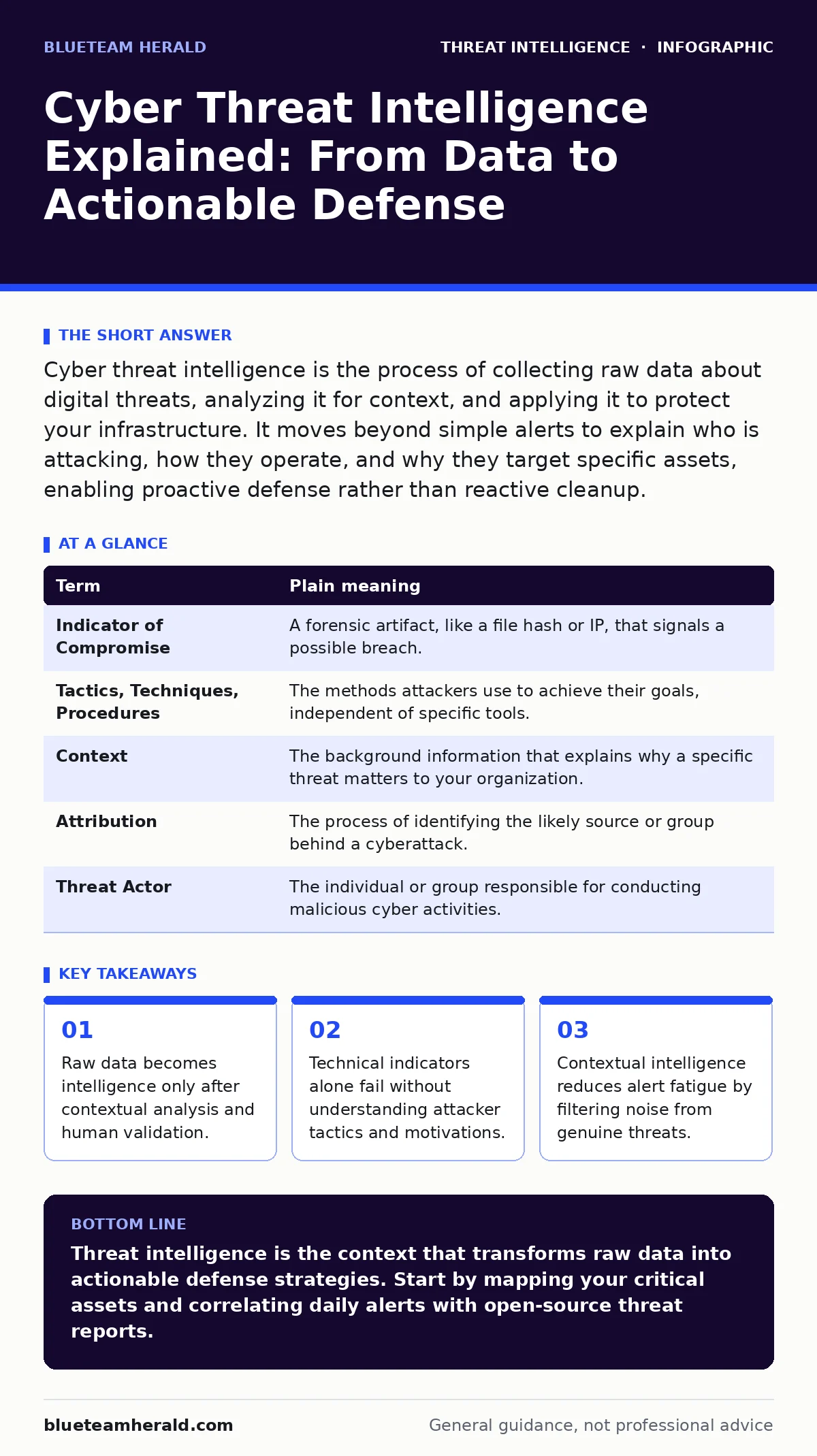
Cyber threat intelligence is the process of collecting raw data about digital threats, analyzing it for context, and applying it to protect your infrastructure. It moves beyond simple alerts to explain who is attacking, how they operate, and why they target specific assets, enabling proactive defense rather than reactive cleanup.
The Weather Forecast Analogy
Imagine you are planning a sailing trip. You see dark clouds gathering on the horizon. That visual observation is raw data. It tells you nothing about the storm’s path, intensity, or duration. A weather service collects radar data, wind speeds, and historical patterns. They analyze this information to predict a hurricane’s trajectory. This prediction is intelligence. You use that intelligence to decide whether to sail or stay in port. Cyber threat intelligence works the same way. It turns scattered digital signals into a coherent picture of imminent danger.
Defining the Core Components
Many beginners confuse data with intelligence. Data is unprocessed facts, such as an IP address or a file hash. Intelligence is data that has been analyzed, contextualized, and applied to a specific decision. Without context, an IP address is just a number. With context, you know it belongs to a known command-and-control server. This distinction matters because acting on raw data causes false positives. Acting on intelligence drives effective security decisions. You must understand the difference to prioritize your work correctly.
| Term | Plain meaning |
|---|---|
| Indicator of Compromise | A forensic artifact, like a file hash or IP, that signals a possible breach. |
| Tactics, Techniques, Procedures | The methods attackers use to achieve their goals, independent of specific tools. |
| Context | The background information that explains why a specific threat matters to your organization. |
| Attribution | The process of identifying the likely source or group behind a cyberattack. |
| Threat Actor | The individual or group responsible for conducting malicious cyber activities. |
Common Points of Confusion
People often think threat intelligence is just a list of bad IP addresses. This view is dangerously incomplete. An IP address can be spoofed, recycled, or benign. Relying solely on these technical indicators leads to alert fatigue. You will block legitimate traffic or miss sophisticated attacks that use clean infrastructure. True intelligence focuses on behavior. It asks how an attacker moves laterally or exfiltrates data. This behavioral focus allows you to detect new attacks that use different tools but the same methods.
Why Context Changes Everything
Context determines the value of any piece of information. Suppose you detect a login from a foreign country. If you operate globally, this is normal. If you only serve local customers, it is suspicious. Context includes your industry, your technology stack, and your geographic footprint. It also includes the current geopolitical climate. Attackers often increase activity during major events. Understanding this timing helps you adjust your defenses. Without context, you cannot distinguish between a curious scanner and a targeted intruder.
Operationalizing the Intelligence
Collecting intelligence is useless if it does not change your security posture. You must integrate findings into your daily operations. This means updating firewall rules, adjusting detection signatures, and training your staff. It also means sharing relevant findings with other teams. If the finance team knows attackers are targeting invoice systems, they can verify unusual requests. This cross-functional approach strengthens your overall resilience. Intelligence must drive action, not just sit in a report.
See also: Purple Teaming Explained: How to Bridge the Gap Between Attack and Defense · OSINT investigation cleanup: containment and recovery steps
Integrating with Security Operations
Threat intelligence enhances other security disciplines. It improves network traffic analysis by highlighting anomalous flows that match known attack patterns. It helps defenders recognize living-off-the-land attacks by identifying unusual use of standard system tools. When you understand the adversary’s playbook, you can reduce your mean time to detect incidents. This speed is critical because the longer an attacker stays hidden, the more damage they cause. Intelligence provides the map; your tools provide the vehicle.
Practical Steps for Beginners
You do not need expensive tools to start. Begin by understanding your own environment. Map your critical assets and identify who might want to steal them. Then, look for free, open-source intelligence sources that focus on your industry. Finally, practice correlating alerts with this external data. This habit builds intuition. It teaches you to see patterns rather than isolated events. Over time, this practice becomes second nature.
- Identify your top 3 critical assets and the data they contain.
- Subscribe to 2-3 reputable open-source threat intelligence feeds relevant to your sector.
- Review one weekly alert log and manually correlate it with external threat reports.
The Human Element Remains Key
Technology cannot replace human judgment. Algorithms can process data, but they cannot understand nuance. A machine might flag a script as malicious because it matches a known signature. A human analyst recognizes that the script is a harmless configuration tool. This judgment prevents unnecessary panic. It also ensures that resources are focused on real threats. Always involve a human in the final decision loop. Automation should support analysis, not replace it.
Key takeaways
- Raw data becomes intelligence only after contextual analysis and human validation.
- Technical indicators alone fail without understanding attacker tactics and motivations.
- Contextual intelligence reduces alert fatigue by filtering noise from genuine threats.
Threat intelligence is the context that transforms raw data into actionable defense strategies. Start by mapping your critical assets and correlating daily alerts with open-source threat reports.
Frequently asked questions
Is threat intelligence only for large enterprises?
No, small organizations benefit greatly from open-source intelligence that focuses on their specific industry and technology stack.
How do I verify if an intelligence source is reliable?
Check if the source provides context, explains their methodology, and allows you to validate their indicators against your own environment.
What is the difference between tactical and strategic intelligence?
Tactical intelligence helps you block immediate threats, while strategic intelligence informs long-term security planning and budget decisions.
Can I use threat intelligence to predict future attacks?
You can predict likely tactics and targets based on current trends, but you cannot predict specific future events with certainty.
How this guide was produced: written by the BlueTeam Herald editorial team with AI assistance, checked against the public references listed below, and reviewed when the facts change. See our editorial policy or report an error.