Purple Teaming Explained: How to Bridge the Gap Between Attack and Defense
Purple teaming replaces the annual audit with continuous dialogue, turning defensive blind spots into immediate engineering improvements rather than report findings.

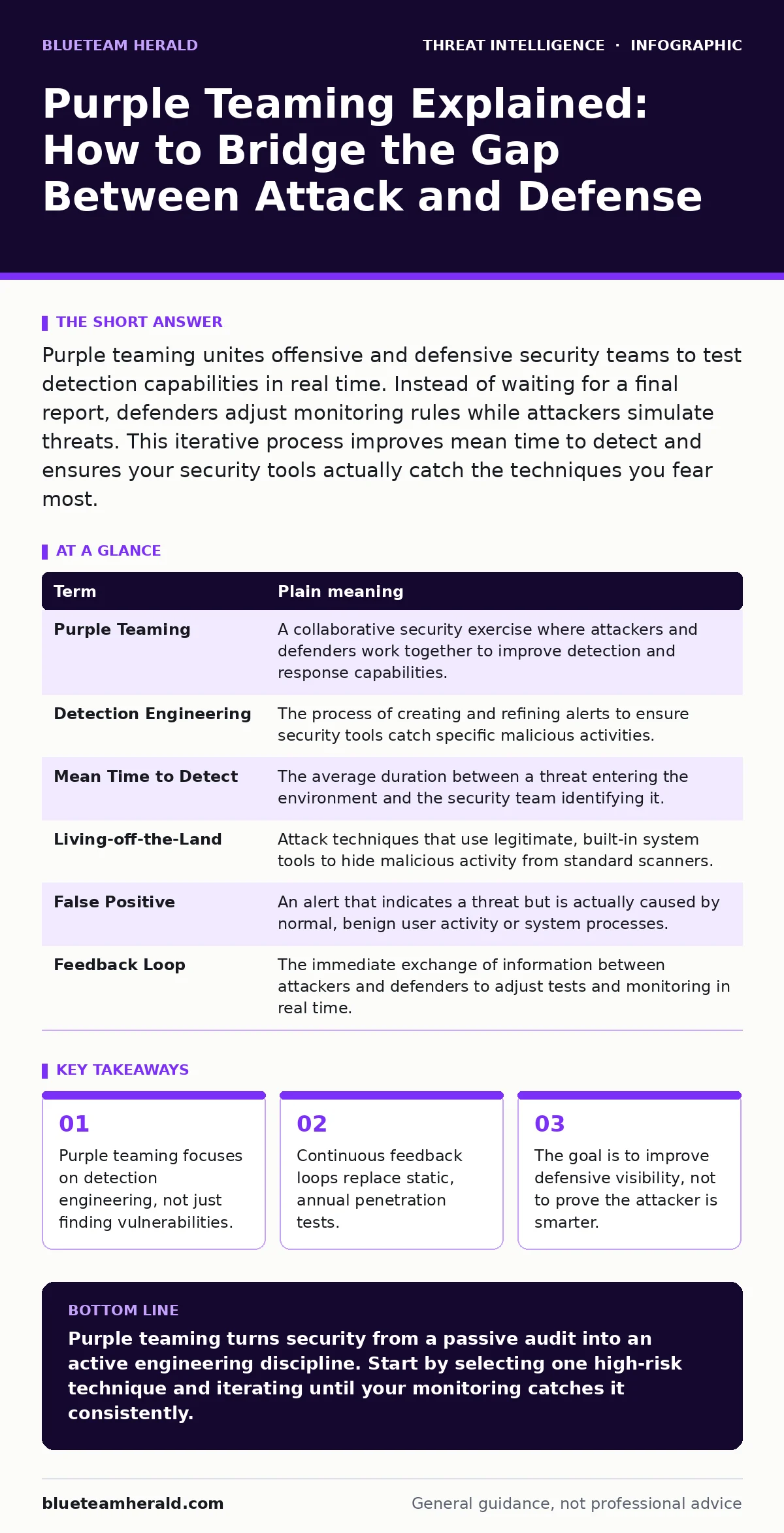
Purple teaming unites offensive and defensive security teams to test detection capabilities in real time. Instead of waiting for a final report, defenders adjust monitoring rules while attackers simulate threats. This iterative process improves mean time to detect and ensures your security tools actually catch the techniques you fear most.
The Fire Drill Analogy
Imagine a building’s fire safety system. A traditional penetration test is like hiring an external firm to start a controlled fire in one room, write a report on how the sprinklers failed, and leave. You read the report months later and maybe fix that one room. Purple teaming is different. It is like having the fire marshal and the building engineer work together in real time.
The marshal tries to trigger alarms using different methods, while the engineer watches the control panel. If an alarm does not sound, they tweak the sensor sensitivity immediately, then try again. The goal is not to burn the building down. The goal is to ensure the alarm system works exactly as designed, every single time.
Defining the Roles Clearly
In this model, the "red" function represents the attacker mindset. These individuals simulate threats to test how well your defenses hold up. They do not care about breaking things for fun. They care about finding paths that your current monitoring misses. The "blue" function represents the defender. These individuals manage the security tools, such as intrusion detection systems and log aggregators. Their job is to see the attack happen and respond to it. Purple teaming is the collaboration between these two groups. It is not a third team. It is a workflow where red and blue members share context instantly.
The Mini Glossary of Terms
| Term | Plain meaning |
|---|---|
| Purple Teaming | A collaborative security exercise where attackers and defenders work together to improve detection and response capabilities. |
| Detection Engineering | The process of creating and refining alerts to ensure security tools catch specific malicious activities. |
| Mean Time to Detect | The average duration between a threat entering the environment and the security team identifying it. |
| Living-off-the-Land | Attack techniques that use legitimate, built-in system tools to hide malicious activity from standard scanners. |
| False Positive | An alert that indicates a threat but is actually caused by normal, benign user activity or system processes. |
| Feedback Loop | The immediate exchange of information between attackers and defenders to adjust tests and monitoring in real time. |
Why Traditional Tests Fall Short
Annual penetration tests provide a snapshot in time. They tell you what was broken on that specific day. They rarely tell you if your monitoring tools would have caught the attacker if they had tried a different approach. Purple teaming addresses this gap. It focuses on the detection layer.
When a red team member uses a technique that bypasses your Windows event log monitoring, the blue team member does not just note the failure. They immediately adjust the logging configuration or create a new correlation rule. Then the red team member tries the same technique again. This iteration continues until the detection works. This process directly reduces your mean time to detect.
The Hidden Cost of Collaboration
Purple teaming requires a cultural shift. It asks attackers to stop hiding their techniques and defenders to stop being defensive about their tools. This transparency can feel vulnerable. You must trust that the red team will not exploit a finding for personal gain or reputation. You must trust that the blue team will not ignore a finding because it creates too much noise. If this trust is absent, the exercise becomes a performance.
The red team will stick to easy wins, and the blue team will claim they detected everything. The value lies in the messy, iterative work of fixing blind spots. This is where you might encounter living-off-the-land attacks that mimic normal administrative tasks. These are hard to detect because they use tools already present on the system. Purple teaming helps you build rules that distinguish between an admin running a script and an attacker doing the same.
See also: Cyber Threat Intelligence Explained: From Data to Actionable Defense · What is a SOAR program: Automating Security Operations
Practical Implementation Steps
You do not need a large budget to start. You need a clear objective and a willing pair of testers. Start with a single, high-risk technique. Do not try to test everything at once. Focus on a behavior that matters to your organization. For example, if you are worried about credential theft, focus on DCSync attacks. This specific technique replicates password data from domain controllers. It is detectable if you monitor the right attributes.
- Select a specific technique: Choose one attack method that your organization considers high risk. Review public frameworks to understand the steps involved.
- Define success criteria: Agree on what "detection" looks like. Is it an alert in your SIEM? Is it a ticket created by the SOC? Be precise.
- Execute and iterate: The red team executes the technique. The blue team watches for the alert. If no alert fires, the blue team adjusts the monitoring logic. The red team repeats the action. Repeat until the alert fires reliably.
Integrating with Broader Security
Purple teaming fits into a larger security posture. It complements other disciplines. For instance, the rules you refine during purple teaming can be converted into Snort and Suricata rules for your network sensors. This ensures that the lessons learned in the host environment propagate to the network layer. Similarly, the insights gained can improve your alert triage processes.
If you find that certain alerts are consistently noisy, you can tune them out. This reduces fatigue for your analysts. It also helps you understand domain generation algorithms or DNS tunneling better, as these often require specific baseline behaviors to identify. By focusing on detection, you build a more resilient system. You are not just patching holes. You are improving the eyes and ears of your security operations.
Key takeaways
- Purple teaming focuses on detection engineering, not just finding vulnerabilities.
- Continuous feedback loops replace static, annual penetration tests.
- The goal is to improve defensive visibility, not to prove the attacker is smarter.
Purple teaming turns security from a passive audit into an active engineering discipline. Start by selecting one high-risk technique and iterating until your monitoring catches it consistently.
Frequently asked questions
Is purple teaming the same as red teaming?
No. Red teaming simulates a full adversary campaign to test overall security posture. Purple teaming is a focused, collaborative exercise to improve specific detection capabilities.
Do I need a dedicated purple team?
No. You can start with existing red and blue team members. The key is the workflow and communication, not the job titles.
How often should we run purple team exercises?
Frequency depends on your change velocity. Many organizations run them quarterly or whenever significant infrastructure changes occur.
Can purple teaming help with compliance?
Yes. It provides evidence that you are actively testing and improving your detection controls, which many compliance frameworks require.
How this guide was produced: written by the BlueTeam Herald editorial team with AI assistance, checked against the public references listed below, and reviewed when the facts change. See our editorial policy or report an error.