CISA Known Exploited Vulnerabilities: Action Plan for Small Business
Small teams can prioritize patching by focusing only on vulnerabilities that attackers are actively using in the wild right now.

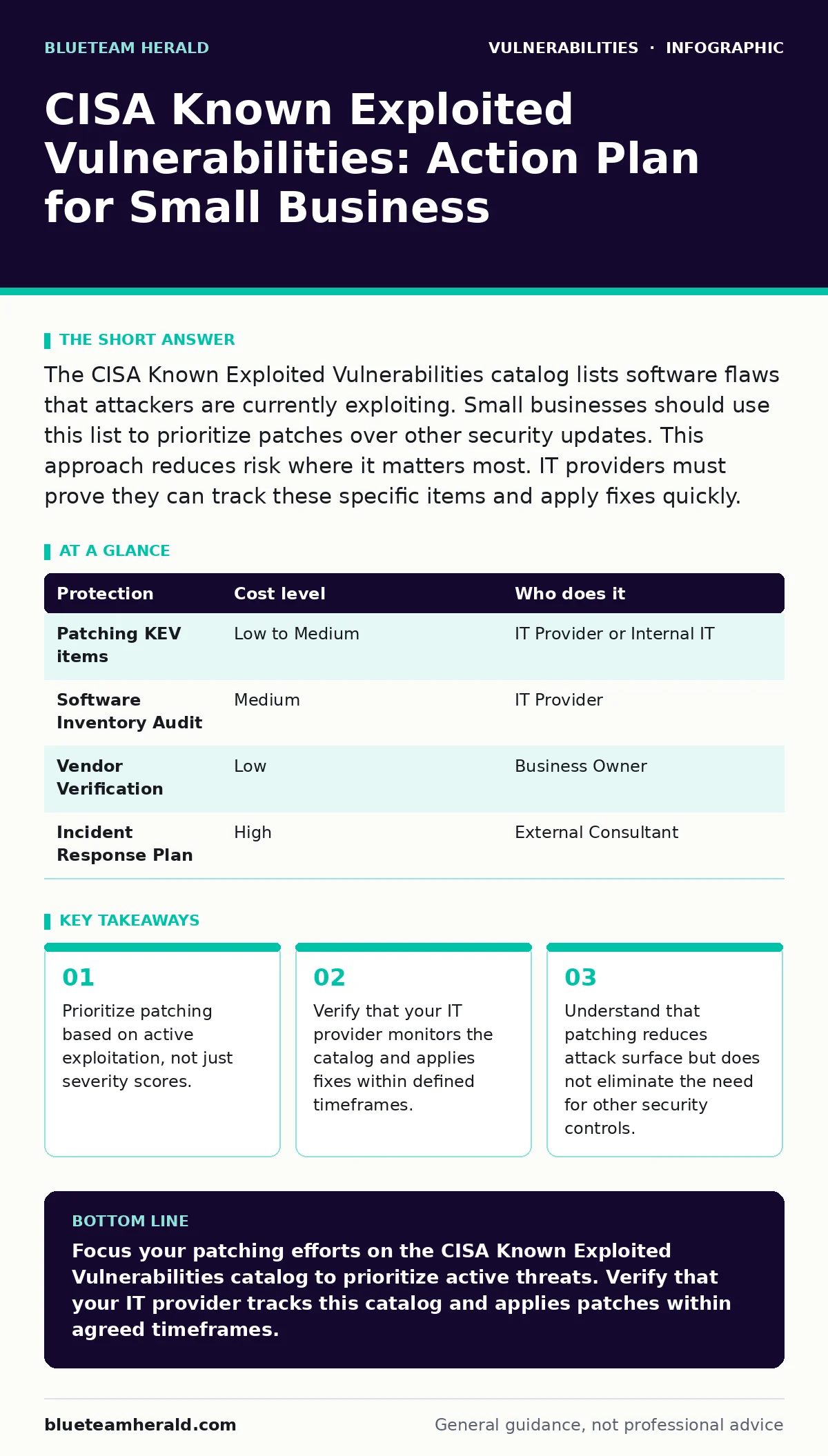
The CISA Known Exploited Vulnerabilities catalog lists software flaws that attackers are currently exploiting. Small businesses should use this list to prioritize patches over other security updates. This approach reduces risk where it matters most. IT providers must prove they can track these specific items and apply fixes quickly.
The Hypothetical Ten-Person Company
This small organization faces the same software flaws as a global corporation. The difference lies in resources. You cannot patch everything at once. You must choose which fixes matter most. The CISA Known Exploited Vulnerabilities (KEV) catalog provides this choice. It lists specific software flaws that threat actors are actively using in attacks.
Many small businesses ignore this catalog because it feels too technical. They instead rely on automatic updates or wait for critical alerts. This passive approach leaves gaps. Attackers do not wait for you to be ready. They target known weaknesses immediately. The KEV catalog tells you exactly which weaknesses are live targets.
Why the Catalog Matters at Small Scale
The primary value of the KEV catalog is focus. Vulnerability databases contain thousands of entries. Most are theoretical or rarely used. Patching every single one requires significant time and testing. Small teams lack this capacity. You need to know which flaws are dangerous today.
The catalog filters the noise. It includes only vulnerabilities with confirmed exploitation in the wild. This distinction changes your priority list. A high-severity bug that no one is exploiting drops in priority. A moderate-severity bug that is actively used rises to the top. This inversion challenges standard security advice.
Consider the trade-off. You might leave a low-priority flaw unpatched for a month. This is acceptable if the flaw is not in the KEV catalog. You save time to patch a KEV item that could lead to immediate compromise. This strategy requires discipline. You must trust the catalog’s curation. The catalog is maintained by the Cybersecurity and Infrastructure Security Agency. It is a public framework.
What to Do With It in Practice
You cannot treat the KEV catalog as a set-and-forget tool. It updates frequently. New entries appear as attackers discover new methods. You must integrate it into your routine. Start by identifying your software inventory. You cannot patch what you do not know you have.
Map your inventory against the catalog. Look for matches. When you find a match, schedule the patch immediately. Do not wait for the next maintenance window if the risk is high. Test the patch in a non-production environment if possible. Small businesses often skip this step due to time pressure. Skipping tests can cause system failures.
| Protection | Cost level | Who does it |
|---|---|---|
| Patching KEV items | Low to Medium | IT Provider or Internal IT |
| Software Inventory Audit | Medium | IT Provider |
| Vendor Verification | Low | Business Owner |
| Incident Response Plan | High | External Consultant |
This table shows the resource allocation. Patching is the core task. It requires consistent effort. The cost is primarily time. You must verify that your IT provider understands this priority. They should not treat KEV patches as optional. They are mandatory for minimizing active risk.
What to Ask an IT Provider
Your IT provider is your first line of defense. They manage the systems that contain these vulnerabilities. You must hold them accountable. Do not assume they are using the catalog. Many providers still rely on generic vulnerability scanners. These scanners miss the context of active exploitation.
Ask specific questions. Vague answers indicate a lack of process. You need to know how they track changes. You need to know how they verify fixes. This conversation protects your business. It ensures that your provider is aligned with current threat intelligence.
- Do you monitor the CISA Known Exploited Vulnerabilities catalog daily?
- How do you prioritize patches when multiple KEV items appear at once?
- Can you provide a report of KEV patches applied in the last month?
- What is your average time to patch a KEV item after release?
- How do you test patches before applying them to production systems?
These questions reveal their maturity. A good provider will have a clear process. They will show you reports. They will explain their testing methodology. If they cannot answer these questions, you are at risk. You may need to find a new provider.
Common Pitfalls and Hidden Costs
Patching is not free. It consumes staff time. It requires testing. It can cause compatibility issues. Some software breaks after a patch. This is a hidden cost. You must budget for downtime. Plan patching during off-hours. Notify users in advance.
Another pitfall is over-reliance on patching. Patching reduces the attack surface. It does not eliminate it. Attackers use other methods. They exploit authentication bypass vulnerabilities. They use social engineering. They target browser updates that users ignore. You must layer defenses.
Imagine a scenario where you patch all KEV items. You feel secure. An attacker then uses a phishing email to steal credentials. Your patches did not help. This is why you need a broader strategy. You should also review your vulnerability management programs. Ensure they cover configuration errors and weak access controls.
See also: Fake Software Updates Prevention Checklist for Secure Systems · Vulnerability Scanning: How Automated Checks Find Security Gaps
Integrating With Other Security Efforts
The KEV catalog works best when combined with other practices. It complements vulnerability scanning. Scanners find all flaws. The catalog tells you which ones to fix first. Use both tools together. This gives you a complete picture.
You should also consider attack vectors in CVSS. The Common Vulnerability Scoring System rates severity. It does not always reflect active exploitation. A CVSS score of 5 might be in the KEV catalog. A score of 9 might not. Trust the catalog for prioritization. Use CVSS for context.
Do not ignore cross-site scripting (XSS) risks. These are common in web applications. They may not appear in the KEV catalog immediately. But they are frequent. Ensure your web applications are reviewed regularly. This is separate from server patching. It requires code reviews or application security testing.
Maintaining Long-Term Discipline
Security is not a one-time project. It is a continuous process. The KEV catalog changes. Your software changes. Your staff changes. You must maintain discipline. Review your processes quarterly. Update your inventory. Re-verify your provider’s performance.
Small businesses often start strong and then fade. This is dangerous. Attackers persist. They wait for you to relax. Keep the pressure on. Make patching a habit. Celebrate when you patch quickly. Learn when you miss a deadline.
This discipline protects your reputation. It protects your data. It keeps your business running. The cost of inaction is far higher than the cost of patching. Stay focused on the active threats. The KEV catalog is your map. Use it wisely.
Final Thoughts on Small Business Security
You do not need a large budget to be secure. You need focus. The CISA KEV catalog provides that focus. It tells you what matters. Your IT provider must execute on it. Your role is to verify and oversee.
Do not get lost in the details of every vulnerability. Stick to the catalog. Patch what is exploited. Test your patches. Ask the right questions. This approach is sustainable. It works for small teams. It works for large ones. The principles are the same. The scale differs.
This routine builds trust. It builds security. It keeps your business safe. Remember that security is a journey. You will face new challenges. But with the right tools and mindset, you can manage them. The KEV catalog is a powerful tool. Use it to your advantage.
Key takeaways
- Prioritize patching based on active exploitation, not just severity scores.
- Verify that your IT provider monitors the catalog and applies fixes within defined timeframes.
- Understand that patching reduces attack surface but does not eliminate the need for other security controls.
Focus your patching efforts on the CISA Known Exploited Vulnerabilities catalog to prioritize active threats. Verify that your IT provider tracks this catalog and applies patches within agreed timeframes.
Frequently asked questions
How often does the CISA KEV catalog update?
The catalog updates frequently, often weekly, as new exploitation evidence is confirmed. You should check for updates regularly.
Does the catalog include all software types?
It includes widely used software across various platforms. It focuses on items with confirmed real-world exploitation.
Can I automate checking against the KEV catalog?
Yes, many vulnerability management tools can integrate with the catalog. Ensure your provider uses such automation.
How this guide was produced: written by the BlueTeam Herald editorial team with AI assistance, checked against the public references listed below, and reviewed when the facts change. See our editorial policy or report an error.