XDR for Small Business: How to Deploy Detection Without a SOC
You can achieve enterprise-grade threat correlation by feeding open telemetry into a unified engine, eliminating the need for full-time analysts.

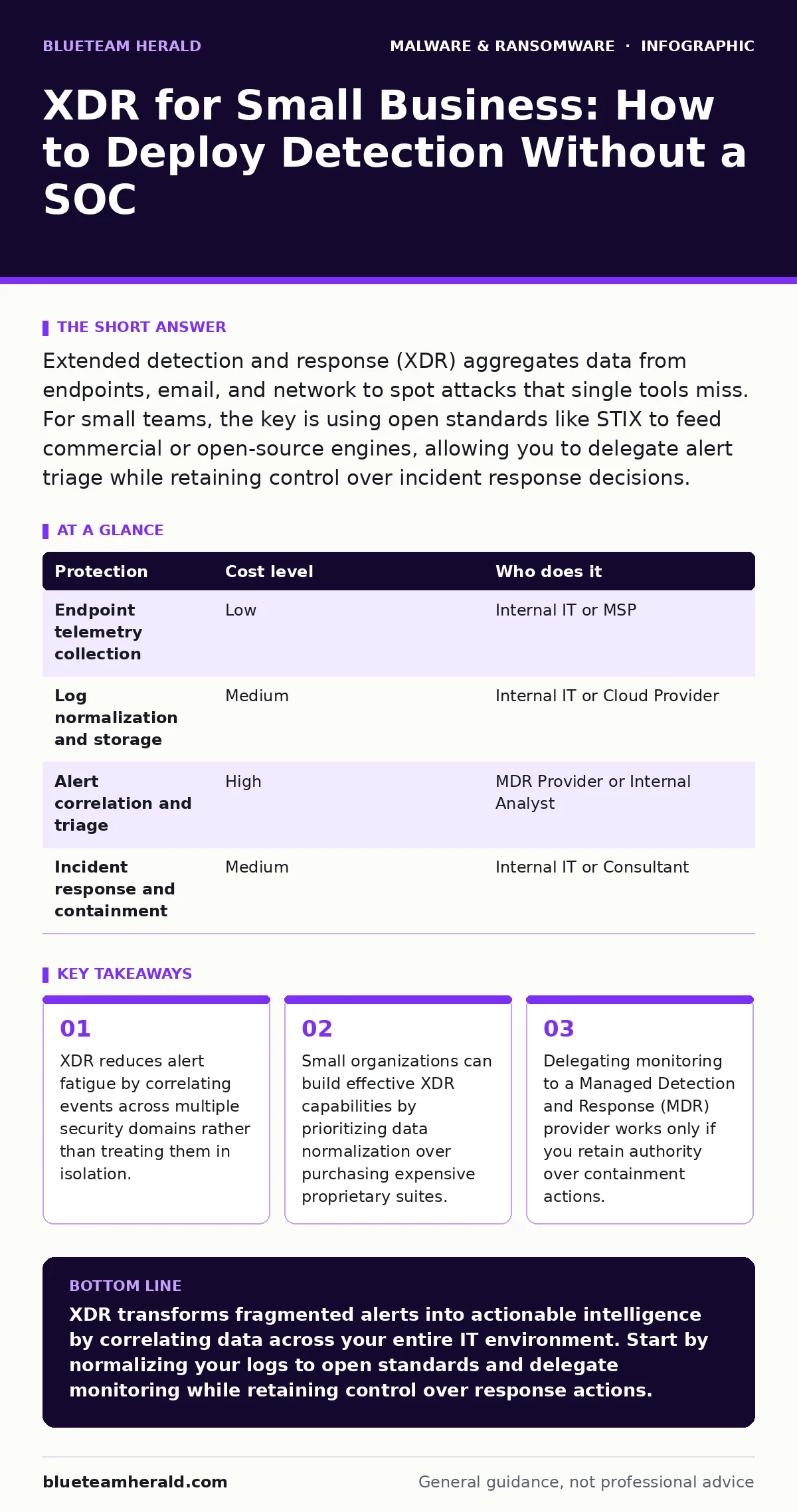
Extended detection and response (XDR) aggregates data from endpoints, email, and network to spot attacks that single tools miss. For small teams, the key is using open standards like STIX to feed commercial or open-source engines, allowing you to delegate alert triage while retaining control over incident response decisions.
The Correlation Gap in Small Operations
Most small businesses rely on point solutions. You have an antivirus scanner for your computers. You have a spam filter for your email. You have a firewall for your network. Each tool operates in a silo. They generate alerts based on their own limited view. This creates a false sense of security. You see green lights everywhere, but the lights do not talk to each other.
Extended detection and response (XDR) solves this by aggregating telemetry. Telemetry is data about system activity. XDR ingests data from endpoints, email, identity providers, and networks. It looks for patterns that span these domains. A single event is rarely an attack. A sequence of events across different systems often is. This is the core mechanism of XDR. It trades storage and processing power for context.
For a small team, the value is not just in detection. It is in reduction. You do not have time to investigate every false positive. XDR filters noise by requiring multiple signals to trigger a high-confidence alert. This allows you to focus on actual threats. It turns a flood of warnings into a manageable stream of incidents.
Building Detection on a Budget
You do not need to buy a proprietary XDR suite to get the benefits. Many commercial tools are expensive and complex. They often require dedicated staff to tune. You can achieve similar results by feeding open telemetry into a unified engine. This approach requires more initial setup but offers long-term flexibility.
Start by ensuring your devices send logs in a standard format. Syslog is a common standard for sending log messages. Many devices support it natively. If your devices do not, you may need a lightweight agent to collect and forward data. The goal is to get all data into one place. A SIEM (Security Information and Event Management) platform or an open-source XDR engine can serve as this central repository.
Consider the trade-off between convenience and cost. Proprietary XDR suites handle data normalization for you. They map different vendor formats to a common schema. Open-source solutions require you to write parsers or use existing ones. This takes time. It also gives you complete control over what data is collected and how it is analyzed. For a small team, this control can be a significant advantage. You can tailor the detection logic to your specific environment.
| Protection | Cost level | Who does it |
|---|---|---|
| Endpoint telemetry collection | Low | Internal IT or MSP |
| Log normalization and storage | Medium | Internal IT or Cloud Provider |
| Alert correlation and triage | High | MDR Provider or Internal Analyst |
| Incident response and containment | Medium | Internal IT or Consultant |
What to Delegate and What to Keep
Delegation is a strategic decision. You cannot delegate everything. If you hand over all security operations to a third party, you lose visibility. You become dependent on their processes and their definitions of normal. This creates a hidden risk. You may not know when your data is being accessed or exfiltrated until it is too late.
Delegate the monitoring. A Managed Detection and Response (MDR) provider can watch your logs twenty-four hours a day. They have analysts who specialize in threat hunting. They can spot anomalies that your small team might miss. They can also provide initial triage. They tell you if an alert is a true positive or a false alarm. This saves you time and reduces stress.
Do not delegate the response. You know your business better than anyone else. You know which systems are critical. You know who has access to sensitive data. You must retain the authority to make containment decisions. If an analyst recommends isolating a server, you should approve that action. This ensures that business continuity is considered. It also keeps you engaged in your own security posture.
The Hidden Cost of Context
XDR requires data. Lots of it. Collecting, storing, and analyzing data has a cost. This is not just about money. It is about complexity. The more data you collect, the more noise you generate. You must tune your detection rules to filter out benign activity. This tuning is an ongoing process. It requires expertise and time.
Many small teams underestimate this effort. They buy a tool and expect it to work out of the box. It does not. You must define what normal looks like for your environment. You must update these definitions as your business changes. If you add a new application, you must update your baselines. If you hire new staff, you must adjust your identity logs. This maintenance is the hidden cost of XDR.
To manage this cost, start small. Focus on the most critical data sources first. Endpoint data is usually the highest value. Email logs are also high value. Network data can be noisy and expensive to store. Prioritize based on your risk profile. If you handle sensitive customer data, identity logs are critical. If you run a web server, network logs are more important. Tailor your data collection to your specific threats.
Integrating Open Standards
Open standards are your friend. They allow different tools to work together. STIX (Structured Threat Information eXpression) is a standard for sharing threat intelligence. It allows you to import known indicators of compromise (IOCs) from various sources. You can use these IOCs to enhance your detection rules. This gives you visibility into threats that are currently active in the wild.
TAXII (Trusted Automated eXchange of Indicator Information) is a protocol for transporting STIX data. It allows you to subscribe to threat feeds. You can automate the ingestion of these feeds into your XDR platform. This keeps your detection rules up to date without manual effort. It is a low-cost way to improve your detection capabilities.
You can also use open standards for your own data. Export your logs in a standard format. This makes it easier to switch tools in the future. It also allows you to use multiple analysis tools. You are not locked into a single vendor. This flexibility is valuable for small businesses. It allows you to adapt to changing needs and budgets.
Questions for Your IT Provider
If you work with an IT provider or Managed Service Provider (MSP), you need to ask the right questions. Many providers offer basic security services. They may not have the expertise to implement true XDR. You need to verify their capabilities. Do not assume that "security monitoring" means XDR.
Ask about data retention. How long do they keep your logs? XDR requires historical data to detect slow-moving attacks. If they only keep logs for thirty days, you are vulnerable to attacks that take longer to detect. Ask about data normalization. Do they map your logs to a common schema? This is essential for correlation. If they do not, they are likely using point solutions.
Ask about their response procedures. What do they do when they detect a threat? Do they just send you an alert? Or do they take action? If they take action, what is their authority? Do they have the ability to isolate systems? Do they have the ability to reset passwords? You need to understand their role in the incident response process.
- Does your provider use a common data schema for all logs?
- How long do you retain historical telemetry for retrospective analysis?
- What is your specific process for validating an alert before contacting the client?
- Do you provide raw access to the detection engine for our internal review?
- How do you handle false positives to prevent alert fatigue?
Beyond Signatures and Heuristics
Traditional antivirus relies on signatures. A signature is a unique pattern in a known malware file. This works for known threats. It fails against new or modified malware. Heuristic detection looks for suspicious behavior. It is better but generates more false positives. XDR goes further. It uses behavior-based detection across multiple domains.
Imagine an attacker uses a legitimate tool to move data. This is a "living off the land" technique. Antivirus will not flag it. Heuristics might flag the tool usage. XDR can flag the combination of tool usage, unusual network traffic, and data exfiltration. This is the power of correlation. It detects attacks that evade single-domain defenses.
You should also consider dynamic malware analysis. This involves running suspicious files in a sandbox to observe their behavior. While not strictly XDR, it complements it. XDR can trigger sandbox analysis for suspicious files. This provides deeper insight into the threat. It helps you understand the full scope of the attack. This is particularly useful for detecting advanced threats like infostealers or web shells.
Key takeaways
- XDR reduces alert fatigue by correlating events across multiple security domains rather than treating them in isolation.
- Small organizations can build effective XDR capabilities by prioritizing data normalization over purchasing expensive proprietary suites.
- Delegating monitoring to a Managed Detection and Response (MDR) provider works only if you retain authority over containment actions.
XDR transforms fragmented alerts into actionable intelligence by correlating data across your entire IT environment. Start by normalizing your logs to open standards and delegate monitoring while retaining control over response actions.
Frequently asked questions
Do I need a dedicated security team to use XDR?
No, but you need someone to manage the data flow and tune detection rules. Many small teams use MDR providers to handle the monitoring aspect.
Can I use open-source tools for XDR?
Yes, platforms like Wazuh or Elastic Security can serve as XDR engines if you feed them normalized telemetry from your endpoints and network.
How is XDR different from EDR?
EDR focuses only on endpoints. XDR aggregates data from endpoints, email, cloud, and network, providing a broader view of the attack surface.
What is the biggest risk of delegating XDR to an MSP?
The biggest risk is loss of visibility and control. Ensure you retain access to raw logs and the authority to approve containment actions.
How this guide was produced: written by the BlueTeam Herald editorial team with AI assistance, checked against the public references listed below, and reviewed when the facts change. See our editorial policy or report an error.