Heuristic Detection Best Practices for Lowering False Positives
Heuristic detection flags anomalies rather than exact matches, making configuration and context more valuable than raw sensitivity settings.

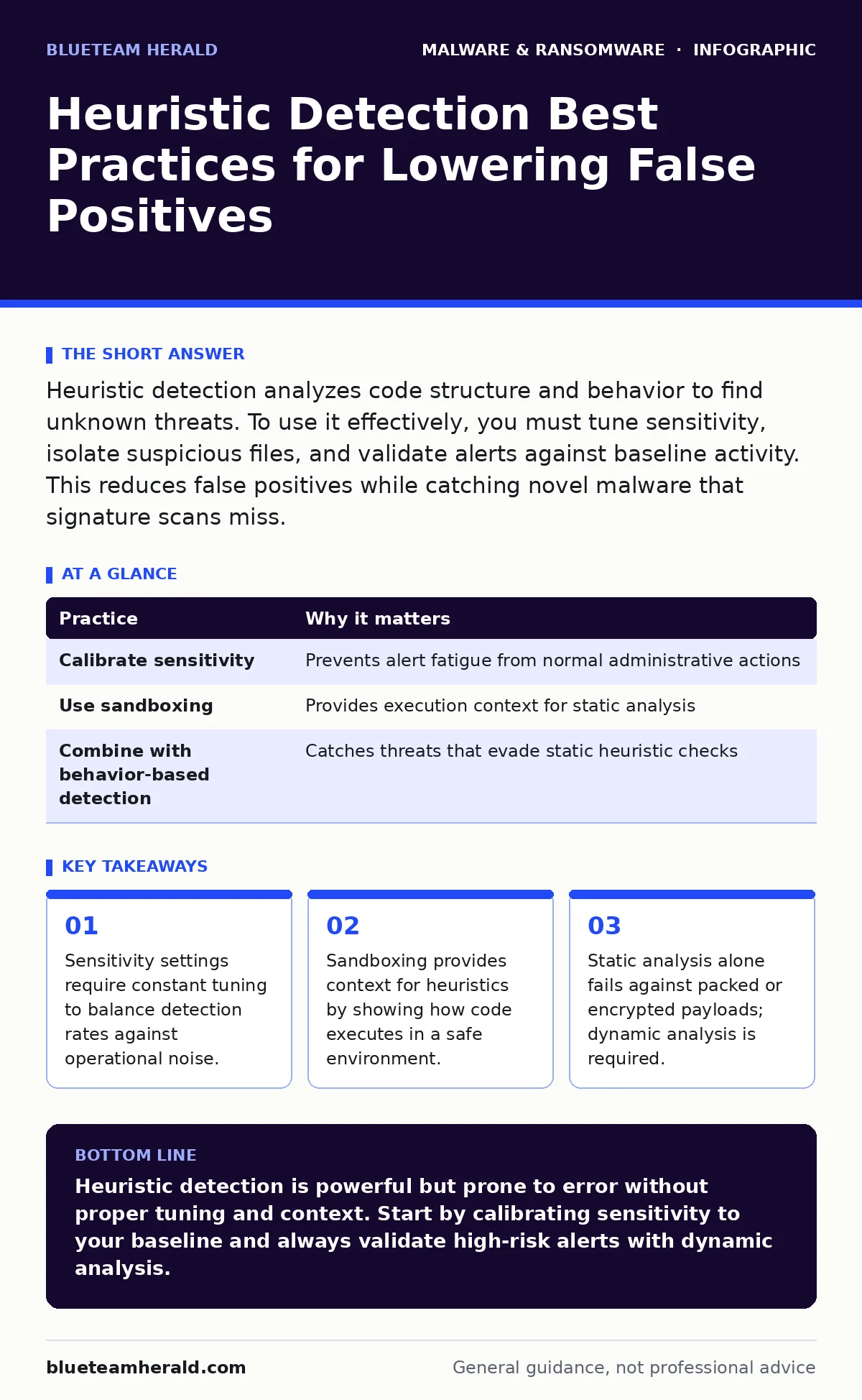
Heuristic detection analyzes code structure and behavior to find unknown threats. To use it effectively, you must tune sensitivity, isolate suspicious files, and validate alerts against baseline activity. This reduces false positives while catching novel malware that signature scans miss.
Defining the Scope of Heuristic Analysis
Heuristic detection identifies threats by analyzing characteristics rather than matching known patterns. Unlike signature-based methods that compare file hashes against a database, heuristics look for suspicious logic, unusual system calls, or structural anomalies. This approach allows security teams to catch novel malware before a signature exists.
However, this flexibility introduces a significant trade-off: the risk of false positives. A legitimate script might exhibit behavior similar to a malicious one if the heuristic rules are too broad. You must understand that heuristics are probabilistic, not deterministic. They suggest a file is likely malicious, but they do not prove it with the certainty of a cryptographic match.
1. Calibrate Sensitivity to Baseline Behavior
The most common failure in heuristic detection is setting sensitivity too high without understanding the environment. High sensitivity catches more threats but generates alerts for normal administrative tasks or specialized software. You must establish a baseline of normal activity for your specific systems. This baseline defines what "normal" looks like for your users and applications. Adjust heuristic thresholds so that only deviations from this baseline trigger alerts.
| Practice | Why it matters |
|---|---|
| Calibrate sensitivity | Prevents alert fatigue from normal administrative actions |
| Use sandboxing | Provides execution context for static analysis |
| Combine with behavior-based detection | Catches threats that evade static heuristic checks |
2. Isolate Suspicious Files for Dynamic Analysis
Static heuristic analysis examines the file code without running it. This method struggles with packed or encrypted malware payloads that hide their true intent until execution. When a heuristic engine flags a file, you should not rely on that single verdict. Instead, move the file to an isolated environment for dynamic malware analysis. This process runs the file in a controlled sandbox to observe its actual behavior. You can see if it attempts to modify system files, connect to command-and-control servers, or encrypt data. This step confirms whether the heuristic flag was a true positive or a false alarm.
3. Contextualize Alerts with User Activity
A file flagged as heuristic-malicious might be benign if the user is a developer testing code. Without context, every heuristic alert looks like a breach. You must correlate heuristic alerts with user identity, role, and recent activity. If a software engineer downloads a suspicious-looking script, the risk profile differs from a finance clerk downloading the same file. Integrate your heuristic engine with identity management systems. This allows you to apply different heuristic rules based on user risk profiles. A high-privilege account might trigger stricter heuristics than a standard user account.
4. Integrate Behavior-Based Detection Layers
Heuristics often focus on static code structure or short-term behavior. Some threats, like infostealers or spyware, operate quietly to avoid detection. They may not exhibit the aggressive behavior that triggers high-sensitivity heuristics. Layer behavior-based detection on top of your heuristic engine. This layer monitors long-term patterns, such as data exfiltration rates or unusual login times. While heuristics catch the initial entry, behavior-based detection catches the persistence and lateral movement. This combination ensures that threats which slip past static heuristics are caught by their operational footprint.
See also: Reimaging Infected Computers: 6 Misunderstandings That Leave Threats Behind · EDR vs MDR: The Critical Difference in Endpoint Security
5. Validate Against Known Safe Signatures
Even advanced heuristics can misidentify legitimate software updates or system drivers. You must maintain a whitelist of known safe signatures to suppress false positives. These signatures act as an exemption list for files that have been manually verified as safe. This step reduces the volume of alerts your analysts must review. However, you must update this whitelist regularly. A file that is safe today might be compromised tomorrow. Relying on static whitelists without periodic review creates a blind spot for supply chain attacks.
6. Monitor for Evasion Techniques
Attackers know that heuristic engines look for specific patterns. They use obfuscation, packing, and encryption to break up these patterns. This is where static heuristics fail most often. You must monitor for files that exhibit high entropy or unusual compression ratios. These characteristics often indicate that the code is hidden or transformed. Adjust your heuristics to flag files with high entropy for manual review or deep scanning. This practice catches threats that attempt to disguise their structure to bypass initial heuristic checks.
7. Automate Response for High-Confidence Alerts
Manual review of every heuristic alert is unsustainable. High-confidence heuristic matches, especially those correlated with known malicious indicators, should trigger automated responses. This might include isolating the endpoint, blocking the network connection, or quarantining the file. Automation speeds up containment, which is critical for fast-spreading threats like ransomware. However, you must limit automation to high-confidence scenarios to avoid disrupting business operations. Low-confidence alerts should always require human validation before action is taken.
8. Regularly Review and Tune Rules
Heuristic rules are not set-and-forget. The software landscape changes, and so does attacker behavior. You must schedule regular reviews of your heuristic rules and their performance metrics. Look for rules that generate high volumes of false positives or miss known threats. Adjust the logic or retire rules that no longer provide value. This iterative process keeps your detection capabilities aligned with current threats. It also ensures that your heuristic engine does not become a source of operational noise.
9. Leverage Extended Detection and Response (XDR)
XDR platforms aggregate data from endpoints, networks, and clouds. They provide a broader context for heuristic alerts than isolated tools can offer. When a heuristic engine flags a file, XDR can show if other endpoints are exhibiting similar behavior. This correlation helps distinguish between isolated false positives and coordinated attacks. It also helps identify the source of the threat. Integrating heuristics into an XDR framework improves both detection accuracy and response speed. It turns individual alerts into actionable intelligence.
Key takeaways
- Sensitivity settings require constant tuning to balance detection rates against operational noise.
- Sandboxing provides context for heuristics by showing how code executes in a safe environment.
- Static analysis alone fails against packed or encrypted payloads; dynamic analysis is required.
Heuristic detection is powerful but prone to error without proper tuning and context. Start by calibrating sensitivity to your baseline and always validate high-risk alerts with dynamic analysis.
Frequently asked questions
How do heuristics differ from signatures?
Signatures match exact known patterns, while heuristics analyze behavior and structure to find unknown threats.
Can heuristics detect zero-day malware?
Yes, heuristics can flag zero-day threats by identifying suspicious behavior or code structure before a signature exists.
Why are false positives common in heuristic detection?
Heuristics use broad rules that can mistakenly flag legitimate software with similar characteristics to malware.
Should I use heuristics on all endpoints?
Use heuristics on all endpoints, but adjust sensitivity based on the criticality and function of each device.
How this guide was produced: written by the BlueTeam Herald editorial team with AI assistance, checked against the public references listed below, and reviewed when the facts change. See our editorial policy or report an error.