EDR vs MDR: The Critical Difference in Endpoint Security
Endpoint Detection and Response tools generate alerts, but only Managed Detection and Response services provide the human analysts required to investigate and remediate those threats.

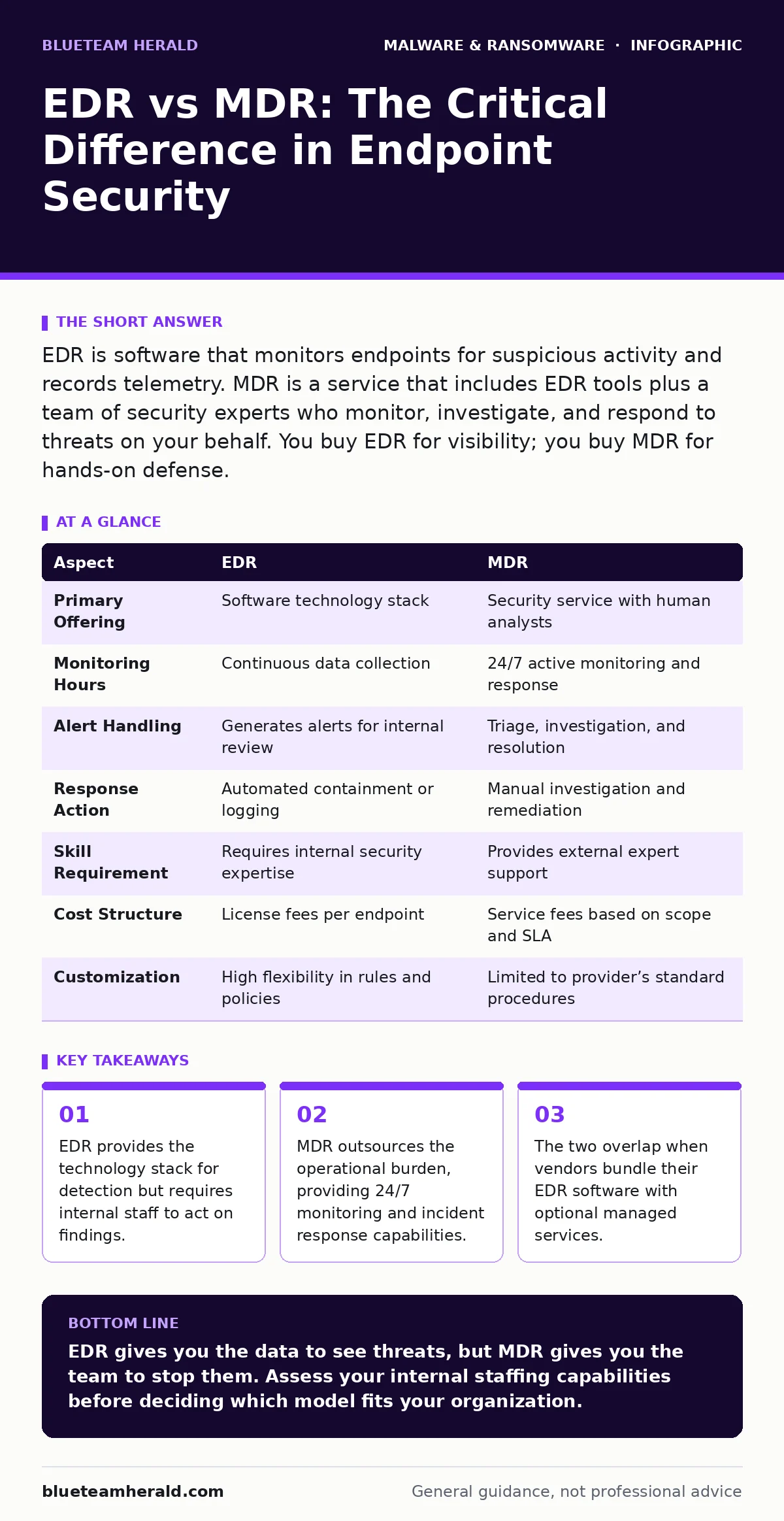
EDR is software that monitors endpoints for suspicious activity and records telemetry. MDR is a service that includes EDR tools plus a team of security experts who monitor, investigate, and respond to threats on your behalf. You buy EDR for visibility; you buy MDR for hands-on defense.
The Core Distinction Between Tool and Service
The fundamental difference lies in who handles the alert. Endpoint Detection and Response (EDR) is a software agent installed on devices to record activity. It captures process executions, network connections, and file changes. This data allows you to see what happened, but it does not tell you what to do. You must have personnel to review the data and take action.
Managed Detection and Response (MDR) is a security service. It uses EDR-like technology to gather data, but it adds a layer of human expertise. A third-party team monitors your environment around the clock. When they spot something malicious, they investigate it and often take steps to contain the threat. You pay for the outcome, not just the visibility.
How EDR Functions as a Visibility Layer
EDR solutions focus on continuous monitoring and data collection. The agent runs in the background of your operating system. It watches for anomalies that deviate from normal behavior. This approach relies on behavior-based detection rather than just known patterns.
Imagine a script runs that encrypts files rapidly. An EDR tool sees the rapid file modification and flags it. It records the parent process, the command line arguments, and the network connections. It may block the action if configured to do so. However, it does not determine if the script is a false positive. It does not check if the user is an administrator performing a legitimate task. That judgment call remains with your internal security team.
How MDR Adds Human Expertise
MDR services solve the problem of alert fatigue. Security teams often face hundreds of alerts daily. Many are noise. MDR providers use automation to filter low-value alerts. They then have analysts review the remaining high-priority events.
These analysts look at the context. They correlate events across multiple endpoints. They determine if an attack is isolated or spreading. If they confirm a breach, they provide a report. Many MDR contracts include containment actions. The provider might isolate a compromised laptop from the network. They might kill a malicious process. This hands-on response is the key differentiator. You are buying their time and skill, not just their software.
Point-by-Point Comparison
| Aspect | EDR | MDR |
|---|---|---|
| Primary Offering | Software technology stack | Security service with human analysts |
| Monitoring Hours | Continuous data collection | 24/7 active monitoring and response |
| Alert Handling | Generates alerts for internal review | Triage, investigation, and resolution |
| Response Action | Automated containment or logging | Manual investigation and remediation |
| Skill Requirement | Requires internal security expertise | Provides external expert support |
| Cost Structure | License fees per endpoint | Service fees based on scope and SLA |
| Customization | High flexibility in rules and policies | Limited to provider’s standard procedures |
Where the Lines Blur
Many vendors offer both products. You might buy an EDR license and add MDR as a premium tier. In this case, the software is the same. The difference is the service level agreement. Some providers call this Unified Detection and Response. They combine endpoint data with cloud and email data.
This overlap can confuse buyers. Check the contract details. Does the vendor promise to investigate every alert? Or do they only escalate critical ones? Some "managed" services only provide triage. They tell you what is bad but leave the fixing to you. True MDR includes remediation. If the provider does not touch your systems to stop an attack, it is not full MDR.
See also: Alert Triage Mistakes and Fixes for Security Analysts · 7 PowerShell Mistakes That Leave Your Network Exposed
Choosing the Right Approach
Choose EDR when you have a mature security operations center. Your team needs deep visibility into endpoint activity. You want to build custom detection rules. You have the staff to monitor alerts during business hours. You prefer to keep all data and control in-house. This path requires significant investment in training and hiring.
Choose MDR when you lack 24/7 staffing. You need expert eyes on your network immediately. You want to reduce the burden on your IT team. You are concerned about ransomware or other advanced threats that require rapid response. MDR is also useful for organizations undergoing a security transformation. It provides immediate protection while you build internal capabilities.
Integrating with Broader Security Practices
EDR and MDR are not standalone solutions. They work best when integrated with other controls. For example, dynamic malware analysis can help verify suspicious files before they reach endpoints. This reduces the noise that EDR tools must process.
You should also consider ransware recovery plans. Detection and response prevent damage, but they do not guarantee zero data loss. If an attacker bypasses your defenses, you need a plan to restore systems. MDR providers can assist with the initial containment, but recovery is your responsibility.
Understanding malware signatures is still relevant. While heuristic detection finds new threats, signatures catch known ones quickly. EDR tools use both methods. MDR analysts use this data to confirm attacks. They look for known indicators of compromise alongside behavioral anomalies.
The Hidden Cost of Complexity
There is a trade-off in both models. EDR requires deep technical knowledge. If your team cannot interpret the data, the tool is useless. You pay for the license but gain little protection. This is a common failure mode for organizations that buy tools without skills.
MDR reduces the skill gap but introduces dependency. You rely on an external team to protect your assets. If their analysts are slow or misinterpret an event, you suffer. You also lose some control. You cannot always dictate exactly how they investigate. You must trust their judgment. This trust is earned through clear service level agreements and regular reporting.
Final Considerations for Implementation
Both EDR and MDR require proper configuration. An EDR tool with weak rules generates noise. An MDR service with poor integration misses context. You must define your baseline of normal behavior. This helps both tools and analysts distinguish between routine activity and attacks.
You should also consider spyware and other stealthy threats. These often evade simple signature checks. Behavioral monitoring is key. Both EDR and MDR excel here, but only MDR guarantees someone is watching the behavior in real-time. Ensure your choice aligns with your threat model. If you face targeted attacks, the human element of MDR is valuable. If you face mass malware, EDR automation may suffice.
Key takeaways
- EDR provides the technology stack for detection but requires internal staff to act on findings.
- MDR outsources the operational burden, providing 24/7 monitoring and incident response capabilities.
- The two overlap when vendors bundle their EDR software with optional managed services.
EDR gives you the data to see threats, but MDR gives you the team to stop them. Assess your internal staffing capabilities before deciding which model fits your organization.
Frequently asked questions
Can I use EDR without MDR?
Yes, if you have the internal staff to monitor alerts and respond to incidents. Many organizations use EDR as part of a broader security stack.
Does MDR replace my security team?
No, MDR supplements your team. You still need internal staff to manage the technology and coordinate with the provider. It reduces the burden but does not eliminate the need for security expertise.
Is MDR more expensive than EDR?
Typically, yes. MDR includes human labor and 24/7 monitoring, which adds significant cost. However, it may be cheaper than hiring a full internal security operations center.
How do I choose between EDR and MDR?
Choose based on your staffing and skill levels. If you lack 24/7 coverage or specialized analysts, MDR is often the better choice. If you have a mature team, EDR offers more control.
How this guide was produced: written by the BlueTeam Herald editorial team with AI assistance, checked against the public references listed below, and reviewed when the facts change. See our editorial policy or report an error.