Ransomware Myths Debunked: The Hidden Truths About Encryption Attacks
Backup isolation and application control matter more than antivirus signatures when preventing ransomware from locking your files and demanding payment.

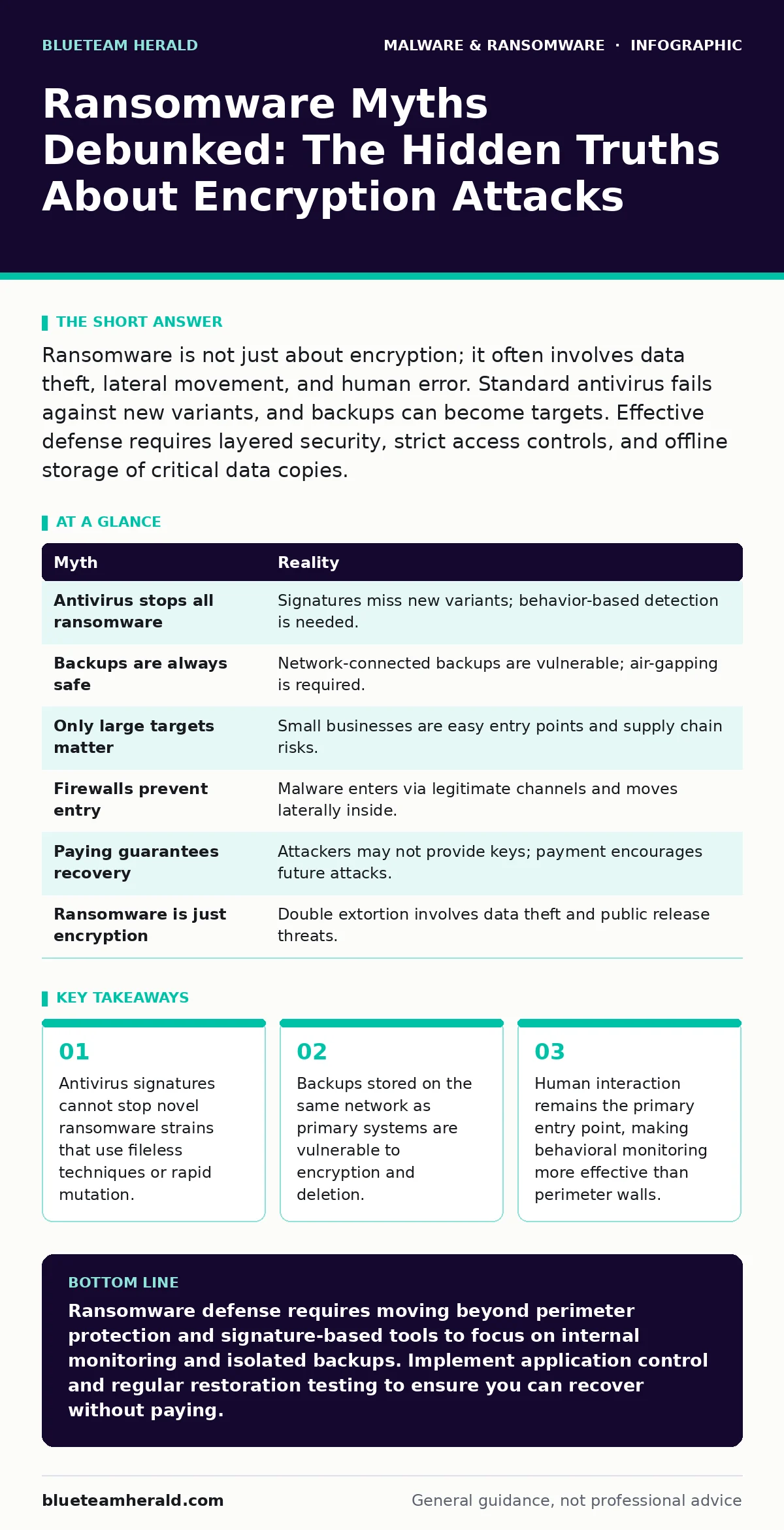
Ransomware is not just about encryption; it often involves data theft, lateral movement, and human error. Standard antivirus fails against new variants, and backups can become targets. Effective defense requires layered security, strict access controls, and offline storage of critical data copies.
Myth: Antivirus Software Stops All Ransomware
Reality: Modern antivirus solutions rely heavily on malware signatures, which are unique digital fingerprints of known threats. When a new ransomware variant appears, it lacks a signature until security vendors analyze and catalog it. This creates a window of vulnerability where the malware operates freely.
Attackers often use polymorphic code, which changes its appearance slightly with each infection while keeping the same function. This technique bypasses signature-based detection because the digital fingerprint never matches the database. You might feel safe with updated antivirus, but you are only protected against yesterday’s threats.
To address this gap, many organizations adopt behavior-based detection. This method monitors for suspicious actions, such as rapid file encryption or unusual process creation, rather than looking for specific code. It catches the intent of the attack, even if the tool itself is new. However, this approach can generate false positives if legitimate software behaves aggressively.
Myth: Backups Are an Untouchable Safety Net
Reality: Many users assume that having backups guarantees recovery. This belief fails when backups are connected to the same network as the infected workstation. Ransomware does not just encrypt files on your desktop; it scans the network for any accessible storage.
If your backup drive is mounted or accessible via the network, the malware treats it as just another set of files. It encrypts the backups and deletes shadow copies, leaving you with no clean restore point. The attacker knows this and often targets backup infrastructure specifically to ensure you have no choice but to pay.
True resilience requires air-gapped backups. These are copies stored on media that is physically disconnected from the network when not in use. Even if the network is compromised, the attacker cannot reach the isolated drive. You must also test restoration procedures regularly to ensure the backups are not corrupted or incomplete.
Myth: Ransomware Only Targets Large Corporations
Reality: Attackers prioritize targets based on willingness and ability to pay, not just size. Small businesses and individual users often have weaker security hygiene, making them easier entry points. The financial impact of downtime can force smaller entities to pay quickly, as they lack the resources for prolonged recovery.
Furthermore, attackers use supply chain compromises to reach larger targets. They infect a smaller vendor with poor security, then use that vendor’s access to move laterally into the larger organization. You might think you are too small to matter, but you could be the stepping stone for a major breach.
This dynamic means that even if you are a small team, your security posture affects others. Implementing basic hygiene, such as multi-factor authentication and regular patching, protects not just you but the broader ecosystem you interact with.
Myth: Firewalls Keep Ransomware Out
Reality: Firewalls filter network traffic based on rules, blocking known bad IP addresses or ports. However, ransomware often enters through legitimate channels. An email attachment from a trusted contact or a download from a reputable website can carry the initial payload.
Once inside, the malware operates on the internal network. Firewalls are designed to protect the perimeter, not to monitor internal lateral movement. The attacker moves from the infected endpoint to shared drives and servers, encrypting data without ever crossing the firewall boundary again.
This is where extended detection and response (XDR) becomes valuable. XDR correlates data from endpoints, networks, and cloud services to detect anomalies. It looks for the chain of events that leads to encryption, rather than just blocking inbound traffic. This holistic view is necessary because modern attacks are multi-stage and persistent.
Myth: Paying the Guarantee Recovery
Reality: There is no guarantee that paying the ransom will result in file recovery. Attackers may provide a decryption key that does not work, or they may disappear after receiving payment. You are dealing with criminals who operate outside the law and have no incentive to honor agreements.
Moreover, paying encourages further attacks. It signals that you are willing to pay, making you a target for secondary extortion or repeated attacks. Some groups sell stolen data even after payment, using the threat of public release to extract more money.
This uncertainty makes ransomware recovery plans critical. These plans outline steps to restore systems from clean backups, communicate with stakeholders, and report the incident to authorities. Having a predefined process reduces panic and ensures a structured response, regardless of whether you choose to pay or not.
Myth: Ransomware Is Just About Encryption
Reality: While encryption is the most visible symptom, modern ransomware often includes data theft. Attackers exfiltrate sensitive information before encrypting files, creating a double extortion scenario. They threaten to publish or sell the data if you do not pay, adding pressure beyond system downtime.
This shift changes the attack surface. Even if you can restore encrypted files from backups, the stolen data remains a risk. You may face regulatory fines, reputational damage, or legal action from affected individuals. The goal is no longer just to lock you out, but to compromise your privacy and trust.
Understanding this dual threat requires a different defensive posture. You must monitor for data exfiltration attempts, not just encryption activity. This includes watching for large outbound data transfers or connections to unknown cloud storage services.
| Myth | Reality |
|---|---|
| Antivirus stops all ransomware | Signatures miss new variants; behavior-based detection is needed. |
| Backups are always safe | Network-connected backups are vulnerable; air-gapping is required. |
| Only large targets matter | Small businesses are easy entry points and supply chain risks. |
| Firewalls prevent entry | Malware enters via legitimate channels and moves laterally inside. |
| Paying guarantees recovery | Attackers may not provide keys; payment encourages future attacks. |
| Ransomware is just encryption | Double extortion involves data theft and public release threats. |
Key takeaways
- Antivirus signatures cannot stop novel ransomware strains that use fileless techniques or rapid mutation.
- Backups stored on the same network as primary systems are vulnerable to encryption and deletion.
- Human interaction remains the primary entry point, making behavioral monitoring more effective than perimeter walls.
Ransomware defense requires moving beyond perimeter protection and signature-based tools to focus on internal monitoring and isolated backups. Implement application control and regular restoration testing to ensure you can recover without paying.
Frequently asked questions
Can ransomware infect mobile devices?
Yes, mobile ransomware exists but is less common than desktop variants. It often locks the screen or encrypts photos, demanding payment via cryptocurrency.
Is cloud storage safe from ransomware?
Cloud storage is safer if you use versioning and offline capabilities. However, if the attacker has access to your cloud credentials, they can delete or overwrite files.
How do infostealers relate to ransomware?
Infostealers capture credentials and session tokens, which attackers use to bypass security controls and deploy ransomware more effectively.
What is the role of web shells in ransomware attacks?
Web shells provide persistent access to servers, allowing attackers to move laterally and deploy ransomware even after initial access is removed.
How this guide was produced: written by the BlueTeam Herald editorial team with AI assistance, checked against the public references listed below, and reviewed when the facts change. See our editorial policy or report an error.