Vulnerability Management Programs: Definition, Purpose, and Core Mechanics
Vulnerability management is a continuous cycle of identification, prioritization, and remediation that treats risk as a dynamic variable rather than a static checklist.

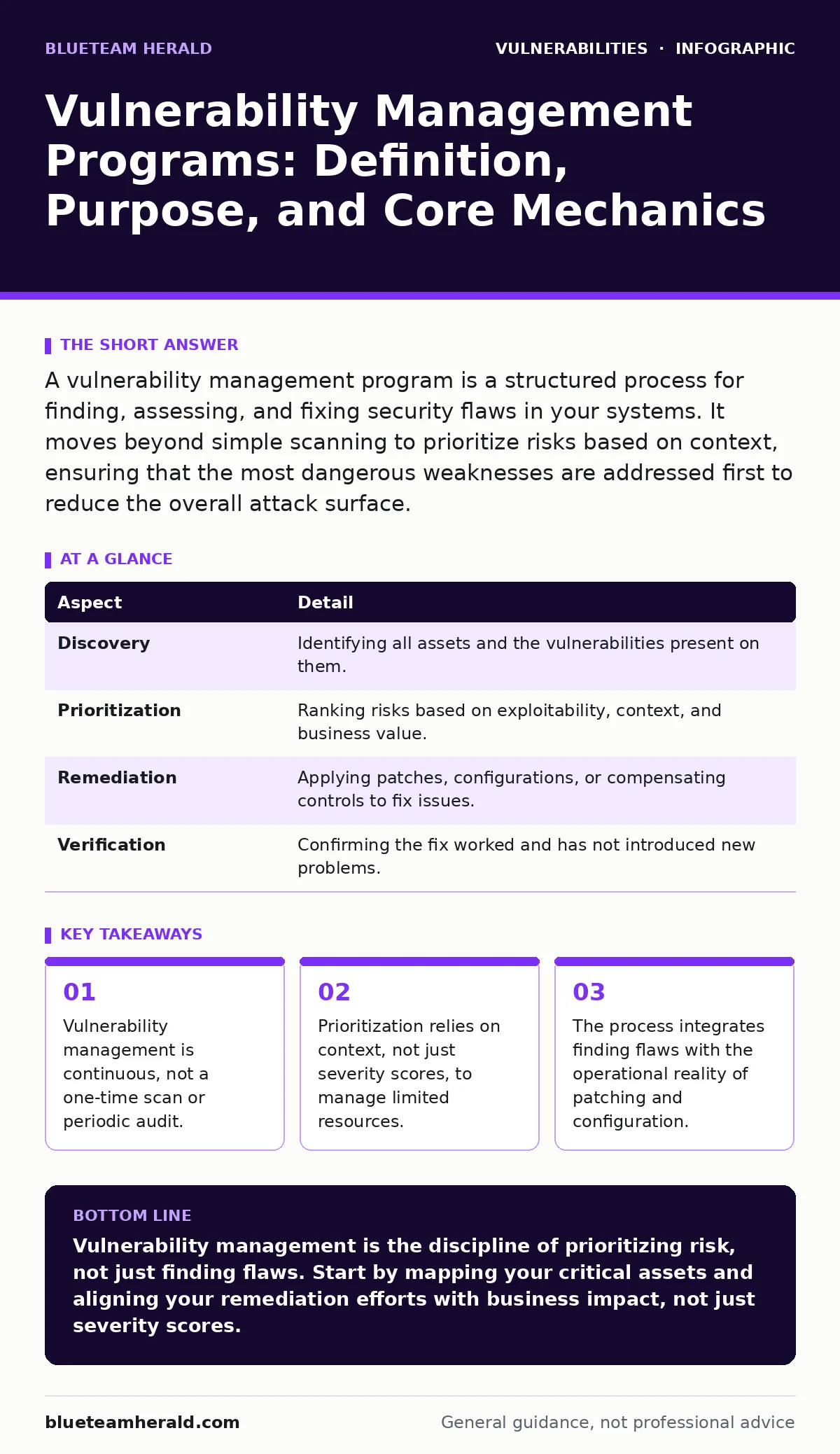
A vulnerability management program is a structured process for finding, assessing, and fixing security flaws in your systems. It moves beyond simple scanning to prioritize risks based on context, ensuring that the most dangerous weaknesses are addressed first to reduce the overall attack surface.
The Leak in the Dam
Imagine a dam holding back a reservoir. Inspecting the wall for cracks is like scanning for vulnerabilities. But finding a crack does not tell you if it will cause a flood. You must consider the water pressure, the width of the crack, and how close it is to the foundation. Vulnerability management is the engineering discipline that decides which cracks to seal first to prevent catastrophic failure. It transforms raw data about weaknesses into actionable risk decisions.
This distinction matters because most organizations treat security as a list of items to check off. They scan, find issues, and panic. A true program recognizes that not all flaws are equal. Some exist in systems that no one can reach. Others sit in the path of active threats. The goal is not zero vulnerabilities, which is impossible, but zero exploitable risk that matters to your specific environment.
What the Program Actually Solves
The core problem is noise. Modern systems contain thousands of components, each with potential flaws. If you treat every finding with equal urgency, you will burn out your team and miss the real threats. Vulnerability management solves the triage problem. It provides a framework to say "this is dangerous now" and "that can wait."
Without this structure, teams fall into reactive modes. They patch the easiest thing first, or the loudest alert, rather than the most critical risk. This leads to a false sense of security. You may have patched a minor issue in a test server while leaving a critical flaw in your public-facing database unaddressed. The program forces you to align technical findings with business impact.
Core Components of the Cycle
A functioning program operates in a loop, not a line. It consists of four distinct phases that feed into each other. Breaking any link in this chain renders the entire effort ineffective.
| Aspect | Detail |
|---|---|
| Discovery | Identifying all assets and the vulnerabilities present on them. |
| Prioritization | Ranking risks based on exploitability, context, and business value. |
| Remediation | Applying patches, configurations, or compensating controls to fix issues. |
| Verification | Confirming the fix worked and has not introduced new problems. |
Discovery is often the weakest link. You cannot manage what you do not know exists. This requires accurate inventory management, not just network scanning. If a server is off the network map, its vulnerabilities are invisible to your program. Prioritization requires more than a severity score. It requires understanding how that flaw interacts with your specific architecture.
Beyond the Severity Score
Many teams rely solely on standardized scoring systems to decide what to fix. These scores provide a baseline, but they lack context. A high score might apply to a feature that is disabled in your environment. Conversely, a medium score might apply to a service exposed to the internet with no authentication.
Context changes the risk profile. You must consider the asset’s exposure, the presence of compensating controls, and the likelihood of an exploit being developed. This is where the concept of attack vectors in CVSS becomes relevant. Understanding how an attacker reaches the flaw helps you determine if the theoretical risk is a practical one. If the vector requires physical access, the priority drops significantly for a remote-facing server.
The Remediation Gap
Finding a flaw is easy. Fixing it is hard. This is the operational reality that separates theory from practice. Remediation often requires coordination with system owners, change management boards, and testing teams. A patch might break a legacy application. A configuration change might disrupt a critical workflow.
This is why security misconfigurations are often harder to fix than software bugs. Misconfigurations are often baked into the design of the system. Changing them requires architectural decisions, not just a download. Your program must account for these delays. If a patch cannot be applied immediately, you must implement compensating controls. These are temporary measures, such as network segmentation or access restrictions, that reduce the risk until a permanent fix is possible.
See also: Unpatched Software Response: Containment, Recovery, and Prevention Steps
Where It Fits in Defense
Vulnerability management does not work in isolation. It is one layer of a broader defense strategy. It feeds into incident response by reducing the number of ways an attacker can enter. It supports compliance by providing evidence of due diligence. But it does not replace other controls.
For instance, input validation prevents many application-level attacks, such as command injection, by ensuring that data enters the system in a safe format. Even if a vulnerability exists, strong input validation can block the exploit. Similarly, keeping browser updates current reduces the risk of client-side attacks. Vulnerability management identifies the gaps; other controls fill them.
Common Misconceptions
There are several traps that undermine these programs. Recognizing them early saves time and resources.
- Scanning is Management: Running a scanner is not a program. It is a data collection step. Without analysis and action, the scan is just noise.
- Zero Risk is the Goal: This is impossible. New vulnerabilities appear daily. The goal is managed risk, not elimination.
- IT Owns It All: Security teams find the flaws, but IT and development teams must fix them. Ownership must be shared.
- Severity Equals Priority: As noted, context matters more than the raw score.
Integrating with Related Practices
To build a resilient posture, you must connect vulnerability management to other security disciplines. For example, understanding cross-site WebSocket hijacking requires knowledge of how your applications handle session tokens. A vulnerability scan might not catch this logic flaw. It requires application security testing.
Similarly, unpatched software is a symptom of poor change management, not just a lack of scanning. Your program should identify why patches are delayed. Is it technical debt? Is it lack of testing resources? Addressing the root cause improves the entire lifecycle.
The program also informs your threat modeling. If you know your most critical assets and their most likely vulnerabilities, you can tailor your detection rules. You are not looking for everything; you are looking for what matters. This focus improves signal-to-noise ratio in your monitoring tools.
The Continuous Reality
Vulnerability management is never finished. The moment you fix one flaw, another appears. New assets are added. Configurations drift. The program must be automated where possible and manual where necessary. Automation handles the repetitive scanning and reporting. Human judgment handles the prioritization and complex remediation.
You must measure effectiveness not by the number of scans, but by the mean time to remediate critical risks. This metric tells you if your process is working. If it is getting faster, you are improving. If it is stagnating, you have a process bottleneck.
Key takeaways
- Vulnerability management is continuous, not a one-time scan or periodic audit.
- Prioritization relies on context, not just severity scores, to manage limited resources.
- The process integrates finding flaws with the operational reality of patching and configuration.
Vulnerability management is the discipline of prioritizing risk, not just finding flaws. Start by mapping your critical assets and aligning your remediation efforts with business impact, not just severity scores.
Frequently asked questions
How often should I scan for vulnerabilities?
Scan continuously or at least daily for external assets. Internal assets can be scanned weekly, but critical systems should be checked immediately after changes.
Do I need vulnerability management if I use a cloud provider?
Yes. Cloud providers secure the infrastructure, but you are responsible for the configurations, applications, and data within that infrastructure.
How this guide was produced: written by the BlueTeam Herald editorial team with AI assistance, checked against the public references listed below, and reviewed when the facts change. See our editorial policy or report an error.