Attack Vectors in CVSS: Why Access Path Determines Your Risk
Attack vector metrics reveal the true difficulty of an exploit, preventing teams from wasting resources on threats that cannot reach their internal systems.

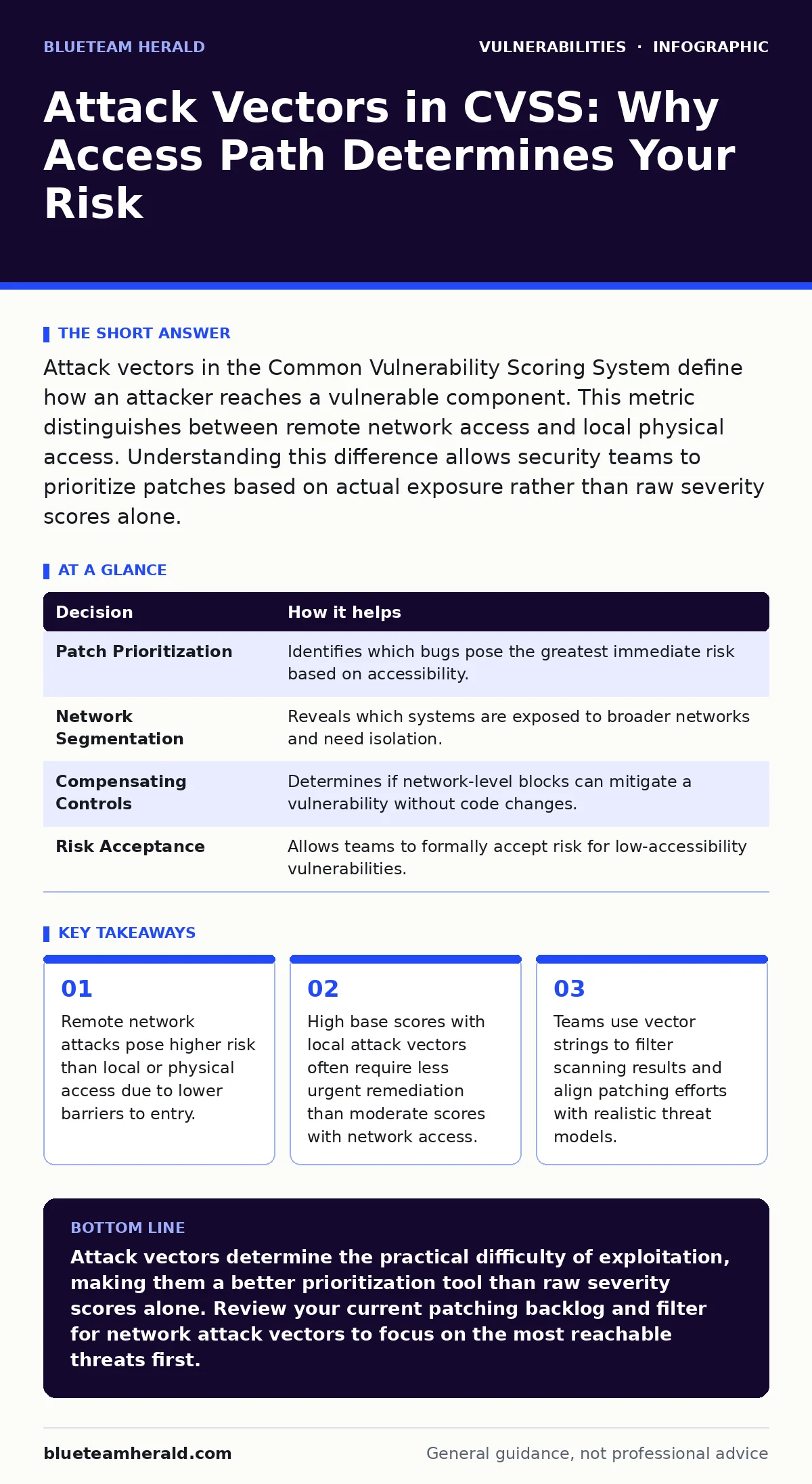
Attack vectors in the Common Vulnerability Scoring System define how an attacker reaches a vulnerable component. This metric distinguishes between remote network access and local physical access. Understanding this difference allows security teams to prioritize patches based on actual exposure rather than raw severity scores alone.
The Mechanics of Attack Path
The Common Vulnerability Scoring System provides a standardized method for rating the severity of computer security vulnerabilities. Within this framework, the attack vector metric defines the proximity required for an attacker to exploit a vulnerability. This specific element answers the question of how a malicious actor reaches the affected component.
Attack vectors are categorized into four distinct types. Network access allows exploitation from anywhere across the internet. Adjacent network access restricts the attacker to the same broadcast domain. Local access requires the attacker to have user-level access on the target system. Physical access mandates that the attacker be present at the same physical location as the vulnerable asset.
Understanding these categories changes how you interpret severity. A vulnerability with a score of nine might seem critical. However, if the attack vector is physical, the practical risk drops significantly for most organizations. The barrier to entry prevents casual exploitation.
Remote vs. Local Exposure
Network attack vectors carry the highest weight in scoring because they allow exploitation without prior access. An attacker can launch a request from any location with internet connectivity. This makes vulnerabilities with this vector highly attractive to threat actors.
Local attack vectors require the attacker to already have a foothold. This usually means they have compromised another service or tricked a user into running malicious code. The attack vector metric reflects this increased difficulty by assigning a lower impact on the final score.
This distinction matters for prioritization. If you treat a local privilege escalation bug the same as a remote code execution flaw, you misallocate your defensive resources. The local bug requires an existing breach. The remote bug can initiate one.
Decisions Informed by Vector Data
Security teams use attack vector data to make concrete decisions about resource allocation. The metric helps determine which vulnerabilities require immediate patching and which can be deferred. It also informs network segmentation strategies.
| Decision | How it helps |
|---|---|
| Patch Prioritization | Identifies which bugs pose the greatest immediate risk based on accessibility. |
| Network Segmentation | Reveals which systems are exposed to broader networks and need isolation. |
| Compensating Controls | Determines if network-level blocks can mitigate a vulnerability without code changes. |
| Risk Acceptance | Allows teams to formally accept risk for low-accessibility vulnerabilities. |
Without this data, teams often react to every high-score vulnerability equally. This leads to alert fatigue and burnout. You spend time fixing issues that attackers cannot easily reach while ignoring easier targets.
What Goes Wrong Without Context
Imagine a team that patches vulnerabilities solely based on their base score. They ignore the attack vector entirely. This approach creates a false sense of security. They might patch a complex local bug while leaving a simple remote bug unaddressed.
This misalignment leaves the organization exposed to the most likely threats. Attackers follow the path of least resistance. They will target the remote vulnerability because it requires no prior access. The team’s effort on the local bug yields no practical security benefit.
Furthermore, ignoring the attack vector obscures the true attack surface. You cannot accurately map your risk if you do not know which systems are reachable from untrusted networks. This leads to blind spots in your defense strategy.
How Teams Use Vector Strings
The CVSS vector string is a compact representation of the scoring metrics. It includes the attack vector as one of the first elements. Security tools parse this string to filter and sort vulnerability data. Teams use these strings to query their vulnerability management programs.
By filtering for network attack vectors, you can isolate vulnerabilities that are exploitable from the internet. This list becomes your primary focus for external-facing systems. You can then filter for local vectors to assess the risk of lateral movement.
This methodical approach integrates with vulnerability scanning outputs. Instead of looking at a raw list of CVEs, you look at a risk-adjusted list. You align your remediation efforts with the actual capabilities of potential attackers. This reduces noise and highlights actionable items.
Compensating Controls and Segmentation
Attack vector analysis drives the implementation of compensating controls. If a vulnerability has a network attack vector but resides on an isolated segment, the risk changes. You may not need to patch the software immediately if the network controls prevent access.
Network segmentation is a primary defense against network-based vectors. By placing sensitive systems in restricted zones, you effectively change the attack vector from network to local or physical. This reduces the likelihood of successful exploitation.
However, this strategy requires careful design. Misconfigurations in segmentation can expose internal systems. Regular audits of firewall rules and access lists are necessary. These audits ensure that the intended isolation remains effective over time.
The Hidden Cost of Automation
Automated tools often struggle with context. They report vulnerabilities based on static data. They do not know if a system is actually reachable from the internet. This leads to false positives in risk assessment.
Teams that rely solely on automation may overestimate their risk. They see a network vector and assume exposure. In reality, the system might be behind a strict firewall. This discrepancy creates unnecessary work.
Manual review is still required to validate the context. You must verify the actual network position of each asset. This step adds time to the process but ensures accuracy. It prevents the team from chasing ghosts.
Integrating with Security Lifecycle
Attack vector awareness must be part of the broader security lifecycle. It influences how you write code, how you configure systems, and how you respond to incidents. It is not just a metric for post-discovery prioritization.
Developers can use this knowledge to design better defenses. Knowing that remote vectors are most dangerous, they can implement strict input validation and authentication. This reduces the likelihood of remote exploitation.
Security regression testing should include checks for network exposure. New features must not inadvertently expose internal services to the public internet. This proactive approach prevents the introduction of high-risk vectors.
Key takeaways
- Remote network attacks pose higher risk than local or physical access due to lower barriers to entry.
- High base scores with local attack vectors often require less urgent remediation than moderate scores with network access.
- Teams use vector strings to filter scanning results and align patching efforts with realistic threat models.
Attack vectors determine the practical difficulty of exploitation, making them a better prioritization tool than raw severity scores alone. Review your current patching backlog and filter for network attack vectors to focus on the most reachable threats first.
Frequently asked questions
Does a network attack vector always mean higher severity?
Not always, but it significantly increases the base score. Other factors like exploitability and impact also determine the final score, but network access lowers the barrier to entry.
How do I find the attack vector for a vulnerability?
Look at the CVSS vector string associated with the CVE. The first metric listed is the attack vector, usually abbreviated as AV:N for network or AV:L for local.
Can compensating controls change the attack vector?
They can effectively change the accessibility. Placing a system behind a firewall may change a network vector to an adjacent or local vector in practice, reducing risk.
Is CVSS the only metric I should use?
No. CVSS provides a standardized score, but you must combine it with context-specific data like asset criticality and exploit availability.
How this guide was produced: written by the BlueTeam Herald editorial team with AI assistance, checked against the public references listed below, and reviewed when the facts change. See our editorial policy or report an error.