Authentication Bypass Vulnerabilities: How They Work and How to Fix Them
Authentication bypass flaws often stem from predictable logic errors in code rather than complex cryptographic weaknesses, allowing attackers to skip identity checks entirely.

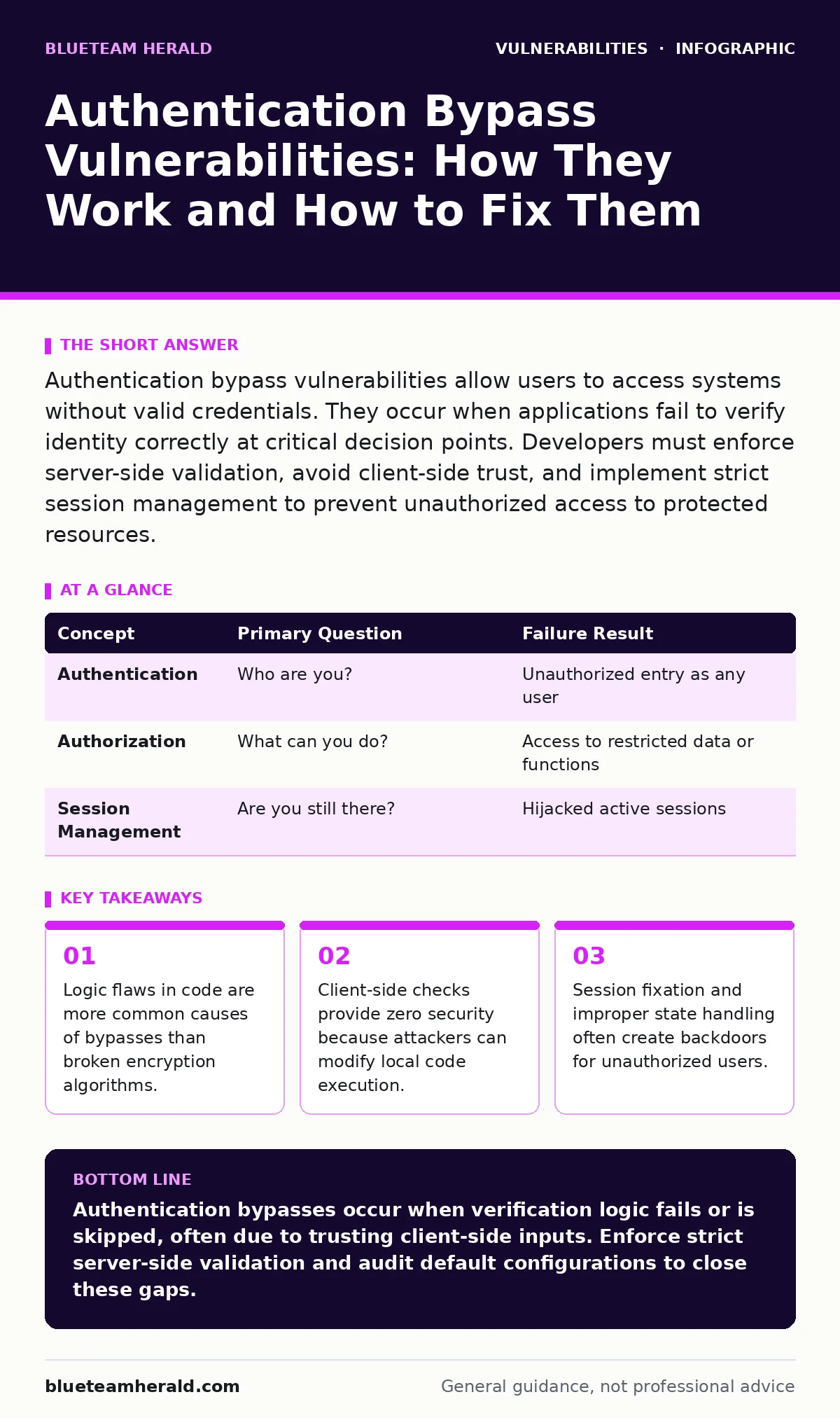
Authentication bypass vulnerabilities allow users to access systems without valid credentials. They occur when applications fail to verify identity correctly at critical decision points. Developers must enforce server-side validation, avoid client-side trust, and implement strict session management to prevent unauthorized access to protected resources.
What defines an authentication bypass vulnerability?
An authentication bypass vulnerability allows an attacker to access a system or data without providing valid credentials. This flaw occurs when the application fails to verify the identity of the user before granting access to protected resources. The system essentially trusts the requestor without proof, treating unauthenticated inputs as legitimate actions. This differs from weak passwords, where credentials exist but are easily guessed. Here, the verification step is missing, flawed, or circumvented entirely.
Why do developers accidentally create these bypasses?
Developers create these bypasses by trusting client-side inputs or implementing incomplete logic flows. A common error occurs when a developer places a security check in the user interface code rather than on the server. The server processes the request regardless of the interface state because it lacks its own validation layer. Another cause is inconsistent error handling, where the system defaults to allowing access when a verification step fails unexpectedly. This design choice prioritizes availability over security, creating a silent backdoor.
How do attackers exploit logic flaws in login forms?
Attackers exploit logic flaws by manipulating the parameters sent during the login process. Suppose the application checks if the username is correct and then checks if the password is correct separately. An attacker might submit a request that only triggers the first check. If the code does not require both checks to pass before granting access, the attacker enters with just the username. This is known as a logical flaw in the authentication chain. The application accepts partial success as total success, bypassing the need for the secret credential.
What is the difference between authentication and authorization?
Authentication verifies who you are, while authorization determines what you are allowed to do. Authentication bypass skips the identity check entirely, letting anyone in as if they were a valid user. Authorization flaws occur after identity is proven, allowing a user to access resources they should not see. Confusing these two concepts leads to insecure designs. A system might correctly identify a user but fail to restrict their actions based on their role. Both require distinct security controls to function properly.
| Concept | Primary Question | Failure Result |
|---|---|---|
| Authentication | Who are you? | Unauthorized entry as any user |
| Authorization | What can you do? | Access to restricted data or functions |
| Session Management | Are you still there? | Hijacked active sessions |
Can default configurations cause authentication bypasses?
Default configurations often cause authentication bypasses by leaving secure features disabled or using weak defaults. Many software packages ship with administrative accounts that have no password or a well-known default one. If administrators do not change these settings before deployment, attackers gain immediate access. This relates directly to security misconfigurations, which are a leading cause of system compromise. The software itself may be secure, but the initial setup creates an open door. Regular audits of default settings are necessary to close these gaps.
Why is client-side validation never enough for security?
Client-side validation is never enough because the attacker controls the client environment entirely. JavaScript checks or form fields in a browser can be modified, removed, or bypassed using developer tools. An attacker can send raw HTTP requests directly to the server, skipping the interface entirely. If the server relies on the client to reject invalid data, it will accept malicious inputs. Server-side validation must repeat every check performed on the client. This ensures that even if the interface is stripped away, the backend remains secure.
How do session management flaws lead to bypasses?
Session management flaws lead to bypasses when the application fails to track user state securely. If a session ID is predictable, an attacker can guess valid session tokens and impersonate users. If the application does not invalidate sessions after logout, a stolen token remains valid indefinitely. This is often linked to vulnerabilities in self-hosted GitLab instances where session cookies are not properly scoped. Proper session management requires random, high-entropy tokens and strict expiration policies. The server must verify the session state on every request, not just at login.
What role do zero-day vulnerabilities play in bypasses?
Zero-day vulnerabilities play a role in bypasses when the flaw is unknown to the vendor and no patch exists. These exploits often target deep logic errors or memory corruption issues that allow code execution. An attacker can inject malicious code that alters the authentication routine in memory. This bypasses the intended logic flow entirely. While rare, these attacks are highly effective because there is no signature to detect them. Mitigation relies on defense-in-depth strategies, such as application whitelisting and strict network segmentation, to limit the impact of such exploits.
How can you detect an authentication bypass attempt?
You can detect an authentication bypass attempt by monitoring for unusual login patterns and access anomalies. Look for successful logins from multiple geographic locations in a short time. Monitor for access to administrative endpoints by users with low privileges. Analyze logs for requests that skip standard authentication endpoints. Implementing a vulnerability management program helps identify known flaws that could lead to bypasses. Behavioral analytics can flag deviations from normal user activity, alerting security teams to potential compromise before data is exfiltrated.
What is the most effective way to prevent these flaws?
The most effective way to prevent these flaws is to enforce server-side validation and follow secure coding standards. Every request that accesses protected resources must undergo strict identity verification. Use established libraries for cryptographic operations and session management rather than writing custom code. Conduct regular code reviews and penetration testing to find logic errors before deployment. Refer to attack vectors in CVSS to understand how different bypass techniques are scored and prioritized. Consistent application of these principles reduces the attack surface significantly.
Key takeaways
- Logic flaws in code are more common causes of bypasses than broken encryption algorithms.
- Client-side checks provide zero security because attackers can modify local code execution.
- Session fixation and improper state handling often create backdoors for unauthorized users.
Authentication bypasses occur when verification logic fails or is skipped, often due to trusting client-side inputs. Enforce strict server-side validation and audit default configurations to close these gaps.
Frequently asked questions
Is 2FA enough to stop authentication bypasses?
Two-factor authentication helps, but it does not stop all bypasses. If the application logic allows skipping the authentication step entirely, 2FA is never triggered. The underlying code must be secure.
How do unpatched software vulnerabilities relate to bypasses?
Unpatched software may contain known bypass flaws. Attackers exploit these documented weaknesses to gain access. Keeping systems updated removes these known entry points.
Can cross-site WebSocket hijacking cause authentication bypass?
Cross-site WebSocket hijacking can steal session tokens if not properly secured. This allows an attacker to impersonate a user, effectively bypassing authentication checks for that session.
Do authentication bypasses only affect web applications?
No, they affect any system with an identity check. APIs, mobile apps, and internal services can all have logic flaws that allow unauthorized access if verification is incomplete.
How this guide was produced: written by the BlueTeam Herald editorial team with AI assistance, checked against the public references listed below, and reviewed when the facts change. See our editorial policy or report an error.