What Does Zero Day Exploit Mean: Mechanisms, Risks, and Mitigation
A zero-day exploit targets unknown flaws that vendors cannot patch, forcing defenders to rely on behavior detection rather than signature updates.

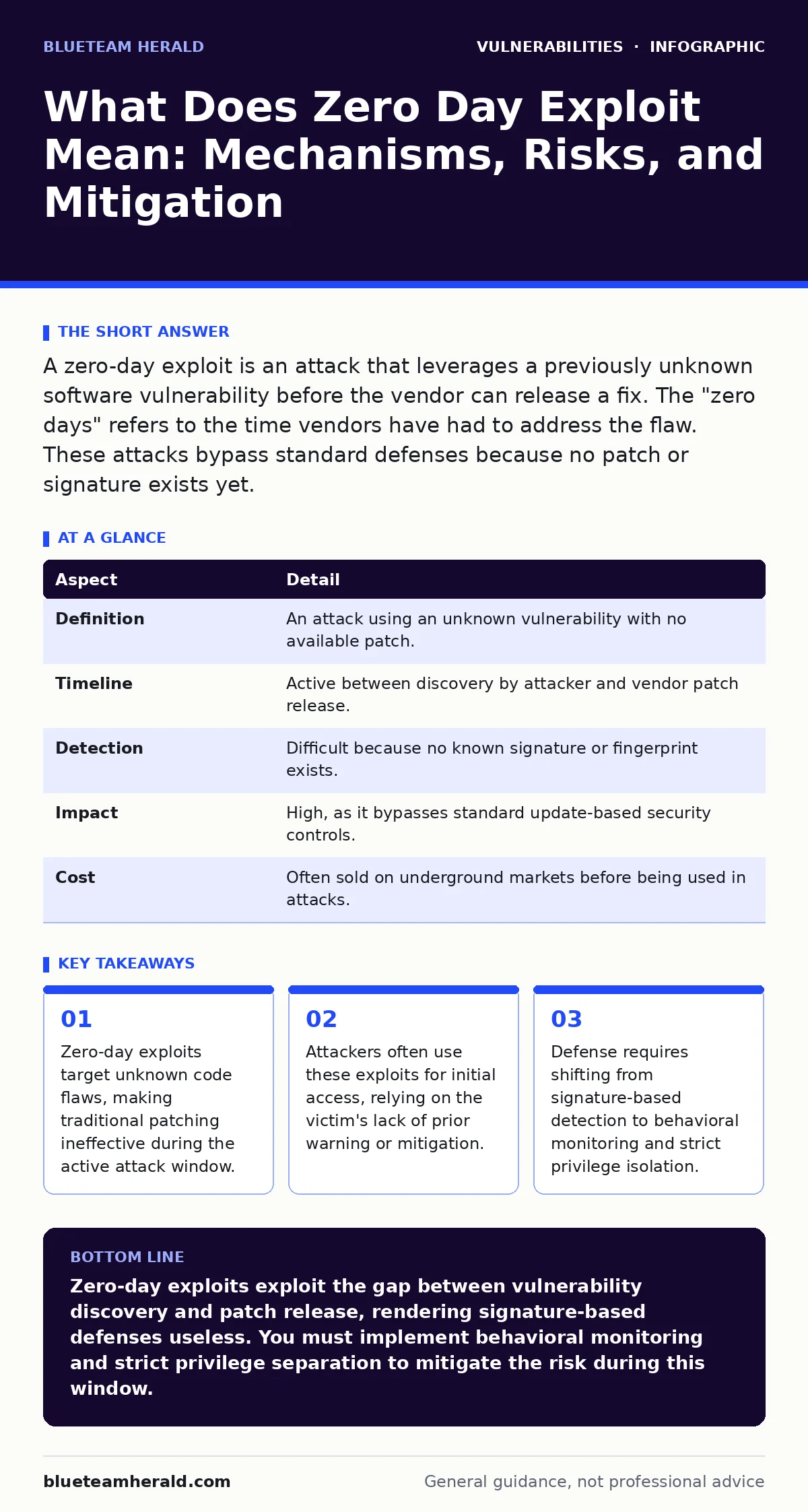
A zero-day exploit is an attack that leverages a previously unknown software vulnerability before the vendor can release a fix. The "zero days" refers to the time vendors have had to address the flaw. These attacks bypass standard defenses because no patch or signature exists yet.
What does zero day exploit mean in practice
A zero-day exploit is a malicious piece of code that takes advantage of a previously unknown software vulnerability. The term "zero-day" describes the fact that the software vendor has had zero days to create a patch for the issue. This creates a dangerous window where the flaw exists in the wild, but no official fix is available. Attackers race to use this gap before the vendor discovers the weakness or before a third party reports it responsibly.
The exploit serves as the delivery mechanism for the attack. It is not the vulnerability itself, but the weapon used to trigger it. When you encounter the phrase "zero-day exploit," it refers to the active use of that hidden flaw. The vulnerability is the open door; the exploit is the key that turns the lock. Understanding this distinction helps you separate the static risk from the dynamic threat.
| Aspect | Detail |
|---|---|
| Definition | An attack using an unknown vulnerability with no available patch. |
| Timeline | Active between discovery by attacker and vendor patch release. |
| Detection | Difficult because no known signature or fingerprint exists. |
| Impact | High, as it bypasses standard update-based security controls. |
| Cost | Often sold on underground markets before being used in attacks. |
How the attack chain unfolds
The process begins with discovery. A researcher or attacker finds a coding error that allows them to break out of the intended program boundaries. This might be a buffer overflow, where too much data is written to memory, or a logic error that bypasses authentication. Once found, the attacker develops an exploit kit. This kit contains the specific instructions needed to trigger the flaw and execute arbitrary code.
The next phase is delivery. The attacker needs to get the victim to run the exploit. This often happens through an email attachment, a malicious website, or a compromised software update. The goal is to trigger the code automatically. If the software crashes without executing the payload, the exploit failed. If it runs silently, the attacker gains a foothold. This initial access is the most valuable part of the chain.
Who falls victim to these attacks
Zero-day exploits affect anyone running the vulnerable software. This includes individual users, small businesses, and large enterprises. However, high-value targets are often prioritized. Attackers may reserve expensive exploits for specific organizations to maximize the return on investment. This practice is known as "exploit hoarding." They will not use the tool on random users if they plan to sell it or use it against a specific government or corporate target later.
General users are not immune. Mass-market attacks use zero-days to infect large numbers of devices quickly. These are often called "worms" because they spread automatically. You do not need to be a high-profile target to be hit. If you run popular software, you are in the blast radius. The sheer volume of users makes it statistically likely that someone will be compromised. This drives the need for broad defense strategies, not just targeted ones.
Why standard defenses often fail
Traditional antivirus software relies on signatures. A signature is a unique pattern of code associated with a known threat. Since a zero-day exploit is unknown, it has no signature. The antivirus engine sees the code as new and potentially harmless. It cannot block what it has never seen before. This is the primary reason zero-days bypass endpoint protection.
Firewalls also struggle. If the exploit uses allowed ports and protocols, the firewall permits the traffic. The data looks like normal communication. Without deep packet inspection or behavioral analysis, the firewall cannot distinguish between legitimate use and malicious exploitation. This limitation highlights the weakness of perimeter-only security. You must assume the perimeter has been breached and defend the internal assets.
What you can do about it
You cannot patch a zero-day immediately because the patch does not exist. Your defense must rely on reducing the attack surface. This means limiting what the software can do. Use application whitelisting to allow only approved programs to run. If an unknown process tries to execute, the system blocks it. This stops the exploit payload from launching, even if the vulnerability is triggered.
Another effective measure is privilege separation. Run applications with the lowest possible permissions. If a web browser is compromised, the attacker should not gain administrative rights to the entire system. This limits the damage. You should also implement network segmentation. If one device is infected, it cannot easily communicate with critical servers. This containment strategy slows down the attacker.
Common misconceptions about zero-days
Many people believe that zero-day exploits are rare. This is incorrect. New vulnerabilities are discovered constantly. The perception of rarity comes from the fact that most are patched quickly or never leave the lab. Only a fraction see active use in the wild. This selection bias makes them seem uncommon. In reality, the supply of potential zero-days is vast.
Another mistake is assuming that disabling JavaScript or macros stops all exploits. While this blocks many attacks, sophisticated exploits can trigger through other means. Some flaws exist in the core rendering engine, not in the script interpreter. Disabling features helps, but it is not a silver bullet. You need a layered approach.
Integrating with broader security programs
Zero-day mitigation fits into larger vulnerability management programs. These programs track known risks and prioritize fixes. While they cannot fix zero-days, they reduce the overall number of vulnerabilities an attacker can choose from. A smaller attack surface makes it harder for attackers to find a useful zero-day.
You should also review input validation practices in your own development. If you build software, strict input validation prevents many vulnerabilities from existing in the first place. This proactive measure reduces the chance of your product having a zero-day. For users, understanding attack vectors in CVSS helps you assess the severity of reported flaws. High-severity flaws are more likely to become active exploits.
Related topics like browser updates are critical because browsers are frequent targets. Keeping them current ensures you have the latest mitigations. Similarly, avoiding security misconfigurations prevents attackers from using simple flaws instead of complex zero-days. If an attacker can enter through an open door, they will not bother picking the lock. Check the CISA Known Exploited Vulnerabilities catalog to see which flaws are actively being used. This helps you prioritize your defenses.
The role of behavior detection
Since signatures fail, you must detect bad behavior. Endpoint Detection and Response (EDR) tools monitor system activity. They look for unusual actions, such as a web browser trying to modify system files. This is not normal behavior. The tool can block the action and alert the administrator. This method does not require knowing the specific exploit. It relies on the fact that malware must do something to achieve its goal.
Heuristic analysis is another tool. It evaluates code based on its structure and intent rather than its exact pattern. If a file looks like a known malware family, it gets flagged. This catches variants of existing threats and some new ones. It is not perfect, but it adds a layer of defense. You should combine behavioral detection with strict access controls. This creates a environment where exploitation is difficult and containment is likely.
Key takeaways
- Zero-day exploits target unknown code flaws, making traditional patching ineffective during the active attack window.
- Attackers often use these exploits for initial access, relying on the victim's lack of prior warning or mitigation.
- Defense requires shifting from signature-based detection to behavioral monitoring and strict privilege isolation.
Zero-day exploits exploit the gap between vulnerability discovery and patch release, rendering signature-based defenses useless. You must implement behavioral monitoring and strict privilege separation to mitigate the risk during this window.
Frequently asked questions
Is a zero-day attack the same as a zero-day vulnerability?
No. The vulnerability is the flaw in the code. The exploit is the tool used to take advantage of that flaw.
Can firewalls stop zero-day exploits?
Standard firewalls cannot stop them if the traffic uses allowed protocols. You need deep packet inspection or behavioral analysis for better protection.
How long does a zero-day window last?
It varies. Some are patched in days, while others remain unpatched for years if the vendor is unaware or unable to fix them.
Should I worry about zero-days on my personal computer?
You should be aware of them, but mass-market attacks are less likely to target you specifically. Keep software updated and use basic security hygiene.
How this guide was produced: written by the BlueTeam Herald editorial team with AI assistance, checked against the public references listed below, and reviewed when the facts change. See our editorial policy or report an error.