DNS Tunneling: Risks and Protection for Small Businesses
Standard firewalls often miss DNS tunneling because the protocol mimics legitimate name resolution, allowing data exfiltration through plain text queries.
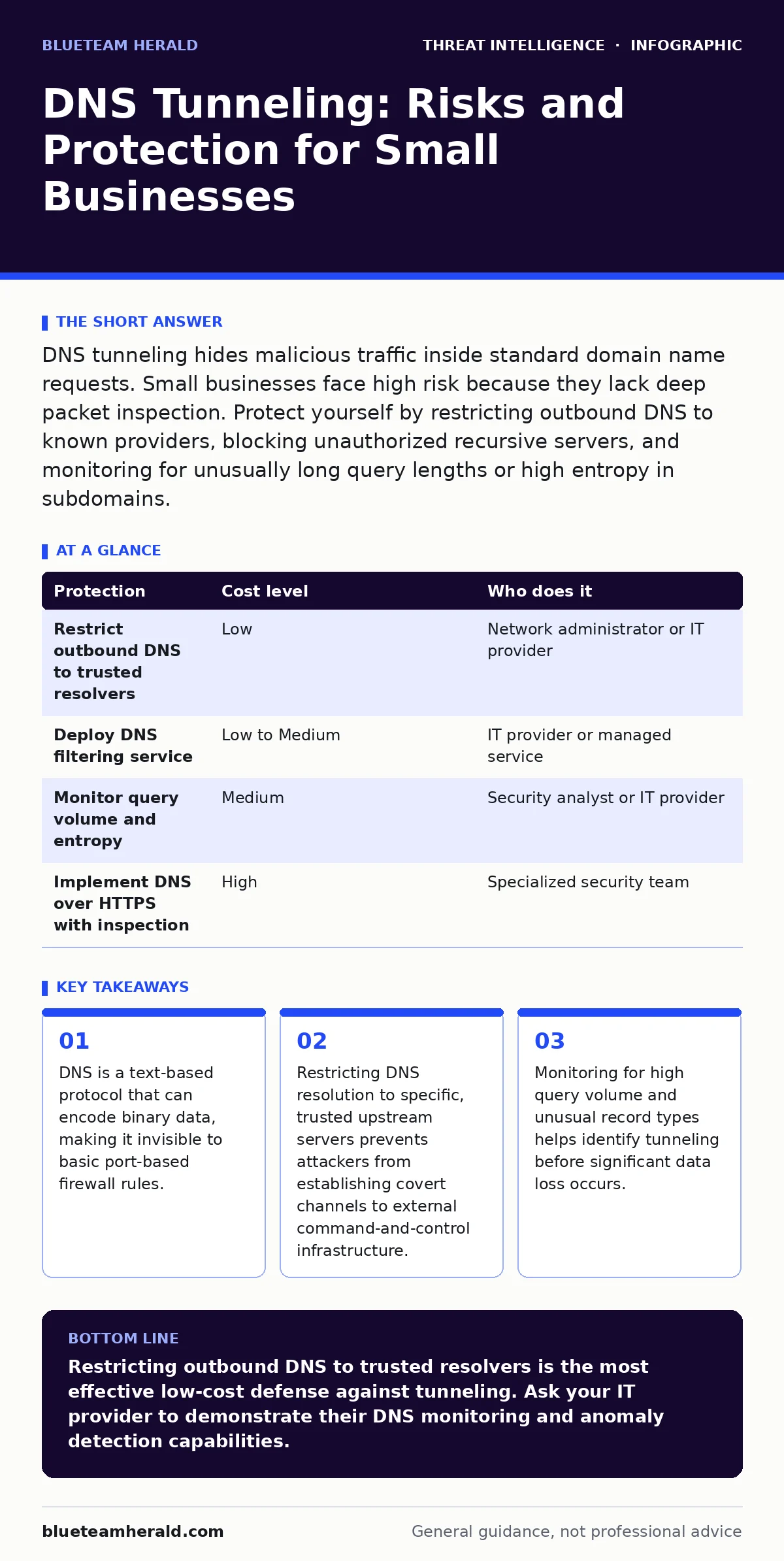
DNS tunneling hides malicious traffic inside standard domain name requests. Small businesses face high risk because they lack deep packet inspection. Protect yourself by restricting outbound DNS to known providers, blocking unauthorized recursive servers, and monitoring for unusually long query lengths or high entropy in subdomains.
The Invisible Pipe in Your Network
Domain Name System tunneling is a technique where attackers encapsulate data within DNS protocol messages. DNS is the system that translates human-readable domain names into IP addresses. Because DNS traffic is ubiquitous and rarely blocked, it serves as an ideal covert channel. The protocol supports long domain names and various record types, providing ample space to hide encoded payloads.
Small organizations are particularly exposed to this threat. They often rely on perimeter firewalls that inspect traffic based on port numbers and protocols. These devices see DNS traffic on port 53 and allow it by default. They do not typically inspect the content of the queries. This creates a blind spot. An attacker can exfiltrate data or receive commands without triggering standard intrusion detection systems.
The risk is compounded by the decentralized nature of DNS. Unlike HTTP, which often passes through a web proxy, DNS queries can go directly to any public resolver. If your network allows any device to query any DNS server, an attacker can easily establish a tunnel. This bypasses internal logging and monitoring tools that focus on application-layer traffic.
How Data Hides in Plain Sight
DNS is a text-based protocol. Attackers convert binary data into text formats like Base64 or hexadecimal. This encoded data is then inserted into the subdomain portion of a DNS query. For example, a query might look like aGVsbG8gd29ybGQ.evil-domain.com. The string before the dot contains the hidden message.
The receiving server, controlled by the attacker, decodes the subdomain to retrieve the data. This server can also send responses in the DNS answer section. This allows for two-way communication. The attacker can issue commands to the infected machine or retrieve more data.
This method is resilient against basic security measures. Firewalls that only check ports will see standard DNS traffic. Web proxies that filter HTTP and HTTPS will not see DNS queries. Even if you use a secure DNS protocol like DNS over HTTPS, the tunneling still occurs within the encrypted payload. The traffic appears as normal web browsing, making it harder to distinguish from legitimate activity.
The volume of data transferred is limited by DNS packet size. However, DNS is designed for high-frequency queries. Attackers can send many small queries per second. Over time, this allows for significant data exfiltration. The steady stream of small requests blends in with normal background noise, making it difficult to detect without specialized analysis.
Why Small Organizations Struggle
Small businesses often lack the resources for deep packet inspection. This technology examines the full content of network packets, not just headers. Implementing it requires significant processing power and storage. For a small team, the cost and complexity are prohibitive.
Many small organizations use managed IT services. The provider may configure firewalls and endpoints but not monitor DNS traffic closely. They might assume that standard security tools are sufficient. This assumption leaves a gap. DNS tunneling exploits this gap by using a protocol that is rarely scrutinized.
Another issue is the lack of visibility. Without centralized logging of DNS queries, you cannot analyze patterns. You cannot see which domains are being queried or how often. This makes it impossible to identify anomalies. You might see a spike in DNS traffic but not know if it is legitimate or malicious.
Small teams also struggle with alert fatigue. If you enable broad monitoring, you will receive many false positives. DNS queries to legitimate services can look like tunneling. Distinguishing between normal behavior and malicious activity requires tuning and expertise. Without this, you may ignore genuine threats or disrupt business operations.
Low-Cost Protections for Limited Budgets
You can reduce the risk of DNS tunneling without expensive tools. The first step is to restrict outbound DNS. Configure your network to only allow DNS queries to specific, trusted servers. These servers should be your own DNS resolvers or those of a reputable provider.
Block direct access to public DNS resolvers like 8.8.8.8 or 1.1.1.1 from internal devices. This forces all queries through your controlled infrastructure. You can then log and monitor all DNS traffic at this choke point. This prevents attackers from bypassing your monitoring by using external servers.
Use DNS filtering services. These services block known malicious domains and categories of risky sites. They also provide logs of all queries. While this does not stop all tunneling, it reduces the attack surface. Attackers often use dynamic domain generation to create new domains. Filtering services can block these patterns if they are identified.
Monitor for anomalies. Look for high query volumes from a single host. Check for unusually long domain names. High entropy in subdomain strings is a strong indicator of encoded data. You can set up simple alerts for these conditions. This helps you identify potential tunneling activity early.
| Protection | Cost level | Who does it |
|---|---|---|
| Restrict outbound DNS to trusted resolvers | Low | Network administrator or IT provider |
| Deploy DNS filtering service | Low to Medium | IT provider or managed service |
| Monitor query volume and entropy | Medium | Security analyst or IT provider |
| Implement DNS over HTTPS with inspection | High | Specialized security team |
Questions for Your IT Provider
When discussing security with your IT provider, ask specific questions about DNS. Do not assume they are monitoring this traffic. Ask how they handle DNS queries from internal devices. Do they force all queries through a central resolver?
Ask about their logging capabilities. Do they retain DNS logs for a significant period? This is necessary for retrospective analysis. If an incident occurs, you need to see what queries were made in the past. Short retention periods limit your ability to investigate.
Inquire about their response to anomalies. What happens if a host generates a high volume of DNS queries? Do they automatically block the host or investigate? Understanding their process helps you assess their readiness. A provider that reacts quickly can limit the damage from a tunneling incident.
- How do you restrict outbound DNS traffic?
- Do you log all DNS queries, and for how long?
- What tools do you use to detect DNS anomalies?
- Can you show me examples of DNS-related alerts?
- How do you handle DNS over HTTPS traffic?
See also: The 3-2-1 Backup Rule: Small Business Data Resilience · Network Traffic Analysis for Small Teams: Detection Without Noise
Beyond Basic Firewall Rules
DNS tunneling is just one example of living-off-the-land attacks. Attackers use legitimate tools and protocols to hide their activity. This makes detection difficult. You must look beyond port numbers and protocol headers.
Understanding domain generation algorithms helps you recognize patterns. These algorithms create random-looking domains for command-and-control servers. Monitoring for newly registered domains or domains with high entropy can help. This complements your DNS security measures.
Network traffic analysis is essential for identifying subtle anomalies. You need to see the full picture of your network activity. This includes DNS, HTTP, and other protocols. Combining these views helps you spot inconsistencies. For example, a host making many DNS queries but little other traffic is suspicious.
For deeper insights, consider studying packet capture analysis. This allows you to examine the raw data of network traffic. You can see the exact content of DNS queries and responses. This is useful for confirming suspicions and understanding the scope of an incident.
Related topics like alert triage help you manage the volume of security events. You need to prioritize alerts effectively. DNS tunneling alerts can be noisy. Learning to distinguish between false positives and true threats saves time and resources.
Finally, understanding mean time to detect helps you measure your effectiveness. The faster you detect tunneling, the less damage is done. Regular testing and monitoring improve this metric. Keep your defenses updated and your team trained.
Key takeaways
- DNS is a text-based protocol that can encode binary data, making it invisible to basic port-based firewall rules.
- Restricting DNS resolution to specific, trusted upstream servers prevents attackers from establishing covert channels to external command-and-control infrastructure.
- Monitoring for high query volume and unusual record types helps identify tunneling before significant data loss occurs.
Restricting outbound DNS to trusted resolvers is the most effective low-cost defense against tunneling. Ask your IT provider to demonstrate their DNS monitoring and anomaly detection capabilities.
Frequently asked questions
Can antivirus software stop DNS tunneling?
Antivirus software focuses on known malware signatures. It often misses tunneling because the traffic looks like legitimate DNS queries. Network-level controls are more effective.
Is DNS over HTTPS safe from tunneling?
DNS over HTTPS encrypts the traffic, hiding it from network monitors. It does not prevent tunneling. You must inspect the decrypted traffic or restrict which DNS-over-HTTPS servers are allowed.
How do I know if I am being tunneled?
Look for high volumes of DNS queries from a single host. Check for unusually long domain names or high entropy in subdomains. Sudden spikes in DNS traffic can also be a sign.
Do I need expensive tools to protect myself?
No. Restricting outbound DNS and using basic logging can significantly reduce risk. Expensive tools help with detection and analysis but are not strictly necessary for basic protection.
How this guide was produced: written by the BlueTeam Herald editorial team with AI assistance, checked against the public references listed below, and reviewed when the facts change. See our editorial policy or report an error.