Network Traffic Analysis for Small Teams: Detection Without Noise
Small businesses can detect data exfiltration by analyzing DNS query patterns rather than inspecting every encrypted web packet.

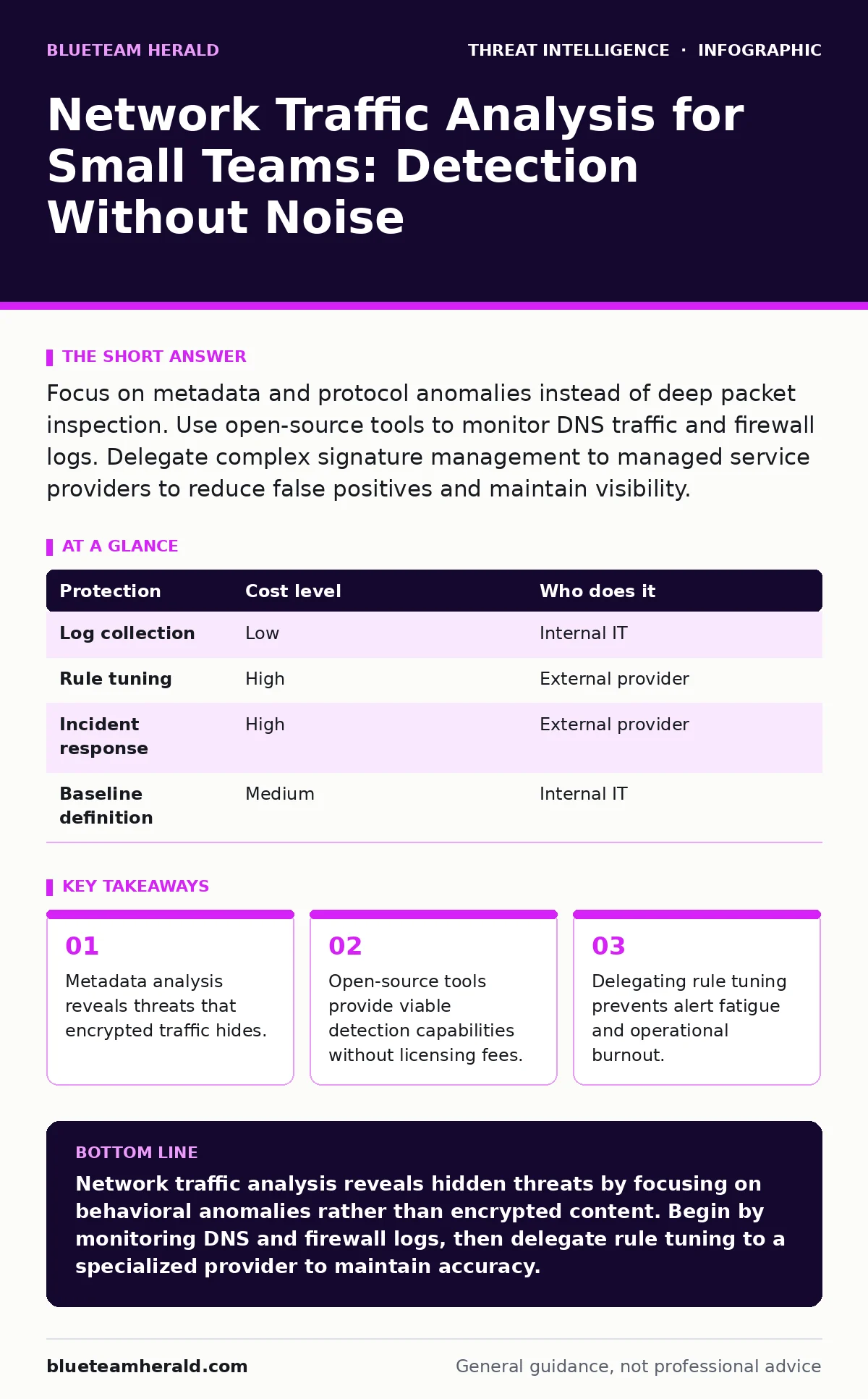
Focus on metadata and protocol anomalies instead of deep packet inspection. Use open-source tools to monitor DNS traffic and firewall logs. Delegate complex signature management to managed service providers to reduce false positives and maintain visibility.
The Visibility Gap in Small Networks
Small organizations often assume that if their antivirus software is running, their network is secure. This assumption creates a blind spot. Antivirus tools inspect files on endpoints, but they do not see how those endpoints communicate with the outside world. Network traffic analysis fills this gap by observing the flow of data between devices.
You do not need to decrypt every conversation happening on your network. Modern encryption makes that computationally expensive and legally complex. Instead, you focus on the metadata. Metadata includes the source and destination addresses, the volume of data transferred, and the timing of connections. These details often reveal malicious behavior even when the content remains unreadable.
Affordable Detection Methods
You can implement effective monitoring without purchasing expensive enterprise security suites. Open-source platforms offer powerful features at a cost of zero for the software license. Tools like Zeek or Suricata allow you to inspect traffic for known patterns of attack. These tools generate logs that describe network events in structured formats.
Packet capture analysis is the foundational skill here. You record a sample of network traffic and examine it for irregularities. While capturing all traffic on a busy network is difficult, capturing samples from critical segments is manageable. You can set up a dedicated computer with two network cards to mirror traffic from your main switch to your monitoring system. This hardware tap ensures you see the traffic without slowing down your primary operations.
The trade-off is storage and processing power. Storing raw network data consumes disk space quickly. You must configure your tools to discard irrelevant data after a short period. Retaining only alerts and metadata keeps storage costs low while preserving the ability to investigate incidents.
What to Delegate
Monitoring generates noise. Without proper tuning, you will receive hundreds of alerts for benign activity. This leads to alert fatigue, where operators ignore warnings because most are false positives. You should delegate the tuning of detection rules to a managed security service provider or a specialized consultant.
Consider how Snort and Suricata rules function. These are text files that define what a threat looks like. Maintaining these rules requires constant updates as new vulnerabilities emerge. A small team cannot dedicate time to reading threat reports and updating signature databases daily. An external provider handles this maintenance, ensuring your detection engine recognizes current threats.
You retain control over policy decisions. You decide which alerts matter to your business and which can be ignored. The provider handles the technical overhead of rule management and log aggregation. This separation allows you to focus on responding to genuine risks rather than managing software configurations.
| Protection | Cost level | Who does it |
|---|---|---|
| Log collection | Low | Internal IT |
| Rule tuning | High | External provider |
| Incident response | High | External provider |
| Baseline definition | Medium | Internal IT |
Detecting Stealthy Exfiltration
Attackers often use legitimate protocols to move data out of your network. DNS tunneling is a common method. It hides command-and-control traffic or stolen data inside standard DNS queries. Since DNS is required for basic internet access, firewalls rarely block it.
You can detect this by looking for anomalies in DNS traffic. Normal DNS queries are short and resolve well-known domains. Suspicious queries may be unusually long, contain random characters, or target domains that were just registered. Domain generation algorithms create new domain names for malware to contact, making them hard to block with static blacklists. Analyzing the entropy, or randomness, of domain names helps identify these automated patterns.
Another vector is DCSync attacks. This technique allows an attacker to replicate password hashes from a domain controller over the network. It looks like normal directory service replication traffic. You detect it by monitoring for replication requests from non-domain controller accounts. If a workstation account requests password hashes, it is a clear sign of compromise.
Integrating Host and Network Data
Network data alone provides context, but host data provides confirmation. Windows event log monitoring reveals actions taken on individual computers. When network analysis shows a suspicious connection, you check the host logs to see what process initiated it.
This correlation reduces false positives. A spike in outbound traffic might seem suspicious. However, if the host logs show that a scheduled backup job started at that time, the traffic is likely legitimate. Without host logs, you might waste time investigating a routine operation. With host logs, you can quickly rule out benign causes.
See also: Intrusion Prevention System vs Intrusion Detection System: Key Differences · What Is Network Scanning: Mechanisms, Risks, and Detection
Questions for Your Provider
When selecting a partner to help with network monitoring, you need to understand their capabilities. Do not accept vague promises of "24/7 monitoring." Ask specific questions about their methodology and tools.
- How do you differentiate between a configuration error and a genuine attack?
- What is your mean time to detect known threats in your environment?
- How do you handle the storage and retention of network logs for forensic analysis?
- Can you provide a sample report showing how you correlate network alerts with host events?
- What is your process for updating detection rules when a new vulnerability is disclosed?
These questions reveal whether the provider uses automated systems that generate noise or skilled analysts who interpret data. You want a partner who understands your business context, not just one who sells software licenses.
Building a Sustainable Practice
Implementing network traffic analysis is not a one-time project. It is an ongoing discipline. You must review your baselines regularly as your business grows and changes. New applications and remote work patterns alter traffic flows. Your detection rules must evolve with these changes.
Start small. Monitor one critical segment of your network, such as the connection to your cloud services. Refine your alerts until you have few false positives. Then expand to other segments. This iterative approach prevents you from being overwhelmed by data before you are ready to analyze it.
Key takeaways
- Metadata analysis reveals threats that encrypted traffic hides.
- Open-source tools provide viable detection capabilities without licensing fees.
- Delegating rule tuning prevents alert fatigue and operational burnout.
Network traffic analysis reveals hidden threats by focusing on behavioral anomalies rather than encrypted content. Begin by monitoring DNS and firewall logs, then delegate rule tuning to a specialized provider to maintain accuracy.
Frequently asked questions
Is network traffic analysis legal?
Yes, monitoring traffic on networks you own or operate is generally legal. However, intercepting and decrypting private communications may violate privacy laws depending on your jurisdiction. Always review local regulations.
Can I do this with just a firewall?
Firewalls provide basic logging of allowed and blocked connections. They do not perform deep inspection or behavioral analysis. You need dedicated tools to detect subtle anomalies and protocol abuse.
How much storage do I need for logs?
Storage needs depend on your traffic volume and retention policy. For small businesses, retaining metadata and alerts for 30 to 90 days is often sufficient for investigation purposes. Raw packet captures should be stored temporarily.
What if I don't have a dedicated security team?
You can use managed detection and response services. These providers monitor your network on your behalf and alert you only to confirmed threats. This allows you to maintain visibility without hiring full-time analysts.
How this guide was produced: written by the BlueTeam Herald editorial team with AI assistance, checked against the public references listed below, and reviewed when the facts change. See our editorial policy or report an error.