Intrusion Prevention System vs Intrusion Detection System: Key Differences
Prevention systems block traffic automatically while detection systems only alert, creating a distinct trade-off between security speed and the risk of blocking legitimate user activity.

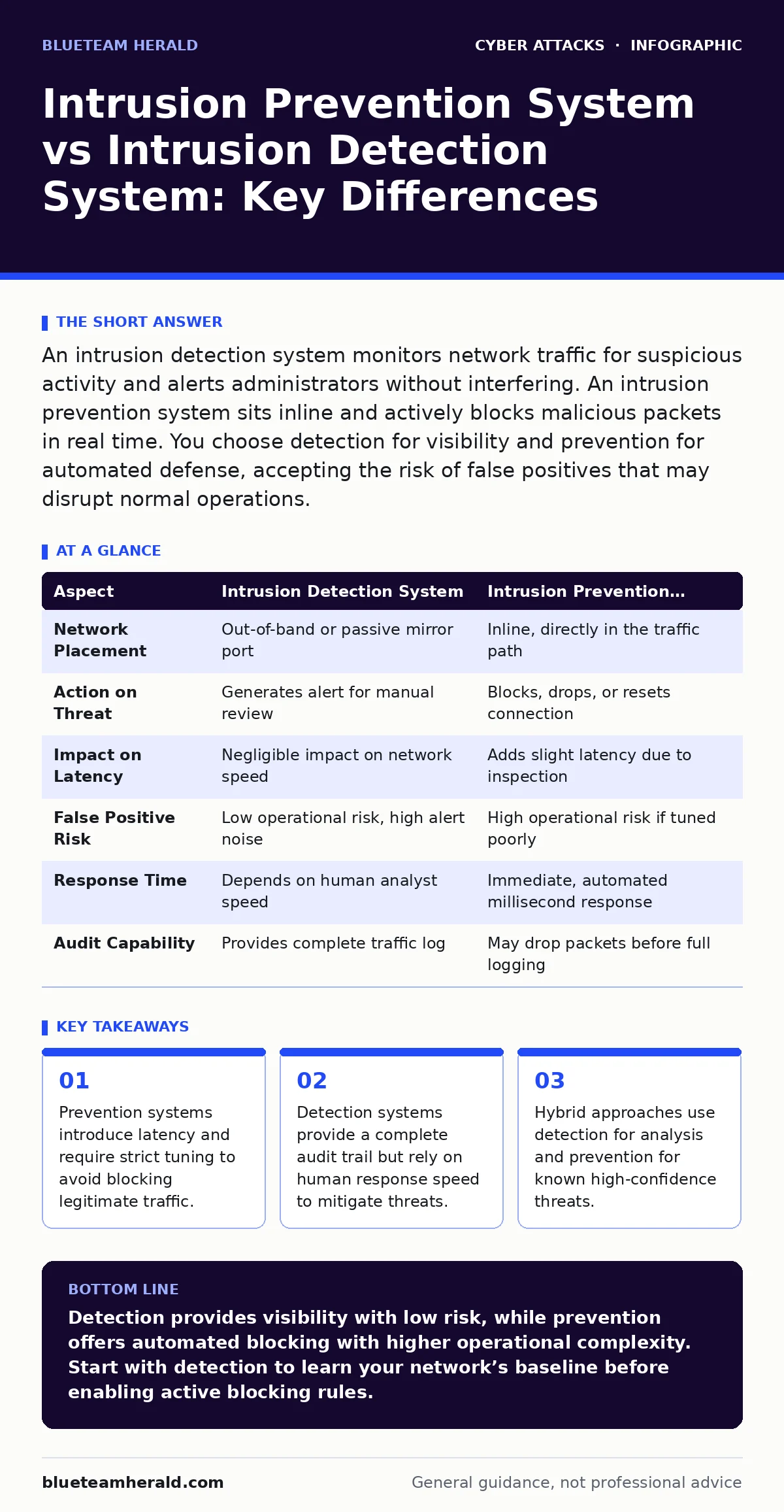
An intrusion detection system monitors network traffic for suspicious activity and alerts administrators without interfering. An intrusion prevention system sits inline and actively blocks malicious packets in real time. You choose detection for visibility and prevention for automated defense, accepting the risk of false positives that may disrupt normal operations.
The Core Difference Between IDS and IPS
The primary distinction between an intrusion detection system and an intrusion prevention system lies in their position within the network flow and their response capability. An intrusion detection system operates in passive mode, analyzing copies of network traffic without interrupting the data stream. It identifies threats based on signatures or behavior anomalies and generates alerts for security teams to investigate.
An intrusion prevention system operates in active mode, sitting directly in the path of network traffic. It analyzes packets in real time and can drop malicious connections, block source IP addresses, or reset sessions automatically. This architectural difference dictates how each system handles security incidents, latency, and operational risk.
What Is an Intrusion Detection System
An intrusion detection system serves as a monitoring tool for network security. It inspects traffic for known attack patterns, such as specific byte sequences associated with malware, or unusual behavior like a sudden spike in login attempts. Because it does not sit in the direct path of traffic, it cannot block attacks by itself.
Instead, it provides visibility into what is happening on the network. Security teams use these alerts to investigate potential breaches, correlate events with other data sources, and manually implement countermeasures. This approach minimizes the risk of disrupting legitimate business operations but requires a responsive security operations center to act on findings.
What Is an Intrusion Prevention System
An intrusion prevention system acts as an automated gatekeeper for network traffic. It sits inline between the firewall and the internal network, forcing all traffic to pass through its inspection engine. When the system identifies a threat that matches its policy rules, it takes immediate action.
This action typically involves dropping the malicious packet, blocking the offending IP address, or resetting the connection. This automation reduces the time between threat detection and mitigation from minutes or hours to milliseconds. However, because the system actively interferes with traffic, any misconfiguration or false positive can immediately disrupt legitimate user access to applications or services.
| Aspect | Intrusion Detection System | Intrusion Prevention System |
|---|---|---|
| Network Placement | Out-of-band or passive mirror port | Inline, directly in the traffic path |
| Action on Threat | Generates alert for manual review | Blocks, drops, or resets connection |
| Impact on Latency | Negligible impact on network speed | Adds slight latency due to inspection |
| False Positive Risk | Low operational risk, high alert noise | High operational risk if tuned poorly |
| Response Time | Depends on human analyst speed | Immediate, automated millisecond response |
| Audit Capability | Provides complete traffic log | May drop packets before full logging |
When to Choose Detection Over Prevention
Choose an intrusion detection system when you prioritize visibility and accurate auditing over automated blocking. This approach suits environments where any disruption to network traffic causes significant business loss, such as high-frequency trading platforms or critical healthcare systems.
Detection systems are ideal for initial security deployments where the security team needs to learn the baseline behavior of the network before implementing strict blocking rules. They also serve well as a secondary layer behind a prevention system, catching threats that the active blocker might miss or misidentify. This setup allows you to refine your security policies without risking accidental outages.
When to Choose Prevention Over Detection
Choose an intrusion prevention system when you need automated defense against known threats and lack the staff to respond to alerts instantly. This approach fits environments with clear security policies where blocking malicious traffic is a priority, such as corporate office networks or cloud infrastructure. Prevention systems are effective for stopping common attacks, such as port scanning or known exploit kits, without requiring human intervention. However, you must dedicate significant time to tuning the system to prevent it from blocking legitimate applications, such as software updates or internal communication tools.
See also: Network Traffic Analysis for Small Teams: Detection Without Noise · Implement Snort and Suricata Rules: Step-by-Step Deployment Guide
Where the Two Approaches Overlap
Many modern security appliances combine both intrusion detection system and intrusion prevention system capabilities into a single device. This hybrid approach allows organizations to use prevention for high-confidence threats with well-defined signatures, while using detection for ambiguous or new behaviors that require manual analysis.
You can configure the system to block known malware but only alert on unusual data transfers that might indicate account takeover. This flexibility balances security speed with operational stability. It also helps mitigate risks associated with social engineering, where attackers may use subtle techniques that automated systems cannot easily distinguish from legitimate activity.
Hidden Costs and Operational Trade-offs
Implementing these systems involves more than just hardware or software costs. The hidden cost of an intrusion prevention system is the administrative overhead required for tuning. Every new application or change in network behavior may require updating the system’s rules to prevent false positives. An intrusion detection system shifts this cost to the human side, requiring skilled analysts to investigate alerts and maintain context.
Neither system provides complete protection against sophisticated attacks, such as slowloris attacks that exploit connection handling limits, or smishing campaigns that trick users into revealing credentials. You must integrate these tools with a broader security strategy, including multi-factor authentication and regular user training, to address threats that bypass network-level controls.
Key takeaways
- Prevention systems introduce latency and require strict tuning to avoid blocking legitimate traffic.
- Detection systems provide a complete audit trail but rely on human response speed to mitigate threats.
- Hybrid approaches use detection for analysis and prevention for known high-confidence threats.
Detection provides visibility with low risk, while prevention offers automated blocking with higher operational complexity. Start with detection to learn your network’s baseline before enabling active blocking rules.
Frequently asked questions
Can I run both systems at the same time?
Yes, many organizations deploy both systems in tandem, using detection for broad monitoring and prevention for specific, high-risk traffic paths.
Do these systems protect against all cyber attacks?
No, they focus on network traffic patterns and cannot prevent attacks that occur outside the network, such as phishing emails or physical theft of devices.
How do I reduce false positives in an IPS?
Tune the system by whitelisting known legitimate traffic and starting with strict blocking rules only for high-confidence threats before expanding coverage.
Is cloud-based detection better than on-premise?
Cloud-based solutions offer easier updates and scalability, while on-premise systems provide greater control over data privacy and latency for sensitive environments.
How this guide was produced: written by the BlueTeam Herald editorial team with AI assistance, checked against the public references listed below, and reviewed when the facts change. See our editorial policy or report an error.