Warning Signs of Vulnerabilities in AI Model Serving Frameworks
AI serving frameworks often expose hidden attack surfaces through data serialization and memory management flaws that bypass standard application firewalls

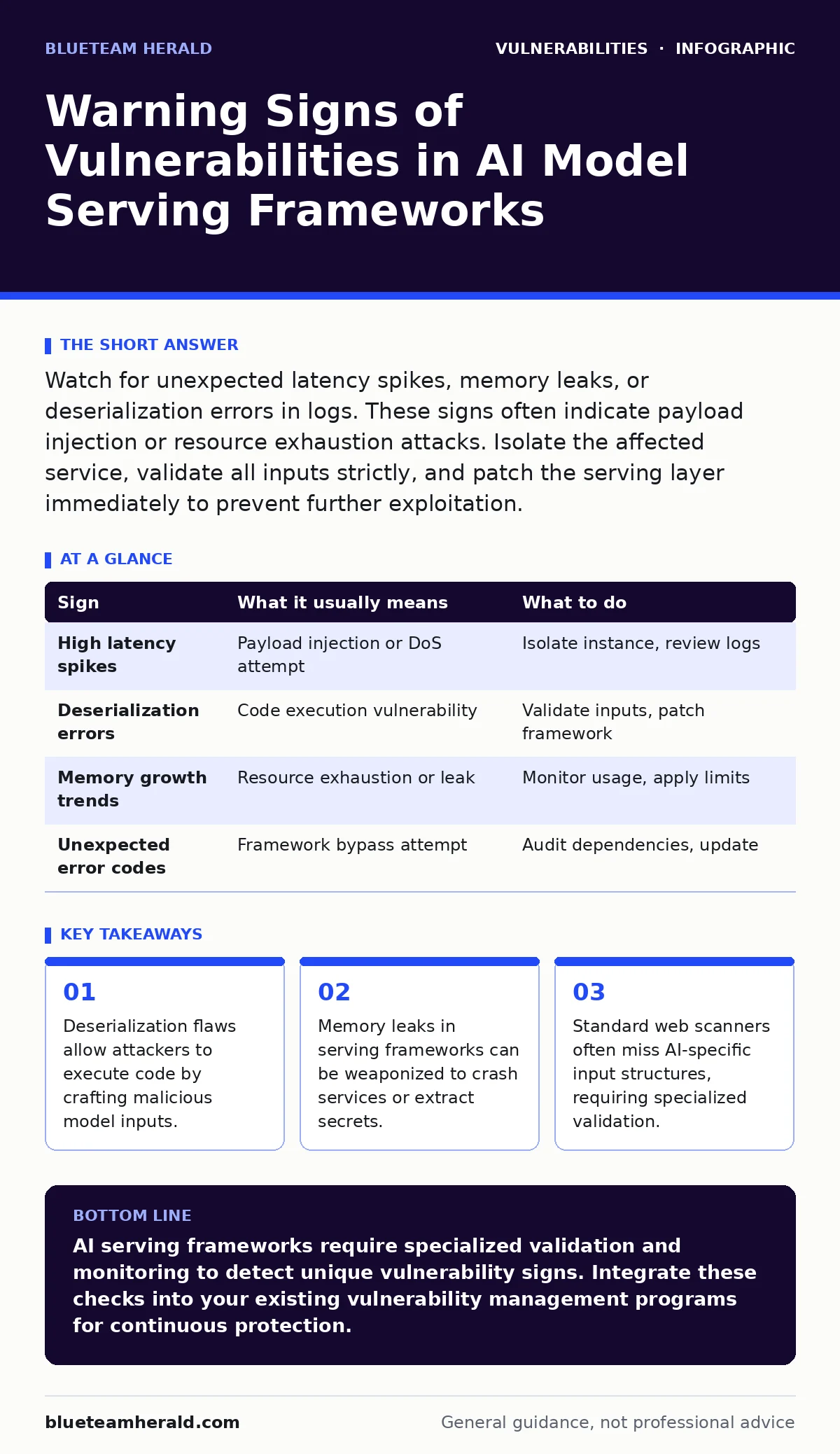
Watch for unexpected latency spikes, memory leaks, or deserialization errors in logs. These signs often indicate payload injection or resource exhaustion attacks. Isolate the affected service, validate all inputs strictly, and patch the serving layer immediately to prevent further exploitation.
Immediate Performance Anomalies in Serving Layers
Performance degradation is often the first visible symptom of a vulnerability in AI model serving frameworks. You may notice sudden spikes in latency or increased error rates during inference requests. These anomalies frequently indicate that the framework is processing malformed inputs that trigger expensive error handling paths. Attackers exploit these paths to conduct denial-of-service attacks or to probe for deeper vulnerabilities.
The serving framework struggles to parse the malicious payload, consuming excessive CPU cycles. This behavior differs from normal traffic patterns where inference times remain relatively stable. Monitoring tools should flag any deviation from baseline response times. You must distinguish between legitimate high-load scenarios and adversarial input causing computational bloat. Ignoring these signs allows attackers to refine their probes without detection.
Deserialization Errors and Input Validation Failures
Deserialization vulnerabilities remain a critical risk in AI serving frameworks that accept serialized model states or complex input structures. When a framework fails to validate the structure of incoming data, it may execute arbitrary code during the deserialization process. You will often see specific error messages related to object instantiation or class loading in application logs.
These errors suggest that the framework is attempting to process data that does not conform to expected schemas. Input validation must occur before the data reaches the model inference engine. Relying on the framework’s internal checks is insufficient because attackers can bypass them with crafted payloads. The vulnerability in npm packages often stems from similar trust assumptions in dependencies. You must treat all external input as untrusted until explicitly validated.
Memory Leaks and Resource Exhaustion
Memory leaks in AI serving frameworks can signal a more serious underlying vulnerability. If the framework fails to release memory after processing requests, it may be due to improper handling of large tensors or stateful connections. Attackers can exploit this by sending requests that force the framework to allocate memory without freeing it. This leads to resource exhaustion and eventual service failure.
You may observe steady increases in memory usage over time, even during low traffic periods. This pattern differs from normal usage where memory stabilizes after peak loads. The issue often relates to how the framework manages GPU memory or shared libraries. Failing to address this can lead to a complete system crash. You should monitor memory usage trends and set alerts for abnormal growth patterns.
Hidden Costs of Framework Dependencies
AI serving frameworks often rely on numerous third-party libraries and dependencies. Vulnerabilities in these dependencies can introduce risks that are difficult to detect. You may not notice a problem until a specific dependency is exploited in the wild. The vulnerabilities in self-hosted GitLab highlight how supply chain risks affect complex software ecosystems.
Similarly, AI frameworks can inherit flaws from underlying tensor libraries or networking stacks. You must regularly audit your dependency tree for known vulnerabilities. Automated tools can help identify outdated or vulnerable packages. However, manual review is necessary to understand the context of each dependency. Ignoring these hidden costs leaves your infrastructure exposed to indirect attacks.
What to Do When You Spot a Sign
When you identify a potential vulnerability, immediate action is required to contain the threat. First, isolate the affected serving instance to prevent further exploitation. Do not simply restart the service, as this may preserve the attacker’s foothold. Second, review the logs to understand the nature of the attack. Look for patterns in the input data or request headers.
Third, apply patches or updates to the serving framework and its dependencies. Ensure that input validation is enforced at the edge, before data reaches the model. This approach mirrors best practices for command injection prevention. You should also consider implementing rate limiting to mitigate resource exhaustion attacks.
See also: How Cross-Site Scripting Works Step by Step · Input Validation Best Practices to Stop Exploits at the Edge
Table of Common Warning Signs
| Sign | What it usually means | What to do |
|---|---|---|
| High latency spikes | Payload injection or DoS attempt | Isolate instance, review logs |
| Deserialization errors | Code execution vulnerability | Validate inputs, patch framework |
| Memory growth trends | Resource exhaustion or leak | Monitor usage, apply limits |
| Unexpected error codes | Framework bypass attempt | Audit dependencies, update |
EXAMPLE: Handling Malformed Inputs
Integrating with Vulnerability Management Programs
Effective detection of AI framework vulnerabilities requires integration with broader security processes. You cannot rely solely on manual checks or ad-hoc monitoring. Incorporate AI serving layers into your vulnerability management programs to ensure regular assessment. Use vulnerability scanning tools that understand AI-specific protocols and data formats.
Standard web scanners often miss these nuances. Reference the CISA Known Exploited Vulnerabilities catalog to prioritize patches for known threats. This ensures that you address the most critical risks first. Regular audits help maintain a secure posture as the framework evolves. You must also consider the implications of Windows privilege escalation vulnerabilities if your infrastructure runs on Windows.
Beyond Standard Security Advice
Standard security advice often fails to address the unique characteristics of AI serving frameworks. For instance, traditional input validation may not account for the complexity of tensor data. You must adapt your strategies to handle these specialized inputs. The risk of input validation failures is higher in AI contexts due to the dynamic nature of model inputs.
You should also be aware that some vulnerabilities may not be immediately apparent. They may only manifest under specific conditions or with certain model architectures. This requires a deeper understanding of the framework’s internals. Do not assume that because a framework is widely used, it is secure. Continuous monitoring and testing are necessary to uncover hidden risks.
Key takeaways
- Deserialization flaws allow attackers to execute code by crafting malicious model inputs.
- Memory leaks in serving frameworks can be weaponized to crash services or extract secrets.
- Standard web scanners often miss AI-specific input structures, requiring specialized validation.
AI serving frameworks require specialized validation and monitoring to detect unique vulnerability signs. Integrate these checks into your existing vulnerability management programs for continuous protection.
Frequently asked questions
How do I detect deserialization attacks in AI frameworks?
Monitor for unexpected object instantiation errors and validate all serialized inputs against strict schemas before processing.
Are AI frameworks more vulnerable than traditional apps?
They face unique risks due to complex data structures and heavy reliance on third-party tensor libraries, requiring specialized validation.
Can standard vulnerability scanners find AI framework flaws?
Standard scanners often miss AI-specific protocols; use specialized tools and integrate with comprehensive vulnerability management programs.
What is the first step if I suspect a vulnerability?
Isolate the affected instance immediately to prevent exploitation, then review logs and apply necessary patches.
How this guide was produced: written by the BlueTeam Herald editorial team with AI assistance, checked against the public references listed below, and reviewed when the facts change. See our editorial policy or report an error.