Host Header Injection: 7 Mistakes That Expose Your Web App
Relying on the Host header for internal logic creates silent backdoors that bypass domain restrictions and redirect users to attacker-controlled servers without triggering standard alerts.

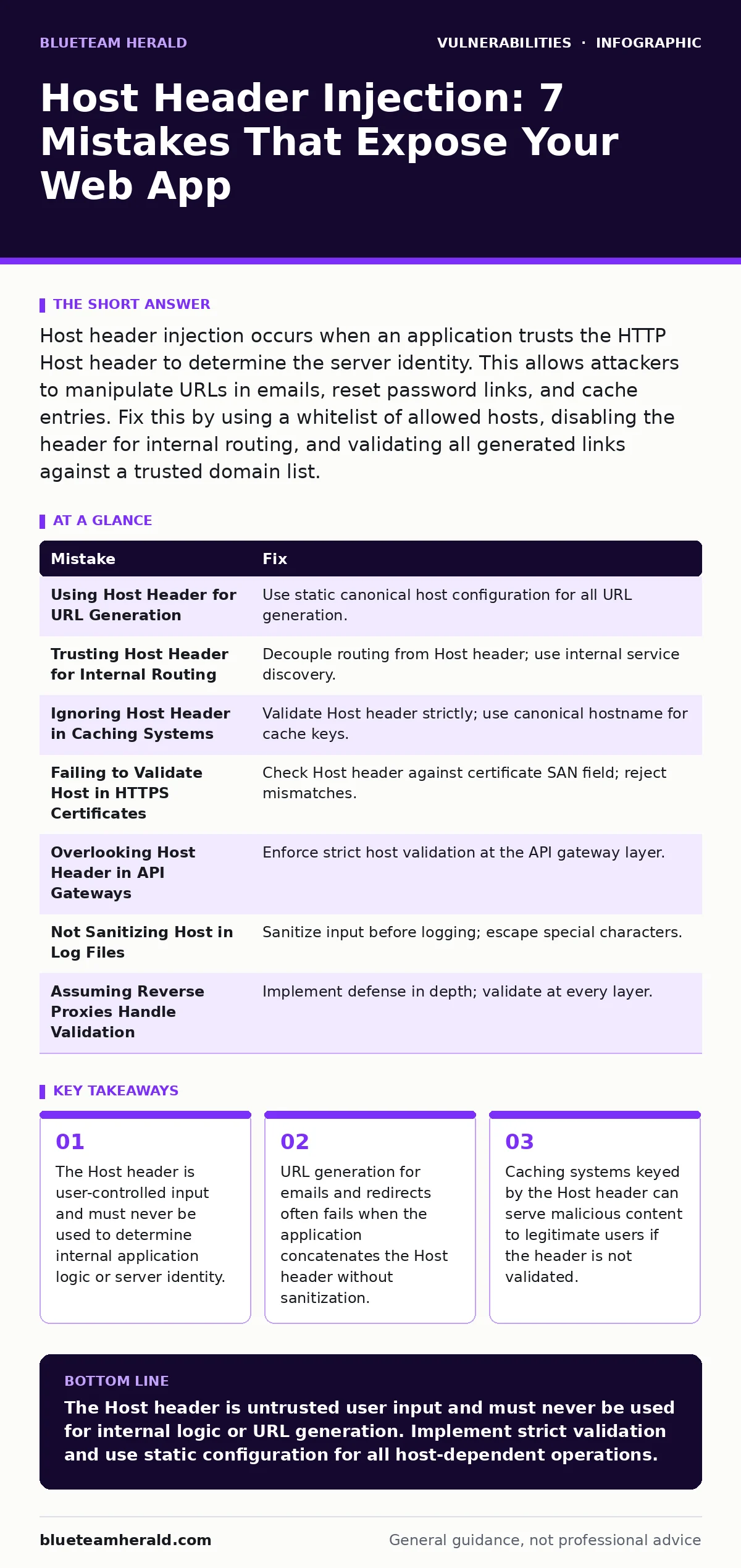
Host header injection occurs when an application trusts the HTTP Host header to determine the server identity. This allows attackers to manipulate URLs in emails, reset password links, and cache entries. Fix this by using a whitelist of allowed hosts, disabling the header for internal routing, and validating all generated links against a trusted domain list.
Mistake 1: Using Host Header for URL Generation
Applications often construct absolute URLs for email notifications, password resets, and API responses by reading the Host header from the incoming request. This practice assumes the header reflects the actual server domain. When an attacker sends a request with a modified Host header, the application generates links pointing to the attacker’s domain.
The consequence is a redirect attack where victims follow malicious links believing they originate from the trusted service. The fix is to define a canonical host configuration in the application settings. Use this static value for all URL generation instead of reading the request header. This ensures links always point to the intended destination regardless of input manipulation.
Mistake 2: Trusting Host Header for Internal Routing
Some applications use the Host header to determine which internal service or database to query. This is common in multi-tenant architectures or microservices setups. If the application routes traffic based on this header, an attacker can force the application to interact with unintended internal resources. This can lead to information disclosure or unauthorized data access. The fix is to decouple routing decisions from the Host header. Use internal service discovery mechanisms or static configuration files to determine routing. Validate that the requested host matches an expected list of internal domains before processing the request.
Mistake 3: Ignoring Host Header in Caching Systems
Content delivery networks and reverse proxies often cache responses based on the Host header. If the application does not validate the host, an attacker can inject a malicious host into the cache. This causes the cache to store and serve malicious content to other users who request the same resource. The consequence is widespread distribution of injected payloads. The fix is to configure the caching layer to ignore or validate the Host header strictly. Use a canonical hostname for cache keys. Ensure that only requests with valid, whitelisted hosts are cached and served.
Mistake 4: Failing to Validate Host in HTTPS Certificates
Applications may use the Host header to verify the validity of an HTTPS certificate. If the application trusts the header, an attacker can present a valid certificate for a different domain but use a malicious Host header to bypass checks. This undermines the security guarantees of TLS. The consequence is a man-in-the-middle attack where the attacker intercepts traffic without triggering certificate errors. The fix is to validate the Host header against the server’s actual certificate. Ensure that the application checks the certificate’s Subject Alternative Name (SAN) field. Reject requests where the Host header does not match the certificate.
Mistake 5: Overlooking Host Header in API Gateways
API gateways often use the Host header to route requests to different backend services. If the gateway trusts the header, an attacker can bypass access controls and reach internal APIs directly. This exposes sensitive endpoints to unauthorized access. The consequence is data breach or service disruption. The fix is to configure the API gateway to enforce strict host validation. Define a whitelist of allowed hosts for each backend service. Reject or redirect requests with invalid Host headers before they reach the application logic.
See also: Stolen Session Tokens: Debunking Six Common Security Myths · Warning Signs of Vulnerabilities in AI Model Serving Frameworks
Mistake 6: Not Sanitizing Host in Log Files
Applications often log the Host header for debugging and monitoring purposes. If the header is not sanitized, an attacker can inject malicious scripts or commands into the logs. This can lead to cross-site scripting (XSS) if the logs are viewed in a web interface. The consequence is compromise of administrative accounts. The fix is to sanitize all input before logging. Escape special characters and remove potentially dangerous content. Use structured logging formats that separate data from metadata. Ensure that log viewers render content safely.
Mistake 7: Assuming Reverse Proxies Handle Validation
Many developers assume that reverse proxies automatically validate the Host header. While some proxies do perform validation, others pass the header unchanged to the backend application. If the application relies on the proxy for security, it remains vulnerable. The consequence is a false sense of security and exposure to injection attacks. The fix is to implement defense in depth. Validate the Host header at every layer of the application stack. Do not rely solely on infrastructure components for security. Configure both the proxy and the application to enforce strict host validation.
| Mistake | Fix |
|---|---|
| Using Host Header for URL Generation | Use static canonical host configuration for all URL generation. |
| Trusting Host Header for Internal Routing | Decouple routing from Host header; use internal service discovery. |
| Ignoring Host Header in Caching Systems | Validate Host header strictly; use canonical hostname for cache keys. |
| Failing to Validate Host in HTTPS Certificates | Check Host header against certificate SAN field; reject mismatches. |
| Overlooking Host Header in API Gateways | Enforce strict host validation at the API gateway layer. |
| Not Sanitizing Host in Log Files | Sanitize input before logging; escape special characters. |
| Assuming Reverse Proxies Handle Validation | Implement defense in depth; validate at every layer. |
Key takeaways
- The Host header is user-controlled input and must never be used to determine internal application logic or server identity.
- URL generation for emails and redirects often fails when the application concatenates the Host header without sanitization.
- Caching systems keyed by the Host header can serve malicious content to legitimate users if the header is not validated.
The Host header is untrusted user input and must never be used for internal logic or URL generation. Implement strict validation and use static configuration for all host-dependent operations.
Frequently asked questions
How do I detect host header injection in my application?
Test your application by sending requests with modified Host headers. Check if the application generates URLs or routes traffic based on the injected value. Use security testing tools to automate this process.
Can host header injection lead to remote code execution?
Indirectly, yes. If the application uses the Host header to construct file paths or command arguments, it may lead to command injection. This can result in remote code execution on the server.
Is host header injection a common vulnerability?
It is a prevalent issue in web applications that rely on the Host header for logic. Many frameworks and libraries do not validate the header by default, leaving applications vulnerable.
How does host header injection relate to cross-site scripting (XSS)?
Host header injection can facilitate XSS attacks by injecting malicious scripts into cached content or log files. If these are rendered without sanitization, they can execute in the victim’s browser.
How this guide was produced: written by the BlueTeam Herald editorial team with AI assistance, checked against the public references listed below, and reviewed when the facts change. See our editorial policy or report an error.