Customer Data Exposure: How to Find and Fix Hidden Leaks
Most customer data exposure occurs through misconfigured cloud storage and unmanaged third-party access rather than direct network intrusions.

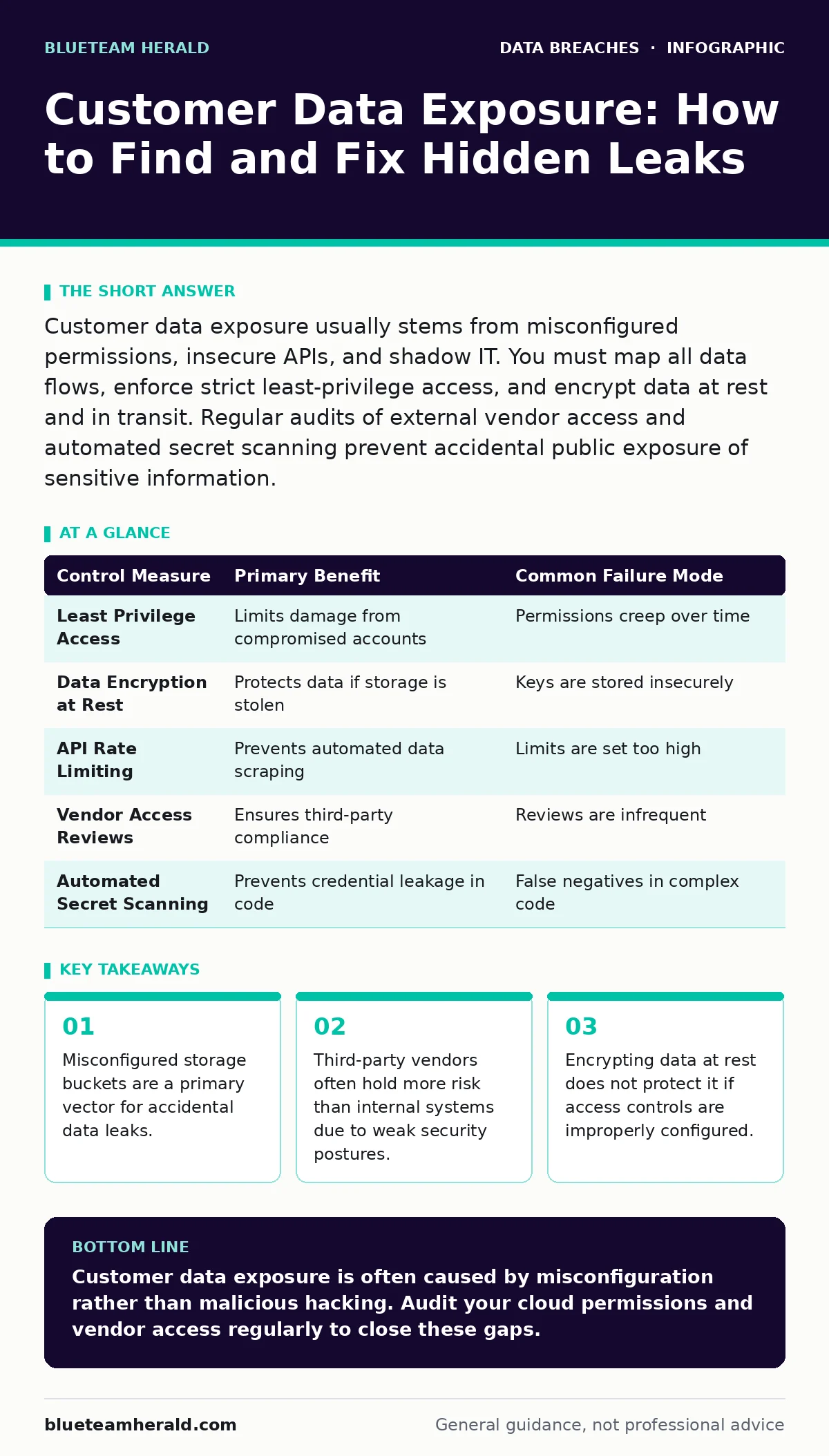
Customer data exposure usually stems from misconfigured permissions, insecure APIs, and shadow IT. You must map all data flows, enforce strict least-privilege access, and encrypt data at rest and in transit. Regular audits of external vendor access and automated secret scanning prevent accidental public exposure of sensitive information.
What causes customer data exposure?
Customer data exposure occurs when unauthorized individuals access, copy, or use personal information stored by an organization. This happens through technical misconfigurations, human error, or malicious exploitation of weak access controls. Common causes include public cloud storage buckets, insecure application programming interfaces (APIs), and unpatched software vulnerabilities. Understanding the root cause is necessary for effective remediation.
How do attackers find exposed customer data?
Attackers use automated scanning tools to search for publicly accessible databases and storage containers. They look for default credentials, unencrypted endpoints, and misconfigured identity management settings. These bots crawl the internet continuously, indexing any resource that lacks proper authentication. You cannot rely on obscurity to protect your data. Active monitoring of external attack surfaces is required to detect these exposures before malicious actors exploit them.
Why are cloud storage misconfigurations so dangerous?
Cloud storage misconfigurations leave data visible to the entire internet without authentication. Administrators often set permissions too broadly during rapid deployment, forgetting to lock down access later. A single misconfigured bucket can expose millions of records instantly. This risk increases when teams use complex infrastructure that is difficult to audit manually. Automated compliance checks must verify permission settings against security baselines regularly.
What is the role of third-party vendors in data leaks?
Third-party vendors often have direct access to customer data for processing or support. Their security controls may be weaker than your own, creating a weak link in the chain. Suppose a vendor uses shared credentials for database access; a breach there exposes your data too. You must treat vendor access as internal access. Implement strict vendor risk management protocols to assess their security posture before granting any data access.
How does poor secrets management lead to exposure?
Poor secrets management allows credentials, API keys, and tokens to remain in code repositories or configuration files. Developers often commit these secrets accidentally, where automated scanners or attackers can retrieve them. These secrets provide immediate access to databases and systems. You must integrate secrets management tools into your development pipeline. These tools rotate credentials automatically and prevent hard-coded secrets from entering production environments.
See also: Data Privacy vs Data Security: The Critical Difference Explained · Identity Sprawl Mechanics: Step-by-Step Lifecycle and Control Points
Why is data classification critical for protection?
Data classification labels information based on sensitivity, allowing you to apply appropriate controls. Without classification, you cannot distinguish between public marketing materials and private health records. This leads to either over-protecting low-risk data or under-protecting high-risk data. Classifying data ensures that encryption and access controls are applied where they matter most. It also simplifies compliance with breach notification laws by identifying what must be reported.
What are the signs of a silent data exfiltration?
Silent data exfiltration often lacks obvious system crashes or error messages. Instead, you see unusual network traffic patterns, such as large data transfers to unknown IP addresses. User accounts may log in from new locations or at odd hours. Database queries might return larger result sets than usual. These anomalies require continuous monitoring and behavioral analysis to detect. Relying solely on perimeter defenses misses these internal threats.
How do you verify that exposed data is secured?
You verify security by conducting regular penetration tests and access reviews. These tests attempt to exploit known vulnerabilities and misconfigurations in your environment. Access reviews ensure that employees and systems retain only the permissions they need. This process identifies stale accounts and overly broad permissions. Combine these technical checks with digital forensics capabilities to investigate any suspected incident thoroughly.
| Control Measure | Primary Benefit | Common Failure Mode |
|---|---|---|
| Least Privilege Access | Limits damage from compromised accounts | Permissions creep over time |
| Data Encryption at Rest | Protects data if storage is stolen | Keys are stored insecurely |
| API Rate Limiting | Prevents automated data scraping | Limits are set too high |
| Vendor Access Reviews | Ensures third-party compliance | Reviews are infrequent |
| Automated Secret Scanning | Prevents credential leakage in code | False negatives in complex code |
What happens when customer data is exposed?
When customer data is exposed, the organization faces immediate operational disruption and long-term reputational damage. Legal teams must assess liability under relevant regulations. IT teams isolate affected systems to prevent further loss. Customers lose trust, which affects future business. The financial cost includes fines, legal fees, and remediation expenses. Preventing exposure is far cheaper than responding to it.
How does employee offboarding contribute to data risk?
Employee offboarding contributes to data risk when access rights are not revoked promptly. Former employees may retain access to databases, email accounts, and cloud consoles. These accounts can be used by malicious actors or disgruntled ex-employees. You must automate access revocation as part of the offboarding process. This includes disabling network access, returning hardware, and changing shared credentials. Delayed offboarding is a common oversight that leads to unauthorized data access.
Can encryption prevent all data exposure?
Encryption prevents data exposure only if the encryption keys are secure and access controls are strict. If an attacker obtains the keys or bypasses authentication, encrypted data becomes readable. Encryption at rest protects data on disks, but data in transit must also be secured using protocols like TLS. You must manage keys separately from the data they protect. Regular key rotation ensures that compromised keys have a limited window of usefulness. Encryption is a control, not a complete solution.
What is the first step in responding to exposure?
The first step in responding to exposure is containment. You must stop the data flow immediately by revoking compromised credentials and isolating affected systems. Do not shut down systems entirely, as this may destroy evidence needed for digital forensics. Preserve logs and memory dumps for analysis. Once containment is achieved, assess the scope of the breach. This determines what data was accessed and who was affected.
How do you balance usability with security?
You balance usability with security by implementing adaptive authentication and clear policy communication. Strict controls that hinder work lead to shadow IT, where employees bypass security for convenience. Use multi-factor authentication for sensitive actions but simplify login for low-risk tasks. Educate users on why certain restrictions exist. When users understand the risk, they are more likely to comply with security measures without feeling frustrated.
Key takeaways
- Misconfigured storage buckets are a primary vector for accidental data leaks.
- Third-party vendors often hold more risk than internal systems due to weak security postures.
- Encrypting data at rest does not protect it if access controls are improperly configured.
Customer data exposure is often caused by misconfiguration rather than malicious hacking. Audit your cloud permissions and vendor access regularly to close these gaps.
Frequently asked questions
How do I know if my data was exposed in a breach?
Monitor external threat intelligence feeds and use scanning tools to check if your data appears on public networks.
What is the difference between a breach and an exposure?
Exposure means data is accessible; a breach means an attacker has actively accessed or stolen that data.
Should I encrypt all customer data?
Yes, encrypt sensitive data at rest and in transit, but ensure key management is secure and access controls are strict.
How often should I review third-party vendor access?
Review vendor access at least annually or whenever their security posture changes significantly.
How this guide was produced: written by the BlueTeam Herald editorial team with AI assistance, checked against the public references listed below, and reviewed when the facts change. See our editorial policy or report an error.