Vendor Risk Management Checklist for Third-Party Security
A vendor’s weak security posture often exposes your network to risk even when your own defenses are perfectly configured and actively monitored.

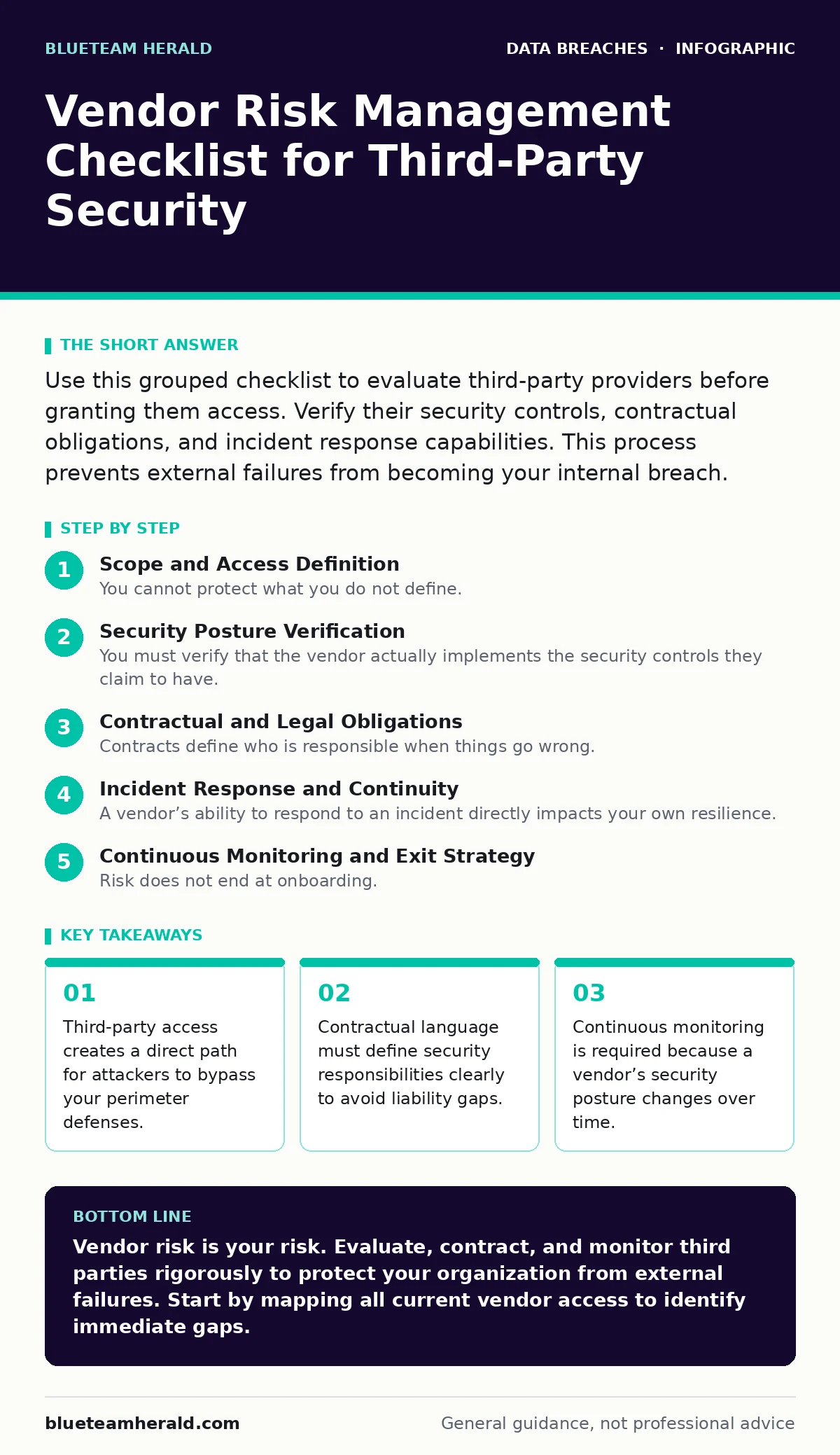
Use this grouped checklist to evaluate third-party providers before granting them access. Verify their security controls, contractual obligations, and incident response capabilities. This process prevents external failures from becoming your internal breach.
Scope and Access Definition
You cannot protect what you do not define. The first step in vendor risk management is determining exactly what data and systems a provider needs to access. Over-privileged accounts are a common source of compromise. If a vendor needs access to customer records, they should not have access to financial ledgers.
- Define minimum required access levels: Principle of least privilege reduces the attack surface.
- Map data flow diagrams: Visualizing data movement reveals unnecessary exposure points.
- Identify data classification levels: Knowing sensitivity dictates the required security controls.
- Specify allowed connection methods: Restricting connectivity to specific protocols limits exploitation vectors.
Imagine a cloud storage provider that requires broad administrative access to your network to sync files. This setup allows an attacker who compromises the provider to move laterally into your core systems. By restricting access to only the specific folders needed, you contain the potential damage.
Security Posture Verification
You must verify that the vendor actually implements the security controls they claim to have. Self-assessment questionnaires are often biased or outdated. Independent audits provide a more reliable view of their operational reality. Look for evidence of active security practices rather than just policy documents.
- Review recent third-party audit reports: External validation confirms control effectiveness.
- Verify encryption standards for data at rest and in transit: Encryption protects data even if other controls fail.
- Confirm multi-factor authentication enforcement: MFA prevents unauthorized access via stolen credentials.
- Check for regular vulnerability scanning: Proactive identification of flaws reduces the window for exploitation.
A vendor may claim to follow best practices but fail to patch known vulnerabilities. This gap can lead to a breach similar to those discussed in our guide on stolen session tokens, where weak authentication allows persistent access. You need proof of remediation, not just policy.
Contractual and Legal Obligations
Contracts define who is responsible when things go wrong. Standard terms often leave security responsibilities ambiguous. You must ensure the contract explicitly states the vendor’s duty to protect your data and notify you of incidents. Without clear language, you may bear the cost of a breach caused by their negligence.
- Include specific security requirements in the contract: Legal enforceability ensures compliance.
- Define incident notification timelines: Rapid awareness allows you to mitigate damage quickly.
- Specify data ownership and return/destruction terms: Clear terms prevent data retention after contract end.
- Include right-to-audit clauses: Independent verification ensures ongoing compliance.
Consider the scenario where a vendor suffers a breach but delays notification due to vague contract terms. This delay can violate breach notification laws, exposing your organization to regulatory fines. Clear contractual obligations protect your legal standing.
Incident Response and Continuity
A vendor’s ability to respond to an incident directly impacts your own resilience. You need to know how they detect, contain, and recover from security events. Their response plan should integrate with your own incident response procedures. Disconnected plans lead to confusion and extended downtime.
- Review their incident response plan: Understanding their process helps you prepare for coordination.
- Verify business continuity and disaster recovery plans: Ensures service availability during major disruptions.
- Confirm backup and restoration procedures: Reliable backups are critical for data recovery.
- Identify points of contact for security incidents: Direct communication channels speed up resolution.
If a vendor’s primary data center fails, your operations may halt. Their disaster recovery plan must align with your acceptable downtime limits. See our guide on the 3-2-1 backup rule for details on ensuring data resilience.
See also: Stop Oversharing on Social Media: A Prevention Checklist · Should I Pay for Credit Monitoring? The Real Value vs Cost
Continuous Monitoring and Exit Strategy
Risk does not end at onboarding. A vendor’s security posture can degrade over time. Continuous monitoring ensures they maintain agreed-upon standards. You also need a clear exit strategy to remove access and retrieve data when the relationship ends. Poor offboarding can leave residual access paths open.
- Establish regular security review intervals: Periodic checks ensure ongoing compliance.
- Monitor for public security incidents involving the vendor: External events may indicate internal weaknesses.
- Define access revocation procedures: Immediate removal of access prevents unauthorized use.
- Verify data deletion upon contract termination: Ensures no residual data remains with the vendor.
Suppose a vendor acquires a smaller company and inherits its security flaws. Without continuous monitoring, you may remain unaware of the increased risk. Refer to our guide on employee offboarding security for insights on managing access termination effectively.
Key takeaways
- Third-party access creates a direct path for attackers to bypass your perimeter defenses.
- Contractual language must define security responsibilities clearly to avoid liability gaps.
- Continuous monitoring is required because a vendor’s security posture changes over time.
Vendor risk is your risk. Evaluate, contract, and monitor third parties rigorously to protect your organization from external failures. Start by mapping all current vendor access to identify immediate gaps.
Frequently asked questions
How often should I review vendor security?
Review at least annually or after any significant change in the vendor’s services or security posture.
What if a vendor refuses to share audit reports?
Consider this a high-risk signal and evaluate alternative providers or restrict access significantly.
Can I rely on a vendor’s certification?
Certifications indicate a baseline but do not guarantee real-time security effectiveness.
How do I handle a vendor breach?
Activate your incident response plan, isolate affected systems, and coordinate with the vendor for forensic details.
How this guide was produced: written by the BlueTeam Herald editorial team with AI assistance, checked against the public references listed below, and reviewed when the facts change. See our editorial policy or report an error.