Should I Pay for Credit Monitoring? The Real Value vs Cost
Monitoring services detect alerts after fraud occurs, while true prevention requires freezing your credit reports with the three major bureaus immediately.

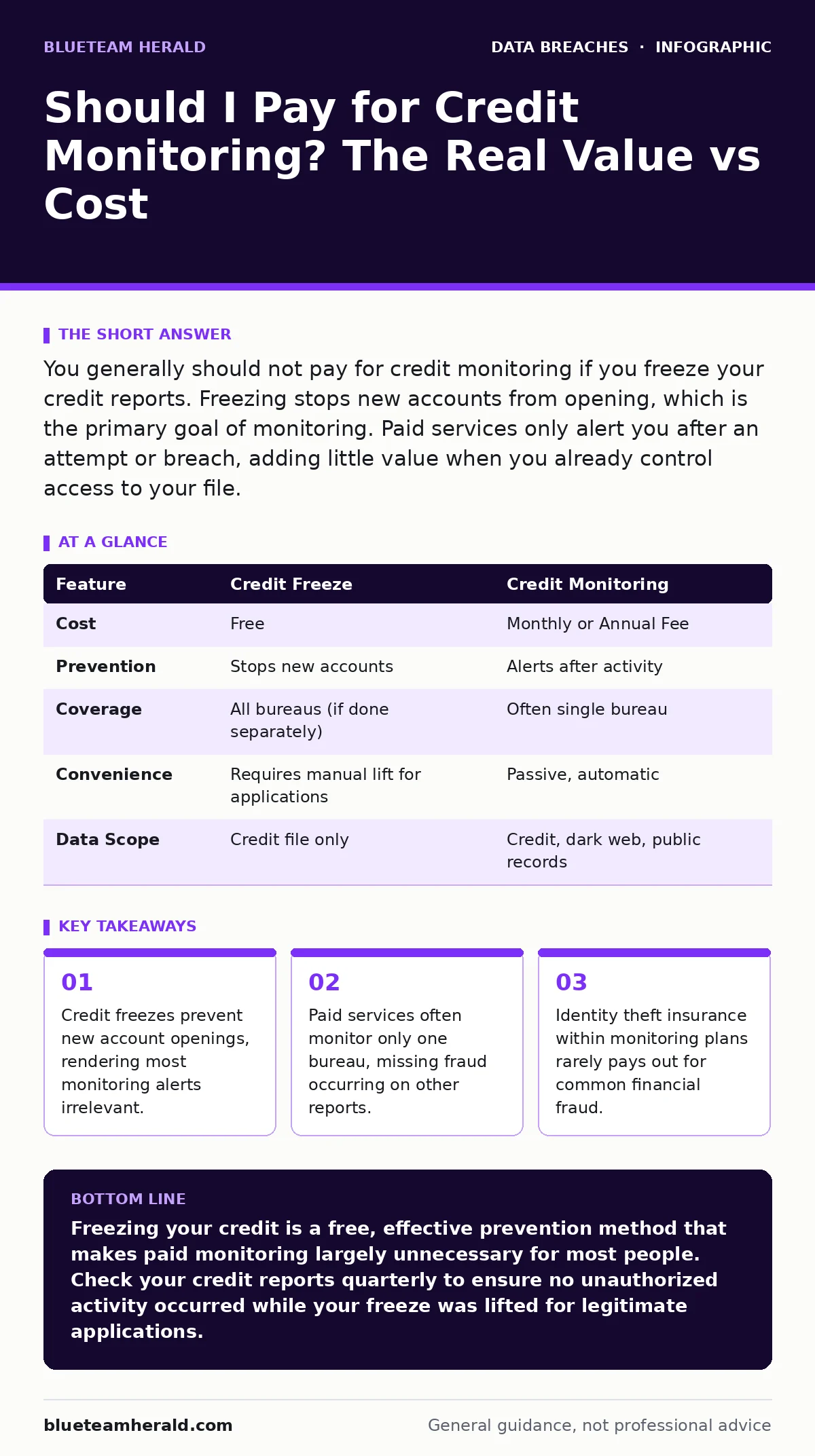
You generally should not pay for credit monitoring if you freeze your credit reports. Freezing stops new accounts from opening, which is the primary goal of monitoring. Paid services only alert you after an attempt or breach, adding little value when you already control access to your file.
Should i pay for credit monitoring?
You should not pay for credit monitoring if you actively freeze your credit reports with all three major bureaus. A credit freeze blocks lenders from accessing your file, preventing new accounts from being opened in your name. This mechanical barrier is more effective than any alert system. Monitoring services only notify you after a change occurs or a breach happens. If you freeze your credit, the change never happens, making the monitoring service redundant for its primary promise.
What does credit monitoring actually do?
Credit monitoring services scan your credit reports and public records for specific changes. They look for new hard inquiries, new accounts, address changes, and court records. When a service detects a change, it sends you an email or push notification. This is a reactive measure. It tells you that someone attempted to use your identity or that your data was exposed. It does not stop the attempt. It only informs you so you can take remediation steps.
Why is a credit freeze better than monitoring?
A credit freeze is a legal right that restricts access to your credit file. Lenders cannot pull your report to approve new credit while the freeze is active. This prevents identity thieves from opening loans, credit cards, or lines of credit. Monitoring cannot stop this; it can only alert you after the thief succeeds or fails. Freezing is free in most jurisdictions and provides absolute prevention for new account fraud. Monitoring provides visibility, which is useful only if you cannot freeze your credit.
When is paid monitoring actually useful?
Paid monitoring becomes useful when you cannot freeze your credit or choose not to. This includes active mortgage applications, car loans, or rental agreements where frequent credit checks are necessary. In these scenarios, you must temporarily lift the freeze, creating a window of vulnerability. Monitoring fills this gap by alerting you to activity during the unfrozen period. It is also useful for monitoring non-credit data, such as Social Security number usage on dark web forums or changes to utility accounts that do not require a credit pull.
What are the hidden costs of these services?
The hidden cost of credit monitoring is often false security. Many users believe a paid subscription prevents identity theft. It does not. It only detects it. Furthermore, most basic plans only monitor one credit bureau. Fraudsters often target the bureau with the least activity or the one not being monitored. You may receive zero alerts while your identity is compromised on other reports. Additionally, these services often upsell identity restoration services, which guide you through the bureaucratic process of disputing fraudulent charges. This guidance is often simple to perform yourself.
See also: Customer Data Exposure: How to Find and Fix Hidden Leaks · Breach Notification Laws: Meaning, Triggers, and Legal Definitions
How do these services handle data breaches?
Monitoring services aggregate data from various sources to detect if your personal information appears in known data breaches. They cross-reference your email, phone number, and address against databases of stolen credentials. This helps you know if your login details are compromised. However, this does not protect your financial identity directly. It prompts you to change passwords. For deeper protection of digital assets, you should review our guide on secrets management to understand how to secure credentials that have been exposed.
What about identity theft insurance?
Many premium monitoring plans include identity theft insurance. This coverage reimburses you for expenses related to recovering from identity theft, such as legal fees or lost wages. The coverage limits are often low, and the exclusions are extensive. Most policies do not cover direct financial losses from unauthorized transactions. Your bank and credit card issuer are responsible for reversing those charges. The insurance is more relevant for complex identity theft, such as medical identity theft, where the damage is not immediately financial. Understanding the scope of customer data exposure helps you assess the risk of such non-financial theft.
| Feature | Credit Freeze | Credit Monitoring |
|---|---|---|
| Cost | Free | Monthly or Annual Fee |
| Prevention | Stops new accounts | Alerts after activity |
| Coverage | All bureaus (if done separately) | Often single bureau |
| Convenience | Requires manual lift for applications | Passive, automatic |
| Data Scope | Credit file only | Credit, dark web, public records |
How do you respond to an alert?
When you receive an alert from a monitoring service, verify the activity immediately. Log into your credit bureau accounts directly, not through the monitoring service link. Check for hard inquiries you did not authorize or accounts you did not open. If you find unauthorized activity, place a fraud alert on your credit report. This warns lenders to verify your identity before extending credit. Then, dispute the fraudulent account with the bureau and the creditor. This process is manual and time-consuming. Having a solid 3-2-1 backup rule for your digital documents can help you recover personal records if they are stolen during the incident.
What if you suspect medical identity theft?
Medical identity theft is difficult to detect through standard credit monitoring. It often does not involve credit pulls. Thieves use your identity to obtain medical services or prescribe drugs. This creates errors in your medical records and billing statements. You must review your Explanation of Benefits (EOB) statements regularly. Look for procedures or medications you did not receive. Standard financial monitoring will not catch this. You may need to place a security freeze on your medical records if your provider allows it. This is a niche risk that general monitoring services rarely address effectively.
How does this relate to digital forensics?
If identity theft occurs, you may need to document the timeline of events for police reports or insurance claims. This is a form of personal digital forensics. Keep records of all alerts, correspondence with banks, and dispute letters. Take screenshots of your credit reports showing the fraudulent accounts. This evidence is critical for proving that the activity was not authorized by you. Without this documentation, reversing the damage becomes significantly harder. Understanding the basics of database security can also help you appreciate how your data was likely accessed and exfiltrated in the first place.
What is the best overall strategy?
The best strategy combines prevention with targeted monitoring. Freeze your credit with all three bureaus to stop new account fraud. Use a free credit monitoring service from one of the bureaus to check for existing account changes or address updates. Reserve paid monitoring only if you have specific needs, such as monitoring for dark web exposure or medical identity theft. Do not pay for monitoring as a substitute for a credit freeze. The freeze is the lock; monitoring is the alarm. You do not need an alarm if the door is locked and no one can enter.
Key takeaways
- Credit freezes prevent new account openings, rendering most monitoring alerts irrelevant.
- Paid services often monitor only one bureau, missing fraud occurring on other reports.
- Identity theft insurance within monitoring plans rarely pays out for common financial fraud.
Freezing your credit is a free, effective prevention method that makes paid monitoring largely unnecessary for most people. Check your credit reports quarterly to ensure no unauthorized activity occurred while your freeze was lifted for legitimate applications.
Frequently asked questions
Can I freeze my credit and still use my existing cards?
Yes, a credit freeze only blocks new credit inquiries. Your existing accounts remain active and unaffected.
Do I need to unfreeze my credit to check my own score?
No, you can always access your own credit report and score without lifting the freeze. This is considered a soft inquiry.
Is credit monitoring worth it for students?
Students are prime targets for identity theft due to limited credit history. A free freeze is better than paid monitoring, but monitoring can help establish good credit habits.
What happens if I lose my PIN for the credit freeze?
Contact the credit bureau directly. They will verify your identity through other means and reset your PIN or provide a new one.
How this guide was produced: written by the BlueTeam Herald editorial team with AI assistance, checked against the public references listed below, and reviewed when the facts change. See our editorial policy or report an error.