CEO Fraud Explained: How Impersonation Attacks Bypass Human Trust
Attackers exploit your desire to be helpful by mimicking authority figures, turning your compliance into a security breach without needing technical exploits.

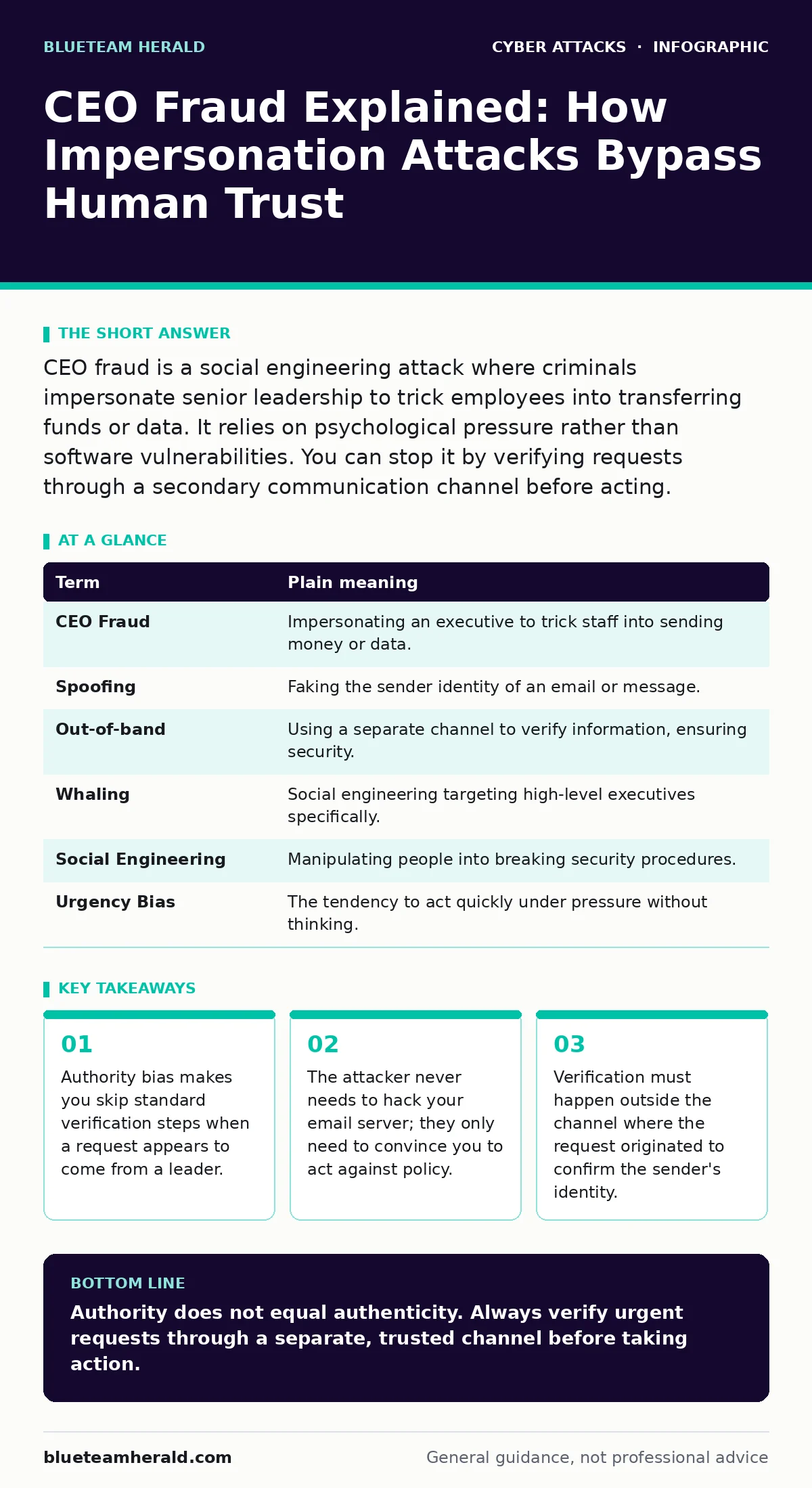
CEO fraud is a social engineering attack where criminals impersonate senior leadership to trick employees into transferring funds or data. It relies on psychological pressure rather than software vulnerabilities. You can stop it by verifying requests through a secondary communication channel before acting.
The Urgent Phone Call
Imagine you receive a phone call from your manager. The voice sounds stressed and hurried. They ask you to buy gift cards immediately because they are in a meeting and cannot use a corporate card. You feel a spike of anxiety. You want to help. You rush to the store, ignoring the fact that this is not how your company handles expenses.
This scenario mirrors CEO fraud. The attacker does not break into your system. They break into your routine. They create a sense of urgency that overrides your normal caution. The goal is to make you act before you think.
In this attack, the criminal poses as a high-ranking executive. They know you respect authority. They know you want to be efficient. They use your professionalism against you. The request often involves moving money or sharing sensitive data. The pressure is the weapon.
Anatomy of the Impersonation
The attacker prepares carefully. They research your organization. They find your name, your role, and your boss’s name on public profiles. They set up an email address that looks nearly identical to your CEO’s address. They might use a slight misspelling or a different domain that looks similar.
This is a form of whaling attacks, which target senior executives, but here the executive is the mask, not the target. The attacker sends a message that looks like an internal email. The tone is direct and demanding. It lacks the usual pleasantries. It creates a narrative where you are the only one who can solve a problem.
The message often references a fake event. A vendor is waiting. A deal is closing. A legal issue is looming. The details are vague enough to avoid easy fact-checking but specific enough to feel real. You are placed in a role where compliance seems like the only logical choice.
Why Verification Fails
You might think you would spot a fake. You look at the sender’s name. It says "John Smith, CEO." You assume the email system validates this. It does not. Email protocols are largely open. Spoofing the display name is trivial. Even if the domain matches, the attacker may have compromised a legitimate account or created a lookalike domain.
This is where security misconfigurations in global email systems come into play. If your organization allows easy creation of external accounts that look internal, the risk increases. The attacker exploits the trust you place in the interface. You see a familiar name and a familiar domain structure. Your brain shortcuts the verification process.
The hidden cost of this shortcut is the bypass of security controls. You might be asked to bypass multi-factor authentication or use a personal device. The attacker guides you to disable the very tools designed to protect you. You become the vulnerability.
The Psychology of Compliance
Humans are wired to respond to authority. This is a social instinct. In a workplace, following instructions from leadership is a norm. Attackers hijack this norm. They create a situation where questioning the request feels like insubordination.
This differs from phishing-resistant authentication methods, which rely on cryptographic proofs. In CEO fraud, the proof is social. The attacker provides a narrative that feels authentic. They may call you on the phone after emailing, using a voice changer or simply a confident tone. The consistency between the email and the call reinforces the lie.
The urgency is key. Time pressure reduces your cognitive capacity to analyze the request. You stop looking for inconsistencies. You focus on execution. The attacker has successfully shifted your focus from security to service.
Simple Safety Habits
You can break this cycle with one rule: out-of-band verification. This means confirming the request through a different communication channel. If the request comes via email, call the person using a known, trusted phone number. Do not call the number in the email. Do not reply to the email.
Use your corporate directory or a business card you already have. If the person is unavailable, escalate to their assistant or HR. A real executive will understand the need for verification. A fake one will become aggressive or disappear.
This habit protects you from smishing and other text-based impersonations as well. The principle is universal. Trust the process, not the message. Verify the source independently. This adds a small delay to your workflow but prevents catastrophic loss.
See also: Business Email Compromise Example: How Attackers Bypass Trust
Mini Glossary
| Term | Plain meaning |
|---|---|
| CEO Fraud | Impersonating an executive to trick staff into sending money or data. |
| Spoofing | Faking the sender identity of an email or message. |
| Out-of-band | Using a separate channel to verify information, ensuring security. |
| Whaling | Social engineering targeting high-level executives specifically. |
| Social Engineering | Manipulating people into breaking security procedures. |
| Urgency Bias | The tendency to act quickly under pressure without thinking. |
Try This Now
- [ ] Identify the official phone number for your direct supervisor and your CEO. Save it in your contacts today.
- [ ] Draft a template response for suspicious requests. It should state that you will verify the request via a secondary channel before proceeding.
- [ ] Review your recent email inbox. Look for any messages that felt urgent or asked for deviations from standard procedure. Analyze why they felt compelling.
Key takeaways
- Authority bias makes you skip standard verification steps when a request appears to come from a leader.
- The attacker never needs to hack your email server; they only need to convince you to act against policy.
- Verification must happen outside the channel where the request originated to confirm the sender's identity.
Authority does not equal authenticity. Always verify urgent requests through a separate, trusted channel before taking action.
Frequently asked questions
Can I trust an email that looks exactly like my boss’s?
No. Visual appearance is easily faked. Always verify the sender through a different method, such as a phone call to a known number.
What if my boss says they are in a meeting and can’t talk?
Ask them to send a confirmation via a different channel or check with their assistant. Real emergencies can wait a few minutes for verification.
Does two-factor authentication stop this?
Not always. If the attacker convinces you to bypass 2FA or uses a compromised account, 2FA may not help. Human verification is still required.
How do I report a suspected CEO fraud attempt?
Forward the email to your security team immediately. Do not delete it. Provide any context you have about the request.
How this guide was produced: written by the BlueTeam Herald editorial team with AI assistance, checked against the public references listed below, and reviewed when the facts change. See our editorial policy or report an error.