What Is Secrets Management: Secure Credentials Without Hardcoding
Proper secrets management prevents credential leakage by isolating sensitive data from application code and version control systems, reducing the risk of unauthorized access.

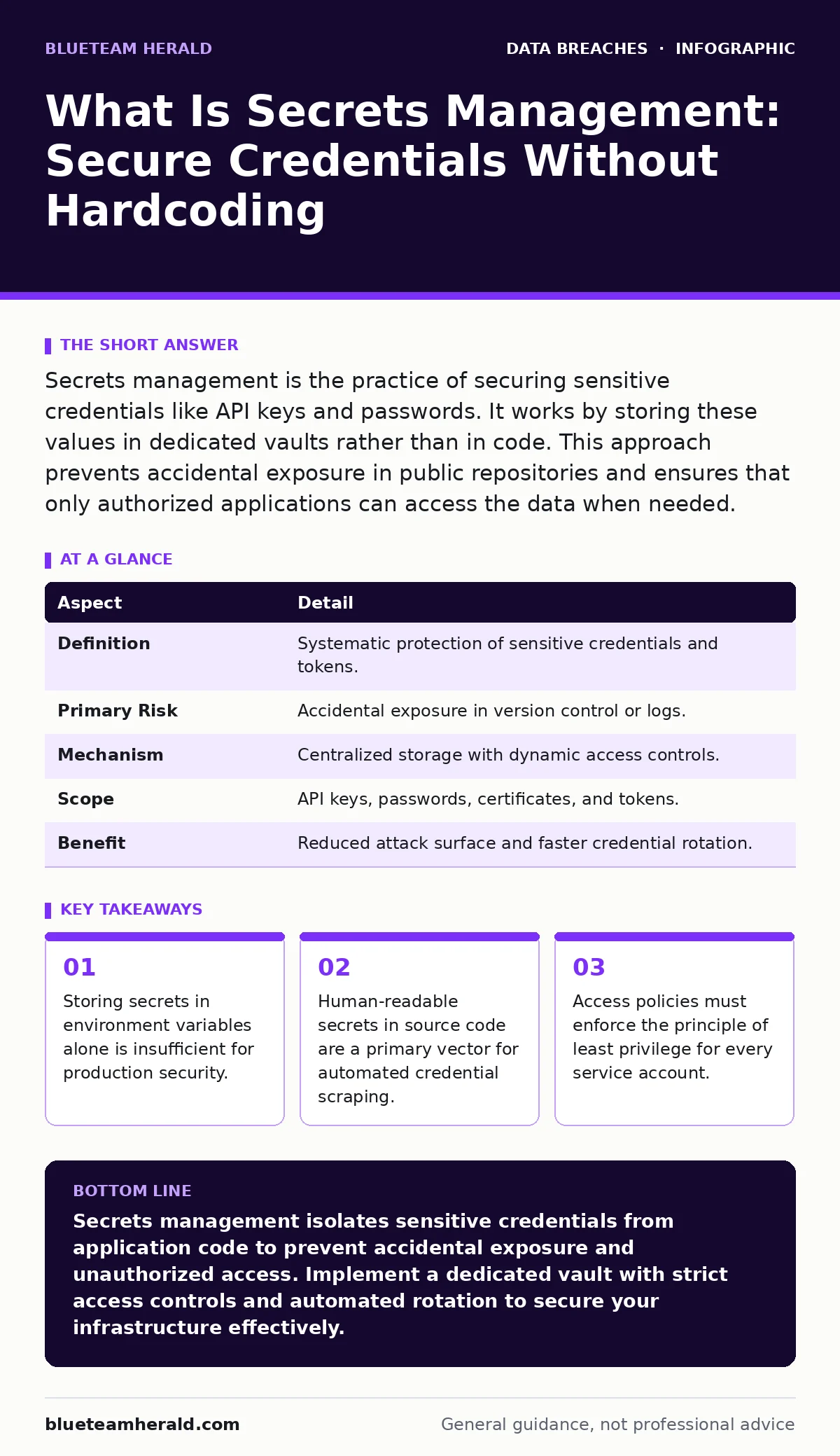
Secrets management is the practice of securing sensitive credentials like API keys and passwords. It works by storing these values in dedicated vaults rather than in code. This approach prevents accidental exposure in public repositories and ensures that only authorized applications can access the data when needed.
Understanding What Is Secrets Management
Imagine you leave your house keys under the doormat for convenience. A visitor can easily find them, but so can a stranger. Secrets management replaces the doormat with a secure lockbox. It is the systematic process of protecting sensitive data such as passwords, API keys, and cryptographic tokens. This practice ensures that only authorized individuals or applications can access these credentials.
The core goal is to separate sensitive information from the code that uses it. When you embed a database password directly into your application script, you create a permanent link between the logic and the secret. If the code is copied, shared, or leaked, the secret travels with it. Dedicated management tools break this link by fetching credentials dynamically at runtime.
| Aspect | Detail |
|---|---|
| Definition | Systematic protection of sensitive credentials and tokens. |
| Primary Risk | Accidental exposure in version control or logs. |
| Mechanism | Centralized storage with dynamic access controls. |
| Scope | API keys, passwords, certificates, and tokens. |
| Benefit | Reduced attack surface and faster credential rotation. |
How Credential Storage Works
Traditional development often relies on environment variables to store secrets. While better than hardcoding, this method has significant flaws. Environment variables are visible to any process running on the same server. If an attacker compromises one application, they can often read the environment variables of neighboring services.
Modern secrets management uses a dedicated vault. This is a specialized server or service that stores encrypted credentials. Applications request access to a specific secret using their own identity. The vault verifies the request against strict policies. If authorized, the vault provides the secret for a limited time. This dynamic delivery means the secret never sits permanently in the application's memory or disk.
This architecture supports automatic rotation. When a password expires, the vault updates it without requiring a code change. Applications that have configured the vault correctly will automatically fetch the new credential. This eliminates the window of vulnerability often seen when developers manually update configuration files across multiple servers.
Who Needs to Protect Secrets
Every organization that uses software interacts with secrets. Startups often overlook this because their codebases are small. However, even a single leaked API key can compromise payment processors or cloud infrastructure. Large enterprises face greater complexity because they manage thousands of services. Each service requires its own set of credentials.
Developers are the primary agents in this process. They must learn to treat secrets as external dependencies. DevOps engineers configure the vaults and the access policies. Security teams audit the configurations to ensure compliance. If you handle stolen session tokens or manage user data, the stakes are higher because a breach directly impacts customer privacy.
Common Mistakes in Handling Secrets
Many teams believe that using environment variables is sufficient. This is a dangerous misconception. Environment variables are easily exposed through crash dumps, logs, or debugging interfaces. They lack the access controls and audit trails provided by dedicated vaults. Treating environment variables as a security boundary creates a false sense of safety.
Another frequent error is sharing secrets among multiple services. When three applications use the same database password, you cannot revoke access for one without disrupting the others. This violates the principle of least privilege. Each service should have its own unique credential. This isolation allows you to detect and contain breaches more effectively.
Hardcoding secrets in configuration files is the most persistent mistake. Even if the file is marked as private, backups, logs, and error messages can expose its contents. Once a secret is in the code, it remains there forever in the version history. You cannot simply delete the file to remove the risk. You must rotate the secret immediately and purge it from all historical records.
Integrating Secrets Into Development
Integrating secrets management into your workflow requires a shift in how you structure applications. Your code should not know the values of the secrets. Instead, it should know how to request them. This often involves adding a client library or SDK to your application. The client communicates with the vault using secure protocols.
During the build and deployment phase, the system injects the necessary connections. The application starts, requests its credentials, and begins operation. If the vault is unreachable, the application should fail securely rather than using fallback defaults. This ensures that no operation proceeds without verified authorization.
You must also consider the lifecycle of the secrets. Regular rotation reduces the impact of any potential leak. Automated rotation scripts can update credentials in the vault and push the changes to dependent services. This process must be tested thoroughly to avoid service interruptions. Refer to the 3-2-1 backup rule when planning how you store recovery keys for your vault itself.
See also: Database Security FAQ: Protecting Records from Internal and External Threats · Stop Oversharing on Social Media: A Prevention Checklist
Auditing and Monitoring Access
Storing secrets securely is only half the battle. You must monitor who accesses them and when. The vault should log every request for a credential. These logs provide an audit trail for security reviews. Look for unusual patterns, such as a service requesting secrets it has never accessed before.
Regular audits help identify over-permissioned accounts. A service that has access to production databases but only runs in development is a risk. Reviewing these permissions ensures that the principle of least privilege is maintained. This process is similar to employee offboarding security, where you must revoke access promptly when roles change.
Preventing Leakage in Repositories
Even with a vault, developers may accidentally commit secrets to version control. Pre-commit hooks can help prevent this. These scripts scan your code for patterns that resemble keys or passwords before you push changes. If a match is found, the commit is blocked. This adds a final layer of defense against human error.
You must also scan your existing repositories for historical leaks. Tools can analyze your entire commit history to find exposed credentials. If you find a leaked secret, you must assume it is compromised. Rotate the credential immediately and revoke the old one. Do not rely on deleting the commit to hide the secret, as it may still exist in clones of the repository.
This discipline protects you from password leaks that originate from your own codebase. It also ensures that you do not inadvertently expose third-party credentials. Consistent scanning and strict commit policies create a culture of security awareness among your development team.
Key takeaways
- Storing secrets in environment variables alone is insufficient for production security.
- Human-readable secrets in source code are a primary vector for automated credential scraping.
- Access policies must enforce the principle of least privilege for every service account.
Secrets management isolates sensitive credentials from application code to prevent accidental exposure and unauthorized access. Implement a dedicated vault with strict access controls and automated rotation to secure your infrastructure effectively.
Frequently asked questions
Can I use environment variables for production secrets?
Environment variables are visible to all processes on the server and lack audit trails. They are insufficient for high-security production environments. Use a dedicated secrets manager instead.
How do I rotate secrets without downtime?
Configure your applications to fetch secrets dynamically from the vault. When you rotate the secret in the vault, the application will automatically retrieve the new value on its next request or configured interval.
Is a secrets manager the same as a password manager?
No. Password managers are for individual human users. Secrets managers are for applications and services, offering programmatic access, high availability, and integration with infrastructure.
What happens if my secrets manager goes down?
Applications that depend on the vault may fail to start or operate. Design your systems to handle this failure gracefully, perhaps by caching valid secrets for a short period, but ensure you have high availability for the vault.
How this guide was produced: written by the BlueTeam Herald editorial team with AI assistance, checked against the public references listed below, and reviewed when the facts change. See our editorial policy or report an error.