Employee Offboarding Security: Stop Data Leaks Before They Start
Most data losses occur because access rights linger long after the final paycheck clears, turning former staff into silent entry points.

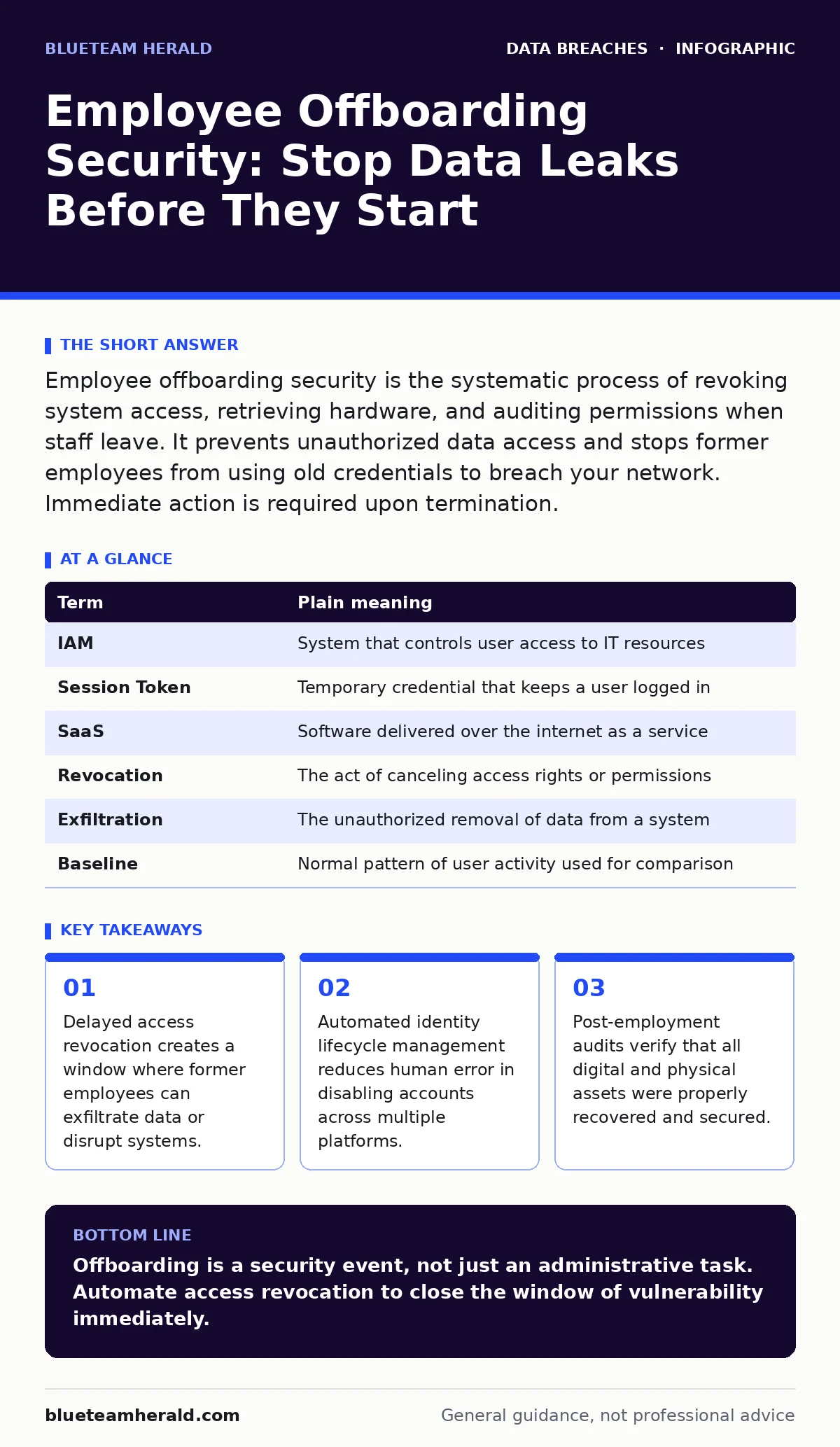
Employee offboarding security is the systematic process of revoking system access, retrieving hardware, and auditing permissions when staff leave. It prevents unauthorized data access and stops former employees from using old credentials to breach your network. Immediate action is required upon termination.
The Building Key Analogy
Imagine your organization is a large office building. Employees hold keys to enter the main lobby, specific floors, and secure server rooms. When an employee quits, you do not just ask them to hand back their badge. You must physically remove their key from the lock, change the combination if they copied it, and ensure they did not leave a spare under the mat. If you wait three days to change the locks, that person can still walk in and open any door they knew about.
Why Manual Tracking Fails
Human memory is unreliable for security. Administrators often forget to disable secondary accounts like marketing automation tools or cloud storage. These forgotten accounts act like hidden side doors. The former employee may not intend to cause harm, but their account remains active. Attackers frequently target these dormant accounts because they lack the scrutiny of active users. This is why manual checklists are prone to failure.
Identity and Access Management
Identity and access management (IAM) is the framework that controls who can see and use your resources. In an offboarding context, IAM systems should automatically trigger a "break glass" procedure. This means immediately disabling authentication tokens and session cookies. A session token is a digital pass that proves you are logged in. If you do not invalidate this token, the user can remain logged in even after their password is changed. This is a critical distinction many teams miss.
The Cloud Complication
Cloud services complicate offboarding because they operate outside your traditional firewall. SaaS applications often have their own user directories. If you disable the employee’s primary email, their access to a project management tool might remain intact. This creates a fragmented security posture. You must integrate your IAM system with these third-party services. This ensures that a single termination event propagates to all connected applications. This integration is the foundation of modern vendor risk management.
Hardware and Physical Assets
Digital access is only half the battle. Physical devices contain cached data, encrypted keys, and local backups. When an employee leaves, their laptop must be collected and wiped. Simply asking them to delete files is insufficient. They may have copied sensitive documents to a personal USB drive before their departure. This is why a formal equipment return process is mandatory. It also serves as a legal record of asset recovery.
See also: Detect Unsecured Cloud Databases: Hidden Signs and Response · Cloud Identity Governance: 8 Practices for Secure Access Control
The Hidden Cost of Delay
The cost of offboarding is not just the time spent revoking access. It is the potential for email account compromise. If a former employee’s email remains active, attackers can impersonate them. They can send phishing emails to current colleagues or clients. This social engineering attack bypasses technical controls because the sender appears legitimate. The damage to trust is immediate and severe. This scenario highlights why speed matters more than perfection in the initial revocation phase.
Audit and Verification
After the immediate revocation, you must verify the action. This is where digital forensics principles apply, even if no breach occurred. You review logs to see what data the employee accessed in their final week. This baseline helps you understand normal behavior versus malicious activity. It also helps you identify if they downloaded large volumes of data before leaving. This step is not about blame; it is about confirming the integrity of your data.
Try This Now
- Create a standardized offboarding checklist that includes every SaaS application your company uses.
- Integrate your HR system with your IAM platform to automate account disabling on the day of termination.
- Perform a monthly audit of inactive accounts to catch any that were missed during the initial offboarding process.
| Term | Plain meaning |
|---|---|
| IAM | System that controls user access to IT resources |
| Session Token | Temporary credential that keeps a user logged in |
| SaaS | Software delivered over the internet as a service |
| Revocation | The act of canceling access rights or permissions |
| Exfiltration | The unauthorized removal of data from a system |
| Baseline | Normal pattern of user activity used for comparison |
Key takeaways
- Delayed access revocation creates a window where former employees can exfiltrate data or disrupt systems.
- Automated identity lifecycle management reduces human error in disabling accounts across multiple platforms.
- Post-employment audits verify that all digital and physical assets were properly recovered and secured.
Offboarding is a security event, not just an administrative task. Automate access revocation to close the window of vulnerability immediately.
Frequently asked questions
How long should I keep former employee accounts disabled?
Keep them disabled indefinitely. If you need the data, export it to a shared, monitored account rather than re-enabling the individual user.
What if the employee refuses to return their laptop?
Remotely wipe the device using your mobile device management tools. Involve legal counsel if the device contains proprietary information.
Does offboarding apply to contractors?
Yes. Contractors often have broader access for specific projects. Their offboarding process should be identical to that of full-time employees.
Can I use the 3-2-1 backup rule for offboarding?
The 3-2-1 backup rule protects data against loss, but it does not prevent unauthorized access. You still need to revoke permissions to secure that data.
How this guide was produced: written by the BlueTeam Herald editorial team with AI assistance, checked against the public references listed below, and reviewed when the facts change. See our editorial policy or report an error.