Identity Sprawl Mechanics: Step-by-Step Lifecycle and Control Points
Identity sprawl creates invisible attack surfaces by accumulating unused permissions that bypass standard detection controls and enable lateral movement without triggering alerts.

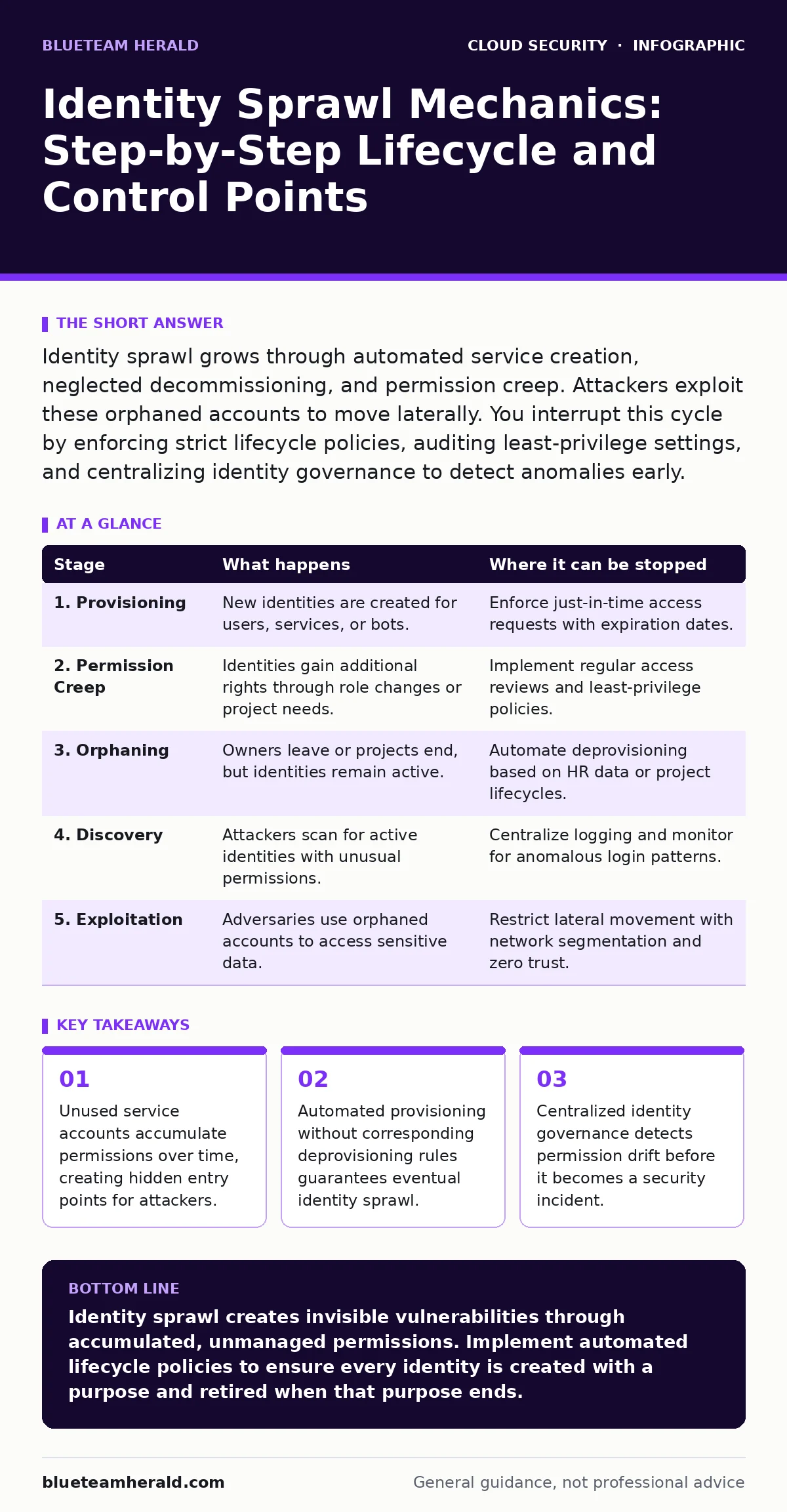
Identity sprawl grows through automated service creation, neglected decommissioning, and permission creep. Attackers exploit these orphaned accounts to move laterally. You interrupt this cycle by enforcing strict lifecycle policies, auditing least-privilege settings, and centralizing identity governance to detect anomalies early.
The Anatomy of Identity Sprawl
Identity sprawl occurs when an organization creates more identities than it can effectively manage or monitor. This condition is not merely a messy directory; it is a structural vulnerability. Each identity represents a potential entry point. When these identities multiply through automation, mergers, or temporary projects, the security team loses visibility. The core problem is not the number of accounts, but the disconnect between identity creation and identity retirement.
Stage 1: Unchecked Provisioning
The lifecycle begins with provisioning. Modern cloud environments encourage rapid deployment. Developers request access to deploy code, and automated systems grant it to maintain velocity. The flaw here is the absence of a matching decommissioning trigger. When provisioning is easy and retirement is manual, identities accumulate. This stage relies on the assumption that temporary access will eventually be revoked, which rarely happens without automated enforcement.
| Stage | What happens | Where it can be stopped |
|---|---|---|
| 1. Provisioning | New identities are created for users, services, or bots. | Enforce just-in-time access requests with expiration dates. |
| 2. Permission Creep | Identities gain additional rights through role changes or project needs. | Implement regular access reviews and least-privilege policies. |
| 3. Orphaning | Owners leave or projects end, but identities remain active. | Automate deprovisioning based on HR data or project lifecycles. |
| 4. Discovery | Attackers scan for active identities with unusual permissions. | Centralize logging and monitor for anomalous login patterns. |
| 5. Exploitation | Adversaries use orphaned accounts to access sensitive data. | Restrict lateral movement with network segmentation and zero trust. |
Stage 2: Permission Creep
Once an identity exists, it tends to gain more permissions. This phenomenon is known as permission creep. A user starts with read-only access to a database. Six months later, they need write access for a specific report. They receive write access to the entire database. Over time, the identity holds privileges far exceeding current job requirements. This stage relies on the administrative convenience of granting broad access rather than precise, scoped permissions. The hidden cost is increased blast radius if the account is compromised.
Stage 3: Orphaning and Dormancy
The most dangerous stage is orphaning. An employee leaves, a contractor finishes, or a project is canceled. The identity remains active because no one assigned it a new owner. These accounts become dormant but active. They do not trigger activity alerts because they are not used frequently. Attackers target these accounts specifically because they are less likely to be monitored. This stage relies on the organization's failure to link identity status to employment or project status.
Stage 4: Discovery by Adversaries
Attackers begin by mapping the identity landscape. They look for accounts that are active but rarely used. These accounts often have weaker security controls because they were created years ago before modern standards were adopted. The attacker scans for credentials leaked in public repositories or uses brute-force attacks on less monitored endpoints. This stage relies on the visibility gap. If the security team does not know the account exists, they cannot protect it. Effective cloud logging and monitoring is critical here to detect scanning activity.
See also: Employee Offboarding Security: Stop Data Leaks Before They Start · Customer Data Exposure: How to Find and Fix Hidden Leaks
Stage 5: Lateral Movement and Exploitation
The attacker compromises an orphaned account. Because the account likely has elevated privileges from permission creep, the attacker gains immediate access to sensitive resources. They move laterally across the environment, accessing databases or configuration files. This stage relies on the lack of segmentation. If the compromised identity can talk to any other resource, the breach expands rapidly. Implementing cloud IAM policies that restrict which resources an identity can access limits this movement.
Interrupting the Cycle
You can interrupt identity sprawl at any stage, but prevention is most effective at provisioning. Implement cloud identity governance to automate the entire lifecycle. This includes creating accounts only when necessary and removing them immediately when no longer needed. Use secrets managers to handle credentials for service accounts, ensuring they are rotated regularly and not stored in code repositories. This reduces the risk of credential leakage.
The Role of Automation
Manual management of identities is impossible at scale. Automation must handle both creation and deletion. Define clear rules for when an identity is considered inactive. For example, if an account has no login activity for 90 days, automatically disable it. This rule must be enforced by the identity provider, not by a human administrator. Automation also helps in detecting anomalies. If a dormant account suddenly logs in from a new location, the system should flag it immediately.
Continuous Review and Remediation
Identity sprawl is a continuous process, not a one-time fix. You must establish a routine for reviewing permissions. Quarterly access reviews are a standard practice, but they are often rubber-stamped. Make these reviews meaningful by requiring justification for each permission. Integrate cloud detection and response tools to identify suspicious behavior in real-time. If an account accesses a resource it has never touched before, trigger an alert. This proactive approach catches issues before they become breaches.
Integrating Security Tools
No single tool solves identity sprawl. You need a combination of cloud-native application protection platforms (CNAPP) and identity governance solutions. CNAPP tools provide visibility into the infrastructure and applications, showing which identities are interacting with which resources. Identity governance tools manage the lifecycle of those identities. Together, they provide a complete picture. Regular cloud penetration testing can also reveal gaps in your identity management by simulating how an attacker might exploit sprawl.
Finalizing the Defense Strategy
The goal is to reduce the attack surface by minimizing the number of active identities. Every identity is a liability. By enforcing strict lifecycle management, you reduce the number of orphaned accounts. By implementing least-privilege principles, you reduce the damage if an account is compromised. By centralizing monitoring, you increase your ability to detect and respond to threats. This layered approach ensures that identity sprawl does not become a critical vulnerability in your cloud environment.
Key takeaways
- Unused service accounts accumulate permissions over time, creating hidden entry points for attackers.
- Automated provisioning without corresponding deprovisioning rules guarantees eventual identity sprawl.
- Centralized identity governance detects permission drift before it becomes a security incident.
Identity sprawl creates invisible vulnerabilities through accumulated, unmanaged permissions. Implement automated lifecycle policies to ensure every identity is created with a purpose and retired when that purpose ends.
Frequently asked questions
How do I identify orphaned accounts in my cloud environment?
Query your identity provider for accounts with no login activity in the last 90 days. Cross-reference this list with HR data to confirm employment status. Look for service accounts linked to terminated projects.
What is the difference between identity sprawl and privilege creep?
Identity sprawl refers to the excessive number of identities. Privilege creep refers to the gradual accumulation of unnecessary permissions by those identities. Both contribute to increased risk but require different remediation strategies.
Can automation completely prevent identity sprawl?
Automation significantly reduces sprawl by enforcing consistent policies. However, it requires accurate input data and regular updates to rules. Human oversight is still needed to review exceptions and adjust policies as the organization changes.
How often should I review cloud IAM policies?
Review policies quarterly at a minimum. Increase frequency for high-privilege accounts or after significant organizational changes. Automated continuous monitoring can provide real-time alerts for policy violations or unusual access patterns.
How this guide was produced: written by the BlueTeam Herald editorial team with AI assistance, checked against the public references listed below, and reviewed when the facts change. See our editorial policy or report an error.