Cloud Detection and Response: Definition, Architecture, and Purpose
Cloud detection and response shifts security focus from static perimeter walls to continuous behavioral analysis of ephemeral cloud resources and identity tokens.
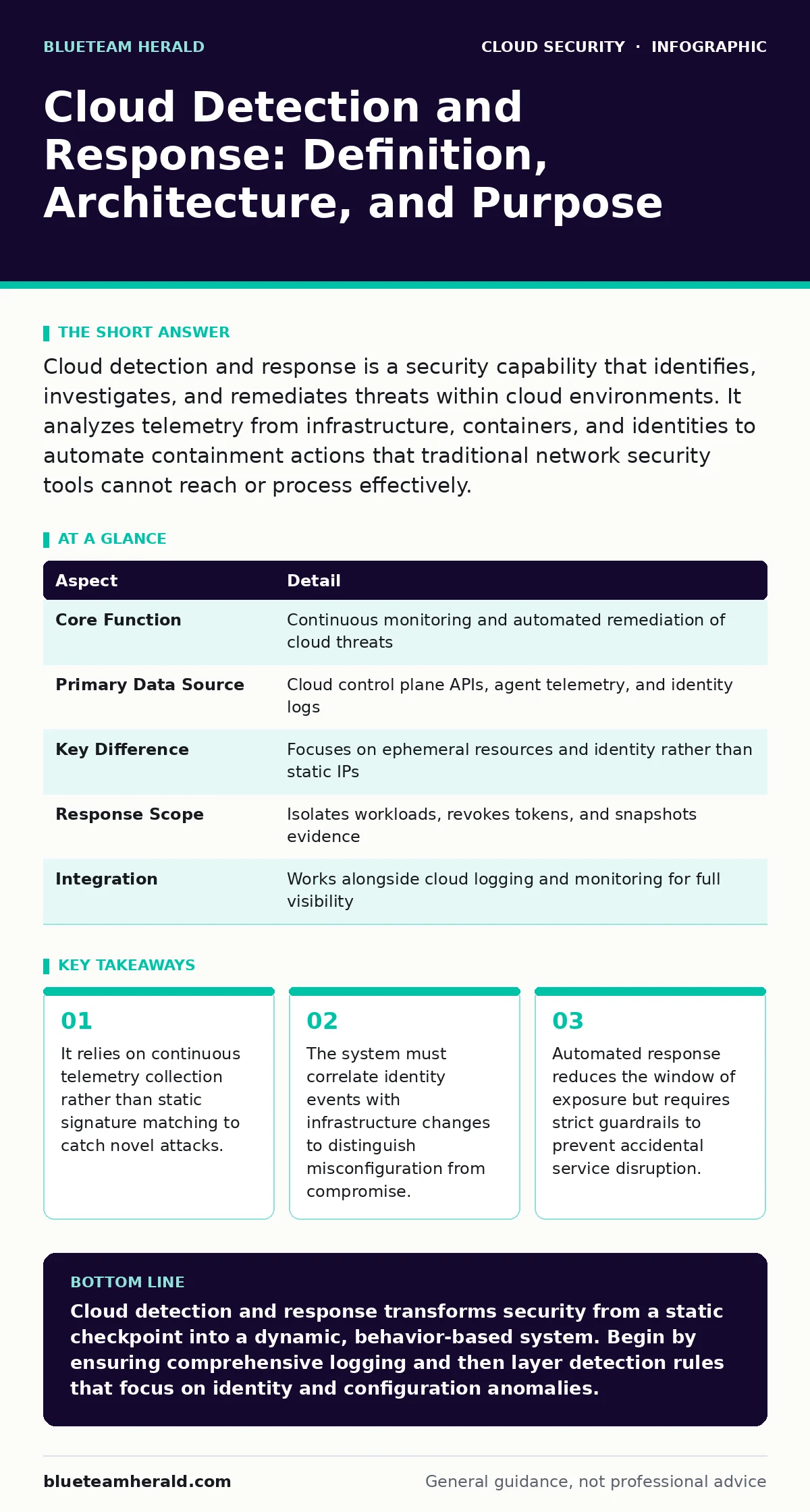
Cloud detection and response is a security capability that identifies, investigates, and remediates threats within cloud environments. It analyzes telemetry from infrastructure, containers, and identities to automate containment actions that traditional network security tools cannot reach or process effectively.
The Evolving Perimeter
Imagine a traditional bank with thick walls and a single guarded door. Security focuses on stopping intruders at that entry point. Now imagine a city where buildings appear and disappear daily, residents use digital keys that expire in minutes, and goods move through invisible tunnels. This is the cloud environment.
In this model, the perimeter is not a wall but a set of policies and identities. Threats do not always come from outside. They often emerge from compromised credentials, misconfigured storage, or malicious code injected into a container. Traditional security tools struggle here because they rely on fixed network boundaries and static IP addresses.
Cloud detection and response, often abbreviated as CDR, addresses this gap. It is a system designed to monitor, detect, and respond to security incidents specifically within cloud infrastructure. Unlike on-premise tools that watch network traffic, CDR watches the cloud control plane and the workload layer.
| Aspect | Detail |
|---|---|
| Core Function | Continuous monitoring and automated remediation of cloud threats |
| Primary Data Source | Cloud control plane APIs, agent telemetry, and identity logs |
| Key Difference | Focuses on ephemeral resources and identity rather than static IPs |
| Response Scope | Isolates workloads, revokes tokens, and snapshots evidence |
| Integration | Works alongside cloud logging and monitoring for full visibility |
The Problem of Ephemeral Assets
The fundamental challenge in cloud security is transience. Virtual machines, containers, and serverless functions can spin up and terminate in seconds. A security tool that takes minutes to scan a system may never see the vulnerable instance. By the time an alert fires, the asset may already be gone, leaving no trace for forensic analysis.
Furthermore, cloud environments are highly dynamic. Users frequently change permissions, open ports, and deploy new services. This creates a moving target for defenders. A configuration that was secure this morning might be exposed by an afternoon change. CDR systems must operate in real-time to keep pace with these changes.
The problem is not just speed but context. An open port might be a misconfiguration or a deliberate setup for a new service. CDR systems must distinguish between noise and threat. They do this by correlating multiple data points. If a new port opens and immediately receives traffic from an unusual geographic location, the system flags it. If it opens and sits idle, it may be ignored.
Core Components of the Architecture
A functional CDR solution consists of three main parts: data collection, detection engines, and response automation. Each part plays a specific role in the security lifecycle.
Data Collection is the foundation. It gathers telemetry from various sources. This includes cloud provider APIs, which record every change to infrastructure settings. It also includes agents installed on virtual machines and containers, which monitor process execution and file integrity. Without comprehensive data, the detection engine is blind.
Detection Engines analyze the collected data. They use rule-based logic, statistical models, and machine learning to identify anomalies. For example, a rule might flag any attempt to access a database from a server that has no business reason to do so. Machine learning models can detect subtle patterns, such as slow data exfiltration that falls below traditional threshold alerts.
Response Automation takes action based on detection results. This can range from sending an alert to a human analyst to automatically isolating a compromised instance. Automation is critical for speed but carries risk. Incorrect automated responses can disrupt business operations. Therefore, response actions are often tiered. Low-risk actions, like logging, happen automatically. High-risk actions, like terminating a production server, require human approval.
Integration with Existing Defenses
CDR does not replace other security tools. It complements them. Think of CDR as the incident response team for the cloud, while other tools provide the initial warnings.
Cloud logging and monitoring provides the raw data. It records what happened, but it does not necessarily tell you if it was malicious. CDR consumes these logs to find the needles in the haystack. Without robust logging, CDR cannot function effectively.
Shift-left security practices aim to catch vulnerabilities before code reaches production. However, not all issues are caught early. Misconfigurations can occur during deployment, and credentials can be compromised after release. CDR acts as the safety net for what slips through the early stages.
Service mesh security manages traffic between microservices. It can enforce encryption and authentication. CDR monitors the service mesh for anomalies in traffic patterns. If a service starts communicating with an unknown external IP, the service mesh may block it, and CDR logs the event for investigation.
Identity as the New Perimeter
In cloud environments, identity is the primary access control mechanism. Users, applications, and services all have identities. Compromising an identity is often easier than breaking into a network. Therefore, CDR systems place heavy emphasis on identity and access management telemetry.
They monitor for unusual login patterns, privilege escalations, and token usage. For instance, if a service account that usually accesses only a specific database suddenly tries to list all storage buckets, CDR flags this as suspicious. This is known as lateral movement. The attacker has gained access and is trying to expand their reach.
Detecting OAuth token abuse is a specific challenge. Tokens are meant to grant temporary access. If an attacker steals a valid token, traditional firewall rules may not stop them because the token is technically valid. CDR systems look for behavioral anomalies associated with the token, such as access from an unusual device or time zone.
See also: Identity Sprawl Mechanics: Step-by-Step Lifecycle and Control Points · Cloud-Native Application Protection Platform Misconceptions
Common Misconceptions and Pitfalls
Many organizations misunderstand what CDR can and cannot do. One common mistake is assuming it provides complete visibility. CDR relies on the data it is given. If logging is incomplete or if certain services are not instrumented, blind spots remain. You cannot detect what you do not measure.
Another misconception is that automation eliminates the need for human analysts. While automation speeds up response, it cannot understand business context. An automated system might isolate a server because it detected unusual traffic, but a human analyst can determine if that traffic was part of a legitimate marketing campaign. False positives can erode trust in the system.
Finally, some believe CDR is a one-time setup. It is an ongoing process. Detection rules must be updated as new threats emerge and as the cloud environment changes. Static rules become obsolete quickly. Regular tuning and validation are necessary to maintain effectiveness.
The Role of Guardrails
Automated response is powerful but dangerous. If a CDR system incorrectly identifies a critical production service as malicious, it could take it offline. This is a denial of service caused by your own security tools. To prevent this, organizations must implement guardrails.
Guardrails are rules that limit what automated responses can do. For example, a rule might state that no automated action can terminate a server tagged as "production-critical." Another rule might require two separate detections to trigger an isolation event. These constraints balance speed with safety.
Testing these guardrails is essential. Cloud penetration testing can simulate attacks to see if the CDR system responds correctly. It helps identify gaps in detection and risks in automation. Regular testing ensures that the system works as intended under pressure.
Key takeaways
- It relies on continuous telemetry collection rather than static signature matching to catch novel attacks.
- The system must correlate identity events with infrastructure changes to distinguish misconfiguration from compromise.
- Automated response reduces the window of exposure but requires strict guardrails to prevent accidental service disruption.
Cloud detection and response transforms security from a static checkpoint into a dynamic, behavior-based system. Begin by ensuring comprehensive logging and then layer detection rules that focus on identity and configuration anomalies.
Frequently asked questions
How does cloud detection and response differ from endpoint detection?
Endpoint detection focuses on individual devices and workloads. Cloud detection and response monitors the entire cloud environment, including infrastructure configurations, identity events, and network flows between services.
Can cloud detection and response prevent data breaches?
It can detect and respond to breaches in progress, limiting their impact. It does not prevent the initial compromise, which requires secure coding, proper configuration, and strong identity management.
Do I need agents on every cloud instance?
Not necessarily. Many CDR systems use agentless monitoring via cloud APIs for infrastructure and identity. Agents are useful for deep workload inspection but add overhead. A hybrid approach often works best.
How long does it take to implement a CDR strategy?
Implementation varies based on environment complexity. Basic logging and rule-based detection can start quickly. Full integration with automated response and machine learning models takes longer and requires careful tuning.
How this guide was produced: written by the BlueTeam Herald editorial team with AI assistance, checked against the public references listed below, and reviewed when the facts change. See our editorial policy or report an error.