Cloud Detection and Response Checklist: Monitor Signals That Matter
Most cloud breaches succeed because defenders monitor infrastructure metrics while attackers exploit identity permissions and misconfigured data stores.

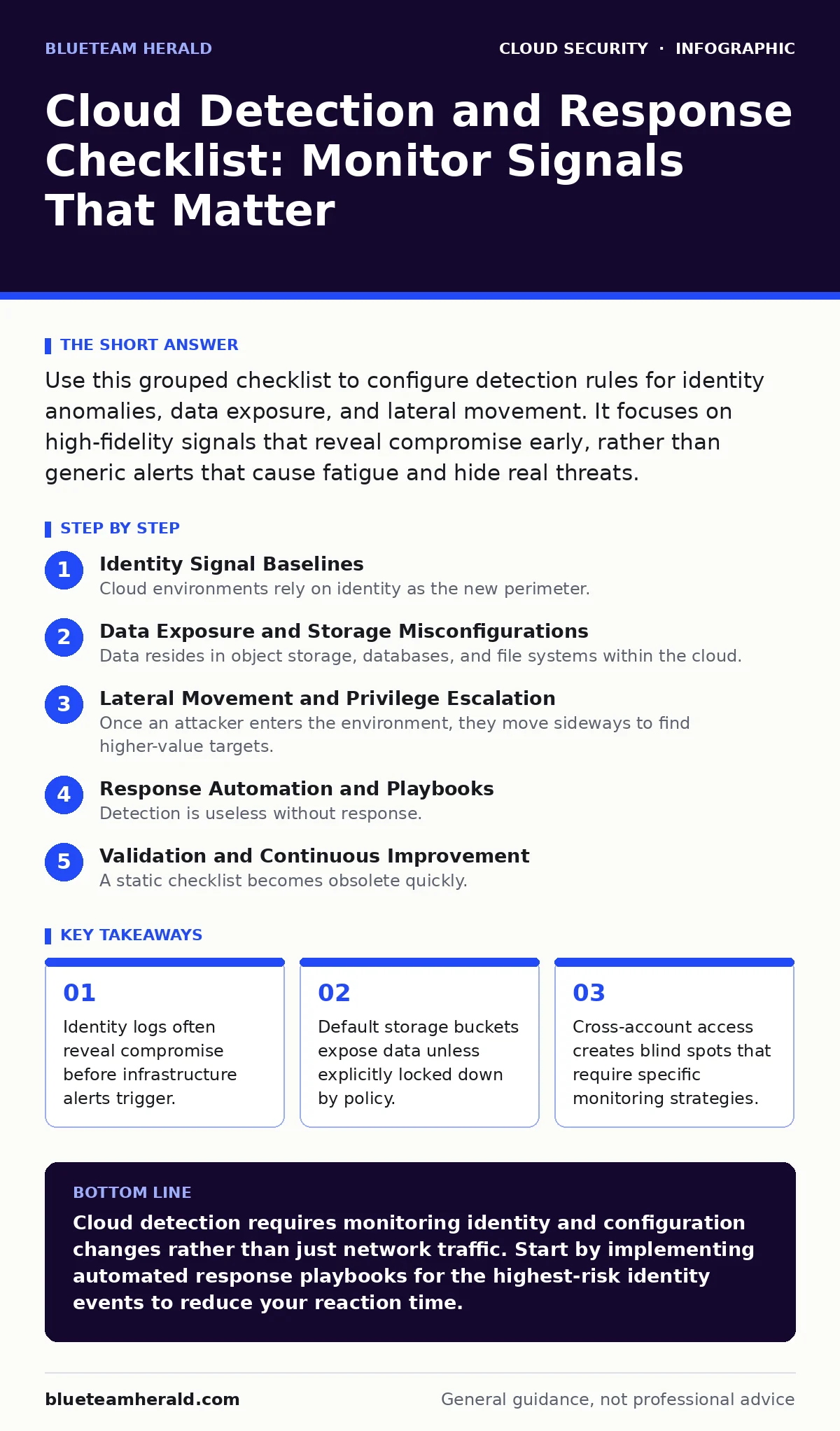
Use this grouped checklist to configure detection rules for identity anomalies, data exposure, and lateral movement. It focuses on high-fidelity signals that reveal compromise early, rather than generic alerts that cause fatigue and hide real threats.
Identity Signal Baselines
Cloud environments rely on identity as the new perimeter. When you move from on-premises networks to cloud platforms, firewalls matter less than who holds the keys. Attackers rarely break into the cloud; they steal credentials or exploit overly permissive roles. Your detection system must understand what normal identity behavior looks like for your specific organization.
- Enable detailed identity and access management logs: These records show every permission check and are the primary source for detecting stolen credentials.
- Alert on impossible travel events: A login from two distant locations in a short time indicates credential theft or session hijacking.
- Detect new administrative role assignments: Attackers often escalate privileges immediately after gaining initial access, so sudden permission changes are high-risk signals.
- Monitor for unused credentials: Long-lived access keys that suddenly become active often signal an attacker using harvested secrets from a code repository.
Data Exposure and Storage Misconfigurations
Data resides in object storage, databases, and file systems within the cloud. Unlike traditional servers, these resources are often accessible via public internet endpoints if configured incorrectly. An attacker does not need to hack the system; they only need to find a door left open. Detection here focuses on changes to access controls rather than traffic patterns.
- Alert on public access changes to storage buckets: Making a container publicly readable is a common misconfiguration that leads to immediate data leakage.
- Monitor for encryption key usage anomalies: Unusual patterns in how data encryption keys are accessed can indicate an attacker attempting to decrypt sensitive archives.
- Detect new inbound rules on network security groups: Opening ports to the public internet, especially for management interfaces, is a frequent lateral movement step.
- Track changes to database authentication settings: Disabling password requirements or allowing public access to unsecured cloud databases creates instant exposure.
Lateral Movement and Privilege Escalation
Once an attacker enters the environment, they move sideways to find higher-value targets. In the cloud, this movement happens through API calls rather than network packets. They might assume a role in another account or create a new user with administrative rights. Your detection must track the flow of trust and permission across services.
- Alert on cross-account role assumptions: Legitimate cross-account access is rare and usually follows a strict pattern; deviations suggest an attacker moving between accounts.
- Detect creation of new cloud user accounts: Attackers often create backdoor accounts to maintain persistence if their original access is revoked.
- Monitor for privilege escalation attempts: Actions that attempt to grant administrative rights to non-admin users are strong indicators of compromise.
- Alert on modification of security logging settings: An attacker will often try to disable logging to cover their tracks, so changes to log retention or destinations are critical signals.
Response Automation and Playbooks
Detection is useless without response. In cloud environments, manual response is too slow. Attackers can exfiltrate data or encrypt systems in seconds. You need automated playbooks that trigger when specific high-confidence signals appear. These playbooks should isolate the threat without disrupting legitimate business operations.
- Automate credential rotation for compromised accounts: Immediately disabling and resetting access keys prevents further unauthorized use while you investigate.
- Isolate compromised compute instances: Automatically detach affected servers from the network to stop lateral movement while preserving forensic evidence.
- Block malicious IP addresses at the gateway: If an attacker is using a known bad IP, automated blocking reduces the window of exposure.
- Revoke suspicious OAuth tokens: If an application token is used in an unusual context, revoking it stops the attacker’s access to connected services.
See also: Identity Sprawl Mechanics: Step-by-Step Lifecycle and Control Points · Cloud-Native Application Protection Platform Misconceptions
Validation and Continuous Improvement
A static checklist becomes obsolete quickly. Cloud services evolve, and attackers adapt their techniques. You must regularly test your detection rules to ensure they still catch relevant threats. This involves simulating attacks and reviewing false positives to refine your baselines.
- Conduct regular cloud penetration testing: External assessments reveal gaps in your detection logic that internal teams might miss due to familiarity bias.
- Review false positive rates monthly: High noise levels cause alert fatigue, leading responders to ignore genuine threats. Tuning rules improves signal quality.
- Validate response playbooks quarterly: Automated actions must be tested to ensure they do not cause unintended outages or data loss during an incident.
- Update detection rules for new services: As you adopt new cloud technologies, you must add corresponding monitoring rules to maintain coverage.
Key takeaways
- Identity logs often reveal compromise before infrastructure alerts trigger.
- Default storage buckets expose data unless explicitly locked down by policy.
- Cross-account access creates blind spots that require specific monitoring strategies.
Cloud detection requires monitoring identity and configuration changes rather than just network traffic. Start by implementing automated response playbooks for the highest-risk identity events to reduce your reaction time.
Frequently asked questions
How do I distinguish between a misconfiguration and an attack?
Context matters. A misconfiguration usually lacks preceding suspicious activity like impossible travel or unusual login times. Attacks often follow a pattern of reconnaissance and privilege escalation.
Should I monitor all cloud regions equally?
Yes. Attackers often operate from regions that differ from your primary workload locations. Blind spots in any region can serve as a staging ground for broader compromise.
What is the biggest blind spot in cloud detection?
Service accounts and automated processes. They often have broad permissions and generate high-volume logs, making it difficult to spot anomalous behavior without careful baselining.
How often should I update my detection rules?
Update them whenever you change your cloud architecture or permissions. Additionally, review and tune them monthly to reduce noise and improve accuracy based on recent incident data.
How this guide was produced: written by the BlueTeam Herald editorial team with AI assistance, checked against the public references listed below, and reviewed when the facts change. See our editorial policy or report an error.