Shift-Left Security: Real Benefits, Hidden Costs, and When to Skip It
Moving security checks earlier reduces fix costs but creates friction that slows development velocity and shifts blame to engineers who lack context.

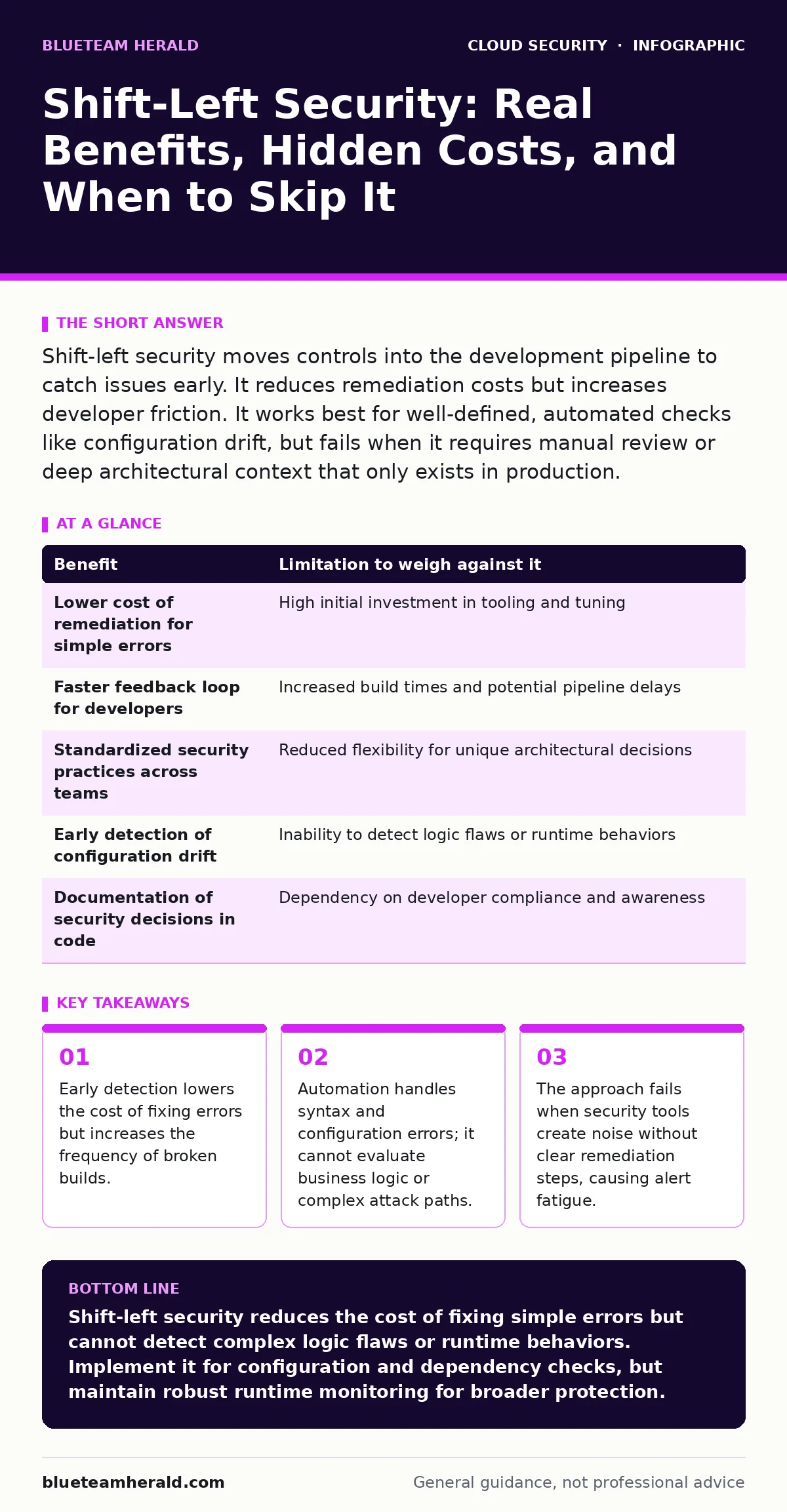
Shift-left security moves controls into the development pipeline to catch issues early. It reduces remediation costs but increases developer friction. It works best for well-defined, automated checks like configuration drift, but fails when it requires manual review or deep architectural context that only exists in production.
The Mechanics of Early Intervention
Shift-left security refers to the practice of integrating security checks into the earliest stages of the software development lifecycle. Instead of waiting for a penetration test or a production incident, you scan code and configurations while they are still being written. This approach relies on static application security testing, which analyzes source code without executing it, and infrastructure as code scanning, which validates configuration files before deployment. The goal is to make security a byproduct of the build process rather than a separate gate.
You are not just moving tools; you are changing the workflow. Developers receive feedback on security issues minutes after committing code, rather than weeks later. This tight feedback loop allows them to fix mistakes while the context is still fresh in their minds. However, this speed comes with a trade-off. Every scan adds time to the build process, and every alert requires a decision. If the tool reports too many false positives, developers will ignore it. If it blocks the build too often, they will bypass it.
The Cost of Context Loss
One non-obvious consequence of shifting left is the loss of runtime context. Static analysis tools examine code in isolation. They cannot see how the application behaves under load, how other services interact with it, or what the actual network traffic looks like. A function might look secure in isolation but become vulnerable when combined with another component in a complex microservices architecture. You cannot detect race conditions or memory leaks through static analysis alone. These issues only manifest when the code runs.
This limitation means that early checks are necessary but insufficient. You must balance them with runtime detection. Relying solely on pre-commit checks creates a false sense of security. Imagine a developer writes a secure database query, but the application logic allows an attacker to manipulate the input in a way the static scanner did not predict. The code passed the left-shifted check, but the application remains vulnerable. This is why you need a layered approach that includes runtime monitoring.
Friction and Developer Experience
The primary benefit of shift-left is reduced remediation cost. Fixing a vulnerability in source code is cheaper and faster than patching a running server or investigating a breach. However, this benefit is only realized if the tooling is seamless. If security scans take ten minutes to run, developers will wait until they are close to deployment to run them, defeating the purpose. If the alerts are vague, developers will waste time figuring out what is wrong. This friction leads to workarounds, such as disabling specific rules or ignoring warnings.
You must tune tools to report only actionable issues. A scan that flags every potential issue, including low-risk informational messages, is useless. It creates a barrier to entry for new developers who are already learning the codebase. The goal is to make security invisible until a problem occurs. When it does occur, the feedback must be precise, pointing to the exact line of code and explaining how to fix it.
Comparing Benefits and Limitations
To evaluate whether shift-left is suitable for your environment, you must weigh the operational benefits against the technical and cultural limitations. The table below outlines the trade-offs.
| Benefit | Limitation to weigh against it |
|---|---|
| Lower cost of remediation for simple errors | High initial investment in tooling and tuning |
| Faster feedback loop for developers | Increased build times and potential pipeline delays |
| Standardized security practices across teams | Reduced flexibility for unique architectural decisions |
| Early detection of configuration drift | Inability to detect logic flaws or runtime behaviors |
| Documentation of security decisions in code | Dependency on developer compliance and awareness |
When It Is Worth It
Shift-left security is most valuable when applied to well-defined, rule-based checks. Configuration management is a prime example. Tools can easily validate that a cloud storage bucket is not publicly accessible or that encryption is enabled. These are binary states: either the configuration is correct, or it is not. Automating these checks prevents common mistakes that lead to unsecured cloud databases. You can enforce these rules at the infrastructure as code level, ensuring that no non-compliant resource is ever created.
It is also worth it for dependency management. Modern applications rely on third-party libraries that may contain known vulnerabilities. Scanning these dependencies early prevents you from introducing known risks into your codebase. This is a mechanical check that does not require human judgment. You can automate the blocking of builds that include severely vulnerable packages. This reduces the attack surface without requiring developers to understand the underlying cryptography or exploit mechanics.
See also: Cloud-Native Application Protection Platform Misconceptions · Hybrid Cloud Advantages and Disadvantages: Risks and Controls
When It Is Not Worth It
Shift-left is less effective for complex, context-dependent issues. Business logic errors, such as authorization flaws, are difficult to detect through static analysis. A tool might see that a user can access a resource, but it cannot determine if that access is appropriate based on the business rules. These issues require human review and testing. Attempting to automate these checks often results in high false-positive rates, which erode trust in the tooling.
It is also not worth it when the tooling disrupts the development flow. If a security scan takes longer than the development cycle, it becomes a bottleneck. Developers will find ways to bypass the check, such as merging code before the scan completes or disabling the tool for specific branches. This creates a security theater where checks exist on paper but not in practice. In these cases, it is better to focus on cloud detection and response capabilities that monitor runtime behavior rather than trying to predict every possible exploit path in the code.
Integrating with Broader Strategies
Shift-left security does not replace other security measures; it complements them. You still need to manage access controls carefully. Misconfigured permissions are a leading cause of cloud breaches. Even if your code is secure, an overly permissive role can allow an attacker to escalate privileges. This is why you must also review cloud IAM policies regularly. Similarly, you should monitor for insecure cloud APIs that might expose sensitive data. These are runtime concerns that static analysis cannot address.
You should also consider the broader identity landscape. Shift-left helps secure the application, but it does not secure the identities that access it. You need strong identity governance to ensure that only authorized users and services can interact with your resources. This includes monitoring for open security groups that might allow unauthorized network access. By combining early code checks with runtime identity and network controls, you create a defense-in-depth strategy that covers both development and operation phases.
The Human Element of Automation
Technology alone cannot solve security problems. You need a culture that values security as part of development. This means training developers to understand why certain checks exist and how to interpret the results. It also means empowering them to make security decisions. If developers feel that security is an external imposition, they will resist it. If they feel ownership over the security of their code, they will engage with the tools and processes.
This cultural shift takes time. It requires communication between security and development teams. Security professionals must explain the risks in terms that developers understand. Developers must provide feedback on the usability of security tools. This collaboration ensures that security measures are practical and effective. It also helps to identify areas where automation is insufficient and human review is necessary.
Key takeaways
- Early detection lowers the cost of fixing errors but increases the frequency of broken builds.
- Automation handles syntax and configuration errors; it cannot evaluate business logic or complex attack paths.
- The approach fails when security tools create noise without clear remediation steps, causing alert fatigue.
Shift-left security reduces the cost of fixing simple errors but cannot detect complex logic flaws or runtime behaviors. Implement it for configuration and dependency checks, but maintain robust runtime monitoring for broader protection.
Frequently asked questions
Does shift-left security eliminate the need for penetration testing?
No, it reduces the number of obvious flaws but cannot replace manual testing for complex logic errors, business rule violations, and runtime exploitation scenarios.
How do I prevent shift-left tools from slowing down my build pipeline?
Optimize tools to run only on changed files, use parallel processing, and focus on high-severity issues first to keep feedback loops fast and actionable.
Can static analysis detect SQL injection in modern frameworks?
It can detect common patterns, but modern frameworks with parameterized queries or ORM layers often obfuscate the logic, leading to false negatives or positives.
Is shift-left security suitable for legacy applications?
It is difficult to implement in legacy systems due to lack of documentation and complex dependencies; start with runtime monitoring and gradually introduce static checks.
How this guide was produced: written by the BlueTeam Herald editorial team with AI assistance, checked against the public references listed below, and reviewed when the facts change. See our editorial policy or report an error.