Hybrid Cloud Advantages and Disadvantages: Risks and Controls
Hybrid cloud architecture increases the attack surface by combining public scalability with private control, creating complex identity and data flow challenges.

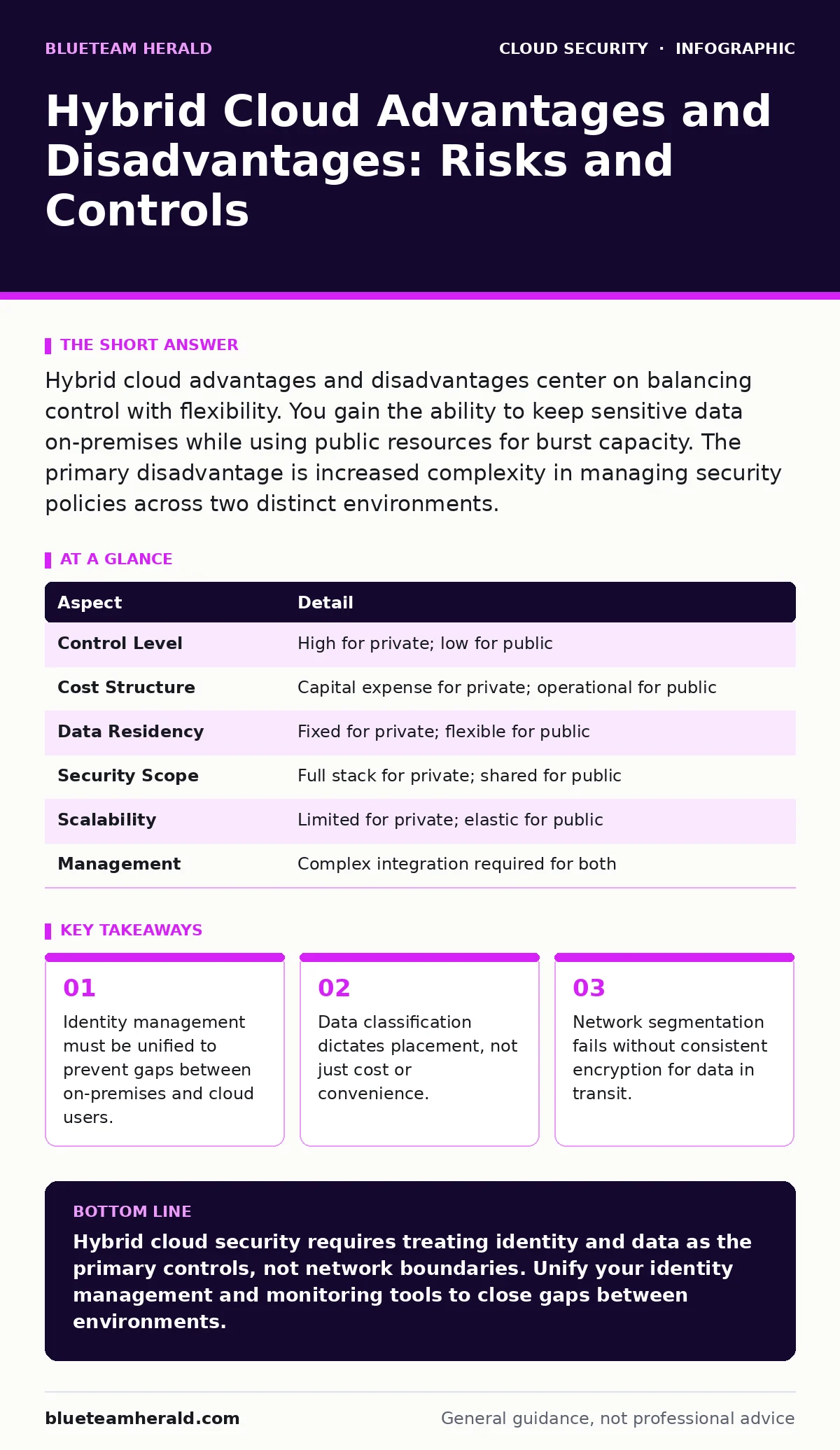
Hybrid cloud advantages and disadvantages center on balancing control with flexibility. You gain the ability to keep sensitive data on-premises while using public resources for burst capacity. The primary disadvantage is increased complexity in managing security policies across two distinct environments.
Understanding the Hybrid Model
Imagine running a restaurant where the kitchen is in your building, but the delivery fleet belongs to a third party. You control the food preparation, but you cannot directly manage the drivers or their vehicles. This analogy describes hybrid cloud architecture. It combines private infrastructure, which you own or lease, with public cloud services provided by external vendors.
The private component handles sensitive workloads, legacy applications, or data subject to strict compliance requirements. The public component absorbs variable demand, handles non-sensitive traffic, and provides global reach. This split allows organizations to avoid the high capital expenditure of building massive data centers while retaining control over critical assets.
| Aspect | Detail |
|---|---|
| Control Level | High for private; low for public |
| Cost Structure | Capital expense for private; operational for public |
| Data Residency | Fixed for private; flexible for public |
| Security Scope | Full stack for private; shared for public |
| Scalability | Limited for private; elastic for public |
| Management | Complex integration required for both |
How Hybrid Cloud Works
Hybrid cloud does not mean simply having servers on-site and an account with a public provider. It requires active integration between the two environments. The core mechanism is consistent identity and network connectivity. You must extend your on-premises directory services to the cloud so that a user’s permissions apply everywhere.
Data flows between these environments over encrypted channels. You often use virtual private networks or dedicated connections to ensure that traffic does not traverse the public internet. This connectivity allows applications to read data from the private store and process it using public compute resources. The challenge lies in maintaining security posture consistency across these different trust boundaries.
Who This Affects
This architecture affects security engineers, system administrators, and compliance officers. Security engineers must design controls that work across different platforms. System administrators manage the patching and configuration of servers that may be physically distant from their management consoles. Compliance officers verify that data remains within legal jurisdictions and meets industry standards.
Developers also feel the impact. They write code that interacts with both local databases and cloud APIs. If the security controls differ between the two, developers may inadvertently create vulnerabilities by following the wrong pattern. Understanding the hybrid model helps all these roles align their efforts toward a unified security strategy.
Hybrid Cloud Advantages and Disadvantages
People search for hybrid cloud advantages and disadvantages to understand the trade-offs. The primary advantage is risk mitigation through segmentation. You can isolate high-value data from the internet-facing parts of your application. This reduces the likelihood of a breach exposing your most critical assets.
The main disadvantage is operational complexity. Managing two environments means maintaining two sets of tools, two sets of logs, and two sets of security policies. Inconsistencies between these sets create blind spots. A misconfigured firewall on the private side might be perfectly secure, but if the cloud side lacks equivalent controls, the entire system is vulnerable.
Common Misconceptions
Many organizations believe that moving to a hybrid model automatically improves security. This is incorrect. The public cloud provider secures the infrastructure, but you secure what you put in it. If you copy insecure on-premises configurations to the cloud, you simply scale your vulnerabilities.
Another misconception is that encryption alone solves data protection issues. Encryption protects data at rest and in transit, but it does not control who can decrypt it. If your identity policies are weak, an attacker with valid credentials can access encrypted data. You must implement strong cloud IAM policies to ensure that only authorized users can access resources.
See also: Cloud-Native Application Protection Platform Misconceptions
Identity and Access Management
Identity is the new perimeter in a hybrid environment. Traditional network boundaries are porous, so you must rely on strict identity verification. You need a unified identity provider that authenticates users for both on-premises and cloud resources. This ensures that a user’s privileges are consistent and that access is revoked immediately when they leave the organization.
Multi-factor authentication should be mandatory for all administrative access. Without it, stolen credentials can grant attackers full control. You must also review permissions regularly to prevent privilege creep. Users often accumulate more access than they need over time, increasing the risk of cloud privilege escalation if their account is compromised.
Data Protection Strategies
Data classification is the foundation of hybrid security. You must identify which data requires on-premises storage and which can reside in the public cloud. Sensitive data should never leave the private environment unless absolutely necessary. If it must move, it must be encrypted using keys that you control.
Key management is critical. If you use the cloud provider’s managed keys, they have the ability to decrypt your data. Using your own keys gives you control but adds management overhead. You must balance this control with the operational burden of key rotation and backup. Unsecured cloud databases often result from failing to classify data correctly before deployment.
Monitoring and Response
You cannot secure what you cannot see. Hybrid environments generate logs from multiple sources. You must aggregate these logs into a central system for analysis. This allows you to detect anomalies that span both environments, such as a user logging in from an unusual location and then accessing sensitive data.
Cloud detection and response tools help automate this process. They can identify threats faster than manual monitoring. However, these tools require proper tuning to avoid alert fatigue. You must define clear baselines for normal behavior in both your private and public environments. Regular cloud penetration testing helps validate that your detection mechanisms are effective against real-world attacks.
Implementation Checklist
- Define clear data classification criteria.
- Implement a unified identity provider.
- Encrypt all data in transit between environments.
- Establish consistent logging and monitoring.
- Regularly review access permissions.
- Test incident response plans for cross-environment scenarios.
Adopting shift-left security practices helps catch issues early. By integrating security checks into your development pipeline, you prevent vulnerabilities from reaching production. This approach reduces the burden on your operations team and improves the overall security posture of your hybrid cloud.
Key takeaways
- Identity management must be unified to prevent gaps between on-premises and cloud users.
- Data classification dictates placement, not just cost or convenience.
- Network segmentation fails without consistent encryption for data in transit.
Hybrid cloud security requires treating identity and data as the primary controls, not network boundaries. Unify your identity management and monitoring tools to close gaps between environments.
Frequently asked questions
Is hybrid cloud more secure than public cloud?
It can be more secure for sensitive data because you retain control over its storage. However, it is more complex to manage, which can lead to configuration errors.
How do I manage users in both environments?
Use a single identity provider that synchronizes with both your on-premises directory and cloud services. This ensures consistent access controls.
What is the biggest risk in hybrid cloud?
Inconsistent security policies between the two environments. Gaps in one side can compromise the entire architecture.
Do I need to encrypt data in both places?
Yes. Encrypt data at rest and in transit everywhere. Ensure that the encryption keys are managed securely and separately from the data.
How this guide was produced: written by the BlueTeam Herald editorial team with AI assistance, checked against the public references listed below, and reviewed when the facts change. See our editorial policy or report an error.