Database Security FAQ: Protecting Records from Internal and External Threats
Most database breaches occur through misconfigured access controls rather than external hacking, meaning your internal policies matter more than your firewall rules.

Secure databases by enforcing least privilege, encrypting data at rest and in transit, and regularly auditing access logs. You must separate administrative duties, validate all inputs to prevent injection, and maintain offline backups to ensure recovery capability during ransomware or corruption events.
What is the primary goal of database security?
Database security aims to protect the confidentiality, integrity, and availability of data stored within database management systems. You must ensure that only authorized users can read or modify records, that the data remains accurate and unaltered by unauthorized processes, and that the system remains accessible during normal operations. This involves configuring access controls, encrypting sensitive fields, and monitoring for anomalous query patterns that indicate compromise.
How do you prevent SQL injection attacks?
You prevent SQL injection by never concatenating user input directly into database queries. Instead, use parameterized queries or prepared statements, which treat user input as data rather than executable code. This mechanism ensures that special characters cannot alter the structure of the SQL command. Input validation alone is insufficient because attackers can often bypass simple regex filters. Parameterization forces the database engine to separate the command logic from the variable data, closing the execution gap.
Why is least privilege critical for database accounts?
Least privilege restricts each user account to the minimum permissions required to perform its specific job. If an application account has full administrative rights, a compromise of that application gives the attacker total control over the database. By granting only SELECT, INSERT, or UPDATE permissions as needed, you limit the blast radius of a breach. This approach also simplifies auditing because you can quickly identify accounts with excessive rights that do not match their functional role.
What is the difference between encryption at rest and in transit?
Encryption at rest protects data stored on disk, while encryption in transit protects data moving between the application and the database. Encryption at rest uses algorithms to scramble data on the storage medium, rendering it unreadable without the correct decryption keys. This protects against physical theft of servers or storage drives. Encryption in transit uses protocols like TLS to secure the connection channel, preventing network sniffers from reading queries or results as they travel across the network infrastructure.
How should you manage database access logs?
You should configure the database to log all authentication attempts, permission changes, and high-risk queries such as bulk data exports. These logs provide the evidence trail needed for digital forensics when investigating a potential breach. Store logs in a separate, write-once storage system that attackers cannot modify or delete. Regularly review these logs for patterns that indicate reconnaissance, such as repeated failed login attempts or queries accessing sensitive tables at unusual times.
What role does network segmentation play in database protection?
Network segmentation isolates database servers from the general corporate network and the internet. You place databases in a dedicated subnet with strict firewall rules that only allow traffic from specific application servers. This prevents an attacker who compromises a web server from directly accessing the database layer. Segmentation reduces the attack surface by ensuring that even if one part of your infrastructure is breached, the critical data stores remain inaccessible from the compromised zone.
How do you handle sensitive data within a database?
You handle sensitive data by classifying it and applying specific protections based on its risk level. For highly sensitive fields like health records or financial identifiers, use field-level encryption or tokenization. Tokenization replaces sensitive data with a non-sensitive equivalent that has no mathematical relationship to the original value. This allows applications to function without exposing the raw data. You must also mask data in non-production environments to prevent accidental exposure to developers or testers.
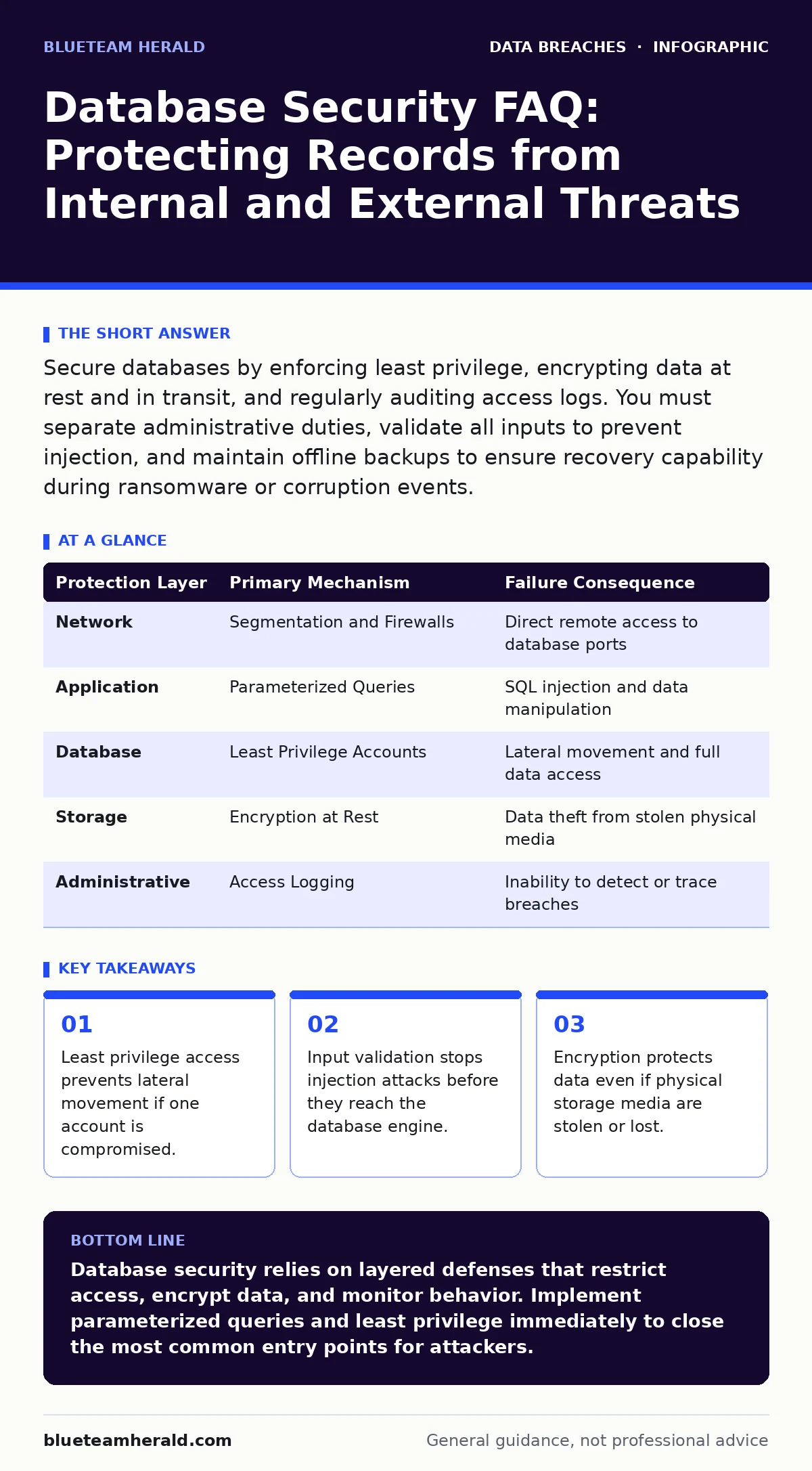
| Protection Layer | Primary Mechanism | Failure Consequence |
|---|---|---|
| Network | Segmentation and Firewalls | Direct remote access to database ports |
| Application | Parameterized Queries | SQL injection and data manipulation |
| Database | Least Privilege Accounts | Lateral movement and full data access |
| Storage | Encryption at Rest | Data theft from stolen physical media |
| Administrative | Access Logging | Inability to detect or trace breaches |
Why are backups essential for database resilience?
Backups provide the only reliable method to recover data after ransomware encryption, accidental deletion, or corruption. You must follow the 3-2-1 backup rule: keep 3 copies of data, on 2 different media types, with 1 copy stored offsite or offline. Offline backups are critical because ransomware often targets connected backup drives. Without isolated, immutable backups, you face permanent data loss or the pressure to pay extortion demands. Regularly test restoration procedures to ensure backups are valid and readable.
How do you detect insider threats in databases?
You detect insider threats by monitoring for behavior that deviates from established baselines. This includes queries that access large volumes of data outside of normal business hours or by users who do not typically handle such information. Implement user behavior analytics to flag anomalies such as a developer suddenly querying production customer records. Combine this with strict access reviews that periodically verify that each user still requires their current level of access. Insider threats are often harder to detect than external attacks because they use legitimate credentials.
Key takeaways
- Least privilege access prevents lateral movement if one account is compromised.
- Input validation stops injection attacks before they reach the database engine.
- Encryption protects data even if physical storage media are stolen or lost.
Database security relies on layered defenses that restrict access, encrypt data, and monitor behavior. Implement parameterized queries and least privilege immediately to close the most common entry points for attackers.
Frequently asked questions
Can I secure a database just by putting it behind a firewall?
No, a firewall only blocks network access. It does not protect against SQL injection, insider threats, or compromised application credentials that have legitimate access.
Is encryption enough to prevent customer data exposure?
Encryption protects data if it is stolen, but it does not prevent unauthorized access by insiders or attackers who have valid decryption keys or access to the application layer.
How often should I review database permissions?
Review permissions quarterly or whenever staff roles change. Stale permissions accumulate over time and increase the risk of unauthorized access or accidental data modification.
What is the biggest risk with using default database configurations?
Default configurations often leave unnecessary ports open, use weak authentication methods, or grant excessive permissions, making the database an easy target for automated scanning tools.
How this guide was produced: written by the BlueTeam Herald editorial team with AI assistance, checked against the public references listed below, and reviewed when the facts change. See our editorial policy or report an error.