Breach Notification Laws: Meaning, Triggers, and Legal Definitions
Breach notification laws force organizations to disclose data incidents, but the legal definition of a breach often excludes encrypted data that attackers cannot read.

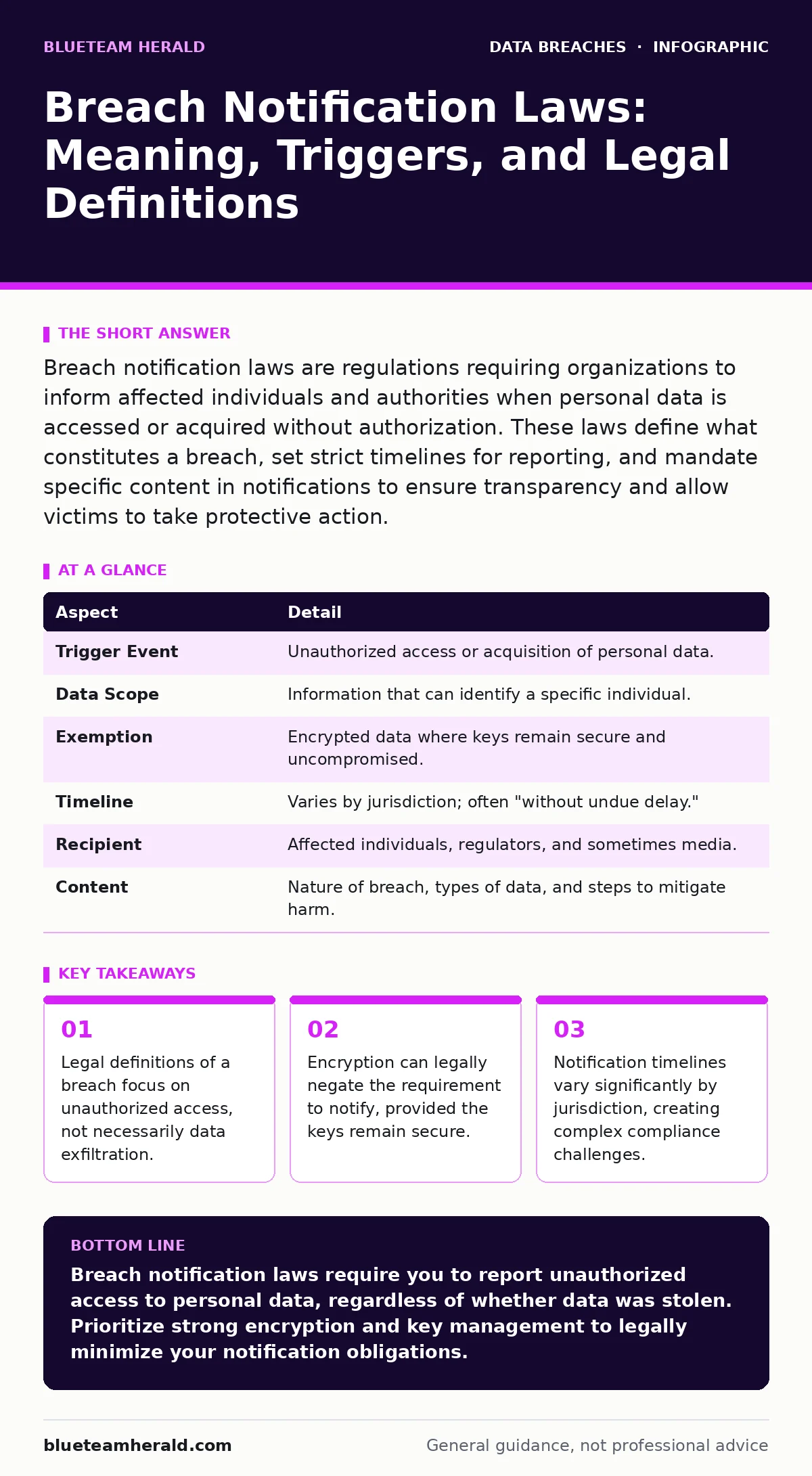
Breach notification laws are regulations requiring organizations to inform affected individuals and authorities when personal data is accessed or acquired without authorization. These laws define what constitutes a breach, set strict timelines for reporting, and mandate specific content in notifications to ensure transparency and allow victims to take protective action.
The Alarm System Analogy
Imagine your home has a sophisticated security system. If a stranger walks through your front door, the alarm sounds immediately. You call the police because you know someone was inside, even if they did not steal anything yet. Now, imagine the stranger only touched the door handle from the outside. The alarm does not sound. You do not call the police.
Breach notification laws operate on a similar principle of threshold. They do not require you to report every suspicious attempt or probe. They require reporting only when a specific barrier is crossed. That barrier is usually the unauthorized acquisition or access of personal data. The law cares about the breach of confidentiality, not just the breach of physical or logical perimeter.
This distinction matters because most security alerts are noise. A firewall blocking a connection is not a breach. A failed login attempt is not a breach. A breach occurs when an attacker successfully bypasses controls and gains access to data they should not see. The notification requirement kicks in at that precise moment of unauthorized access.
Defining the Legal Breach
A data breach, in the context of notification laws, is the unauthorized access to or acquisition of unsecured personal data. Personal data typically includes information that can identify an individual, such as names, addresses, social security numbers, or financial account details. The key term here is "unsecured."
Data is considered secured if it is encrypted or redacted in a way that renders it unreadable to an unauthorized person. If an attacker steals a hard drive containing encrypted files, and the encryption keys were not compromised, many jurisdictions do not consider this a reportable breach. The data was accessed, but it was not readable. Therefore, the risk to the individual is deemed negligible.
This definition creates a critical dependency on your encryption strategy. If your encryption implementation is flawed, or if you store keys alongside the data, the data is legally "unsecured." You must treat encryption as a legal control, not just a technical one. Failure to encrypt properly can turn a contained incident into a public relations disaster and a legal liability.
| Aspect | Detail |
|---|---|
| Trigger Event | Unauthorized access or acquisition of personal data. |
| Data Scope | Information that can identify a specific individual. |
| Exemption | Encrypted data where keys remain secure and uncompromised. |
| Timeline | Varies by jurisdiction; often "without undue delay." |
| Recipient | Affected individuals, regulators, and sometimes media. |
| Content | Nature of breach, types of data, and steps to mitigate harm. |
The Day-to-Day Reality
In daily operations, breach notification laws transform security incidents into legal events. When a security team detects an intrusion, the first question is not just "how do we stop it?" but "does this meet the legal definition of a breach?" This shifts the focus from pure technical remediation to evidence preservation and legal assessment.
You must determine what data was accessed. This requires precise logging and forensic analysis. If you cannot prove that no personal data was accessed, you must assume it was. This uncertainty often forces organizations to notify individuals even when they are unsure. The cost of notifying unnecessarily is lower than the penalty for failing to notify when required.
This dynamic creates a hidden cost in logging infrastructure. You need logs that are detailed enough to reconstruct user activity but not so voluminous that they are unusable during an incident. Consider how digital forensics relies on this data integrity. If your logs are incomplete, you cannot defend your decision not to notify. The legal burden of proof rests on you, not the regulator.
What People Usually Get Wrong
A common misconception is that data must be stolen for a breach to occur. Many believe that if the attacker was ejected before copying files, no notification is needed. This is incorrect. Most laws focus on unauthorized access. If an attacker could have read the data, the breach has happened. The potential for harm is sufficient to trigger notification requirements.
Another error is assuming that internal access is safe. If an employee accesses customer records without authorization, it is a breach. Notification laws do not distinguish between external hackers and internal miscreants. The unauthorized nature of the access is what matters. This highlights the importance of employee offboarding security and strict access controls.
Organizations also frequently misunderstand the "harm" threshold. Some believe they only need to notify if the data causes financial loss. This is false. The law protects privacy and autonomy. The embarrassment, anxiety, or risk of identity theft is sufficient harm. You do not need to wait for victims to report fraud before acting.
The Encryption Loophole
Encryption is the most powerful tool for avoiding notification obligations. If you encrypt data at rest and in transit, and manage keys separately, you create a legal shield. If attackers steal encrypted data, you can often argue that the data was "secured" and therefore no breach occurred.
However, this protection is fragile. If the encryption keys are stored on the same server as the data, or if they are accessible via the same network path, the encryption provides no legal protection. The attacker can read the data, so it is unsecured. You must implement key management as a distinct security domain.
This technical nuance has significant legal consequences. A poorly configured encryption system can invalidate your defense against notification requirements. Regular audits of your key management infrastructure are necessary. You must ensure that the keys are not just secure in theory, but secure in practice against the same threats that target your data.
See also: Data Privacy vs Data Security: The Critical Difference Explained · Database Security FAQ: Protecting Records from Internal and External Threats
Navigating Multiple Jurisdictions
Breach notification laws are not uniform. Different states, countries, and industries have different rules. A healthcare provider in the United States must follow federal HIPAA rules, while also complying with state laws that may be stricter. A company operating in Europe must follow the GDPR, which has its own notification timelines and definitions.
This fragmentation creates a compliance nightmare. An incident in one region may trigger notifications in another. You must map your data flows to understand which laws apply to each dataset. This is where vendor risk management becomes critical. If a third-party processor holds your data, their breach is your breach. You are responsible for notifying, even if you did not cause the incident.
The safest approach is to comply with the strictest applicable law. If one jurisdiction requires notification within 72 hours, and another allows 60 days, you should aim for the 72-hour window. This ensures you meet all obligations without having to track multiple deadlines during a crisis. Consistency simplifies operations and reduces legal risk.
The Content of Notification
When you must notify, the content of the message matters. Laws typically require you to describe the nature of the breach, the types of data involved, and the steps individuals can take to protect themselves. Vague language is dangerous. It can be seen as an attempt to hide the severity of the incident.
You must be specific about what data was exposed. If only names and addresses were accessed, say so. Do not imply that financial data was stolen if it was not. Overstating the breach can cause unnecessary panic and damage trust. Understating it can lead to legal penalties for misleading the public.
The notification should also include contact information for questions. This creates a channel for affected individuals to seek help. It demonstrates accountability and transparency. A well-crafted notification can mitigate reputational damage by showing that you are in control and taking responsibility.
The Broader Security Context
Breach notification laws are just one part of a comprehensive security strategy. They react to incidents that have already occurred. To prevent them, you must focus on prevention and detection. This includes securing accounts against email account compromise and monitoring for stolen session tokens.
Data backup strategies also play a role. If you have a reliable 3-2-1 backup rule in place, you can recover from ransomware or data destruction without paying ransoms. However, backups do not prevent unauthorized access. They only ensure availability. You still need to protect confidentiality to avoid notification requirements.
Specialized threats like medical identity theft require additional vigilance. Health data is highly valuable and sensitive. Breaches in this sector often trigger stricter penalties and more intense scrutiny. Understanding the specific risks associated with your data type is essential for effective compliance.
Even sophisticated threats like domain generation algorithms used by malware can lead to breaches if they compromise endpoints. These algorithms allow malware to communicate with command-and-control servers, potentially exfiltrating data. Detecting these patterns early can prevent a breach from occurring in the first place.
Key takeaways
- Legal definitions of a breach focus on unauthorized access, not necessarily data exfiltration.
- Encryption can legally negate the requirement to notify, provided the keys remain secure.
- Notification timelines vary significantly by jurisdiction, creating complex compliance challenges.
Breach notification laws require you to report unauthorized access to personal data, regardless of whether data was stolen. Prioritize strong encryption and key management to legally minimize your notification obligations.
Frequently asked questions
Do I need to notify if the data was encrypted?
Generally, no. If the data was encrypted and the encryption keys were not compromised, the data is considered "secured" and not reportable in most jurisdictions.
What is the difference between access and acquisition?
Access means the attacker viewed or interacted with the data. Acquisition means the attacker copied or exfiltrated the data. Most laws trigger on access alone.
Who do I notify besides the affected individuals?
You often must notify state attorneys general, federal regulators, and sometimes major media outlets if the breach affects a large number of people.
Can I delay notification to contain the breach?
You can take reasonable time to investigate, but "without undue delay" usually means within days, not weeks. Prolonged delays can result in penalties.
How this guide was produced: written by the BlueTeam Herald editorial team with AI assistance, checked against the public references listed below, and reviewed when the facts change. See our editorial policy or report an error.