Data Privacy vs Data Security: The Critical Difference Explained
Security protects data from theft, but privacy determines who can see it, meaning you can have perfect security with zero privacy if owners lack control.

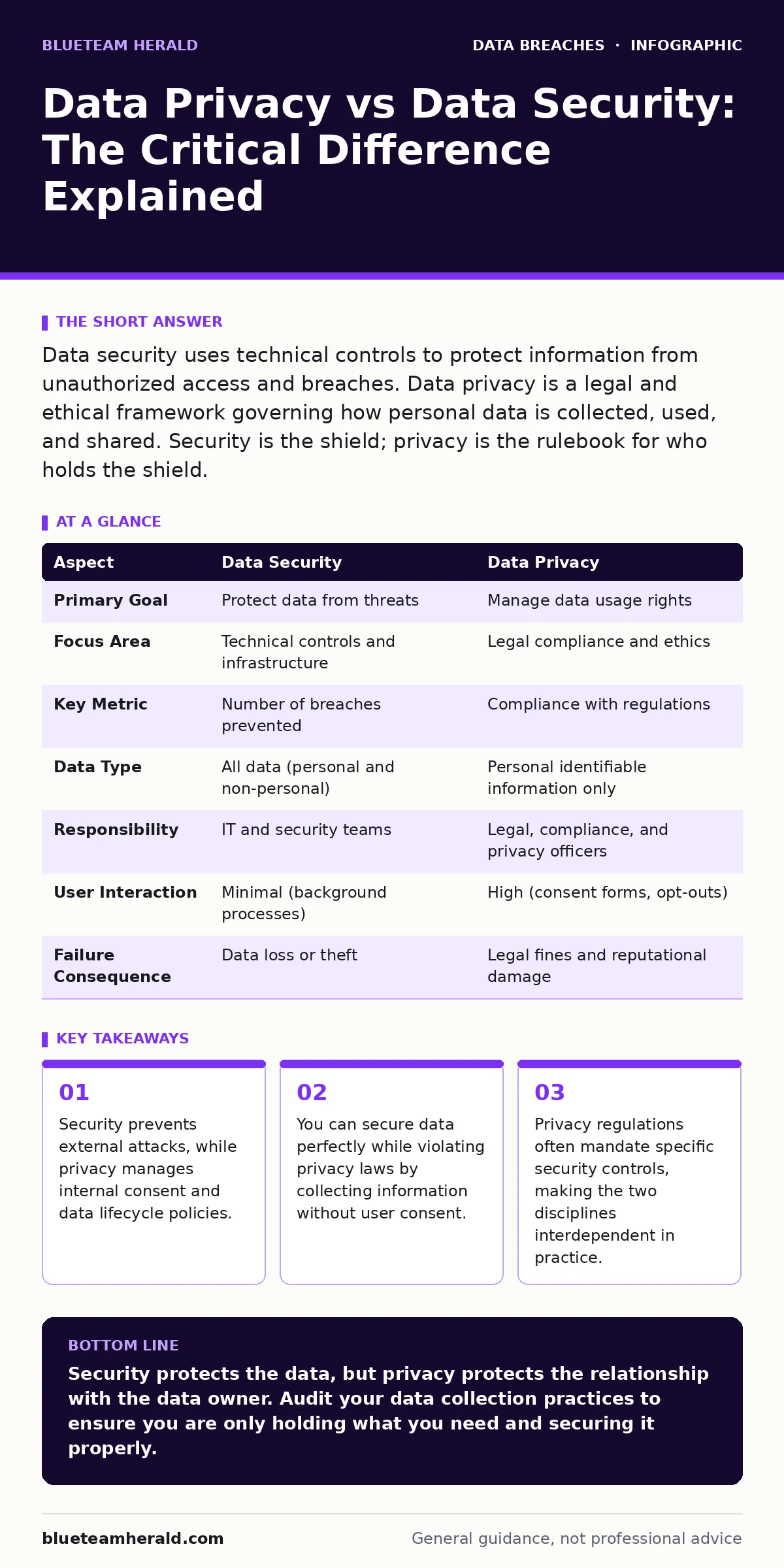
Data security uses technical controls to protect information from unauthorized access and breaches. Data privacy is a legal and ethical framework governing how personal data is collected, used, and shared. Security is the shield; privacy is the rulebook for who holds the shield.
The Core Distinction
Data security and data privacy are often used interchangeably, but they address fundamentally different problems. Data security refers to the technical and physical measures you take to protect digital assets from unauthorized access, corruption, or theft. It is about keeping the data safe. Data privacy concerns the proper handling, processing, and storage of personal information.
It is about respecting the rights of the individuals whose data you hold. You can have strong security without privacy, such as when a company encrypts all customer records but sells the decrypted data to advertisers without consent. Conversely, you cannot have true privacy without security, because if the data is stolen, the privacy promises are broken.
What Is Data Security
Data security involves the implementation of controls to safeguard information. These controls include encryption, which scrambles data so only authorized parties can read it, and access controls, which limit who can view or edit files. The goal is confidentiality, integrity, and availability. Confidentiality ensures only authorized users see the data.
Integrity ensures the data has not been altered. Availability ensures the data is accessible when needed. Security teams focus on threats like malware, hacking attempts, and physical theft of devices. They build walls and install locks. The metric for success is whether an attacker succeeded in breaching the perimeter or exfiltrating files. Security is a defensive posture against active threats.
What Is Data Privacy
Data privacy is a policy-driven discipline that governs how personal data is managed. It answers questions like why you are collecting data, how long you will keep it, and who you will share it with. Privacy frameworks, such as GDPR or CCPA, establish legal obligations for organizations. These laws require you to obtain explicit consent from individuals before processing their information.
You must also provide mechanisms for users to request deletion or correction of their data. Privacy is not about hiding data from attackers; it is about limiting the scope of data collection and usage. It ensures that data is used only for the purpose it was collected. Privacy teams audit business processes to ensure compliance with these regulations.
| Aspect | Data Security | Data Privacy |
|---|---|---|
| Primary Goal | Protect data from threats | Manage data usage rights |
| Focus Area | Technical controls and infrastructure | Legal compliance and ethics |
| Key Metric | Number of breaches prevented | Compliance with regulations |
| Data Type | All data (personal and non-personal) | Personal identifiable information only |
| Responsibility | IT and security teams | Legal, compliance, and privacy officers |
| User Interaction | Minimal (background processes) | High (consent forms, opt-outs) |
| Failure Consequence | Data loss or theft | Legal fines and reputational damage |
Where They Overlap
The line between security and privacy blurs where technical controls enforce legal requirements. Encryption is a security tool, but it also serves privacy by rendering stolen data useless to attackers who lack the decryption keys. This is known as data minimization in practice. If you encrypt sensitive fields, you reduce the risk of exposure, which satisfies privacy mandates for protecting personal information.
Access controls also bridge the gap. By restricting access to the minimum number of employees who need it, you enhance security and adhere to the privacy principle of least privilege. Without strong security, privacy policies are merely words on paper. A breach renders any privacy promise void. Therefore, privacy programs must fund and prioritize security initiatives.
Choose Security First When
- You are designing the architecture for a new database or cloud storage system.
- You need to protect intellectual property or trade secrets that are not personal data.
- You are responding to an active cyberattack or malware outbreak.
- You must ensure business continuity during a ransomware event.
- You are implementing disaster recovery plans to restore data availability.
See also: Breach Notification Laws: Meaning, Triggers, and Legal Definitions · Data Breach vs Data Leak: Decide Which Term Fits Your Incident
Choose Privacy First When
- You are collecting personal information from customers or employees.
- You need to define retention policies for how long data is stored.
- You are drafting consent forms for marketing communications.
- You must respond to a subject access request from an individual.
- You are expanding into a new region with strict data protection laws.
The Hidden Cost of Separation
Treating security and privacy as separate silos creates blind spots. Security teams may implement broad data collection for monitoring purposes, violating privacy principles. Privacy teams may draft policies that are technically impossible to enforce, weakening security posture. This disconnect leads to inefficient resource allocation. You might spend heavily on firewalls while ignoring the legal risks of data hoarding. Imagine a scenario where a company secures its servers perfectly but fails to delete old customer records.
A breach later exposes years of unnecessary data, leading to massive fines. This overlap requires collaboration. Security provides the tools; privacy provides the rules for their use. Understanding this synergy prevents costly errors. See how vendor risk management helps align these goals with third parties. Also consider breach notification laws which trigger when security fails to protect privacy.
Practical Integration Steps
Start by mapping your data flows. Identify where personal data enters, moves, and exits your organization. Apply security controls at each stage, such as encryption in transit and at rest. Then, apply privacy controls, such as consent checks and retention limits. Train employees on both disciplines. Developers should understand privacy by design, while security analysts should understand legal obligations. Regular audits should check for both technical vulnerabilities and policy violations. This integrated approach ensures you are not just safe, but also compliant.
Review employee offboarding security procedures to ensure access is revoked and data is handled correctly. Monitor for stolen session tokens which bypass traditional security checks. Understand email account compromise vectors that often lead to privacy violations. Learn about digital forensics to investigate incidents. Protect against medical identity theft by securing health data specifically. Follow the 3-2-1 backup rule to ensure data resilience.
Key takeaways
- Security prevents external attacks, while privacy manages internal consent and data lifecycle policies.
- You can secure data perfectly while violating privacy laws by collecting information without user consent.
- Privacy regulations often mandate specific security controls, making the two disciplines interdependent in practice.
Security protects the data, but privacy protects the relationship with the data owner. Audit your data collection practices to ensure you are only holding what you need and securing it properly.
Frequently asked questions
Can I have good privacy without good security?
No, because if your data is stolen, you have failed to protect the individual's privacy regardless of your internal policies.
Does encryption solve both security and privacy issues?
Encryption solves security by preventing unauthorized reading, but it does not solve privacy issues related to how data was collected or shared.
Who is responsible for data privacy in a company?
Typically, a Chief Privacy Officer or legal team handles privacy, while the Chief Information Security Officer handles security, though they must collaborate.
How do I know if I am violating privacy laws?
If you collect personal data without explicit consent or retain it longer than necessary, you are likely violating privacy regulations.
How this guide was produced: written by the BlueTeam Herald editorial team with AI assistance, checked against the public references listed below, and reviewed when the facts change. See our editorial policy or report an error.