Data Breach vs Data Leak: Decide Which Term Fits Your Incident
Confusing these terms distorts your response strategy because breaches imply active intrusion while leaks often stem from internal misconfiguration or negligence.

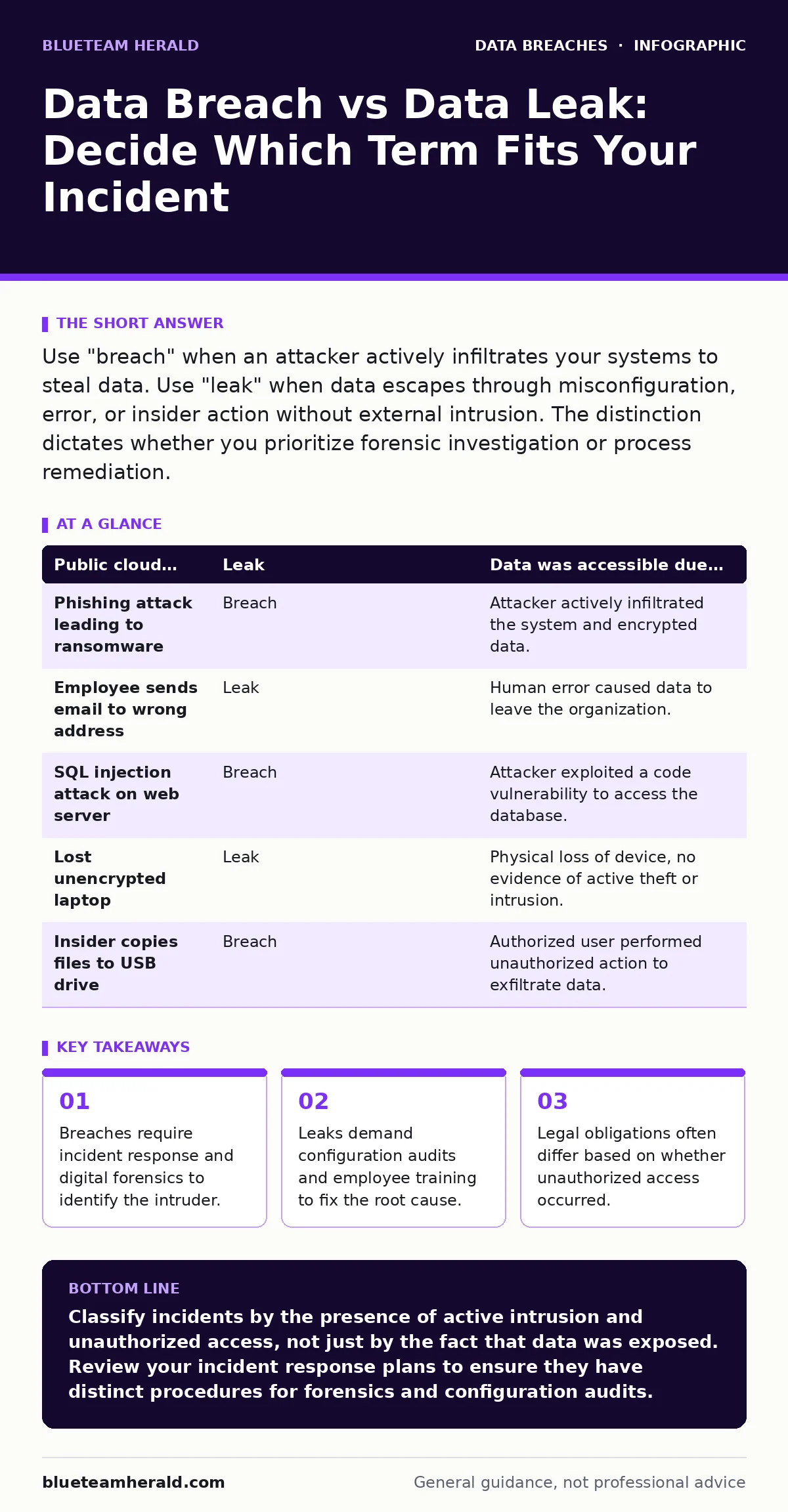
Use "breach" when an attacker actively infiltrates your systems to steal data. Use "leak" when data escapes through misconfiguration, error, or insider action without external intrusion. The distinction dictates whether you prioritize forensic investigation or process remediation.
Did an external actor cross a boundary?
The primary distinction lies in agency. A data breach occurs when an unauthorized party actively penetrates a security perimeter to access, copy, or alter information. This implies intent and capability. The attacker bypasses controls, such as firewalls or authentication mechanisms, to reach the data.
A data leak happens when data exits your control without a deliberate external intrusion. This often results from human error, such as sending an email to the wrong recipient, or from technical misconfigurations, like leaving a database publicly accessible. No hacker broke in; the door was simply left open.
Imagine a server administrator accidentally sets a cloud storage bucket to "public." Anyone on the internet can read the files. This is a leak. The data is exposed, but no one forced their way in. If a hacker then exploits a vulnerability in that same server to install malware and exfiltrate the files, that is a breach.
Was there unauthorized access or just exposure?
You must determine if the data was merely visible or actually accessed by an unauthorized entity. Exposure means the data is reachable, but you may not know if anyone looked at it. Access confirms that someone interacted with the data.
In a leak scenario, the data might sit in a public folder for months. You might discover it during a routine audit. No one necessarily downloaded it. The risk is potential compromise, not confirmed theft. The response focuses on closing the exposure.
In a breach scenario, logs show specific IP addresses accessing sensitive files at unusual hours. Authentication tokens were used to bypass permissions. The attacker did not just see the data; they interacted with it. This confirms unauthorized access.
This distinction matters for breach notification laws. Many regulations require notification only when there is a reasonable likelihood of harm to individuals, which is easier to prove with confirmed access than with mere exposure. If you cannot prove access, you may still have reputational risk, but the legal threshold might not be met.
What is the source of the failure?
Identifying the root cause helps you label the incident correctly. Breaches typically stem from exploited vulnerabilities, such as unpatched software or weak credentials. The failure is in the defense against an active adversary.
Leaks often stem from process failures or configuration errors. A developer might hardcode API keys in a public repository. An employee might print sensitive documents and leave them in a shared area. The failure is in handling or securing the data at rest or in transit.
Consider vendor risk management. If a third-party vendor loses your data because they failed to encrypt their backups, is it a breach or a leak? If their systems were hacked, it is a breach. If they accidentally emailed your data to the wrong client, it is a leak. Your contractual obligations may differ based on this classification.
How does this affect your investigation?
The investigative path diverges sharply after classification. For a breach, you need digital forensics. You must preserve logs, memory dumps, and disk images to trace the attacker’s movements. You are looking for indicators of compromise, such as new admin accounts or unusual network traffic.
For a leak, you need a configuration audit. You must find the misconfigured setting or the process gap. You are looking for why the data was accessible. Forensic tools are less useful here unless you suspect an insider threat.
Suppose you find customer records on a public code repository. This is a leak. You remove the code and rotate the credentials. You do not need to analyze network packets for signs of a remote attacker. However, if you find that the code repository was compromised and an attacker pushed the sensitive data, that is a breach. You must now investigate how the attacker gained write access to the repository.
Situation | Better fit | Why
| Public cloud storage bucket | Leak | Data was accessible due to misconfiguration, not intrusion. |
|---|---|---|
| Phishing attack leading to ransomware | Breach | Attacker actively infiltrated the system and encrypted data. |
| Employee sends email to wrong address | Leak | Human error caused data to leave the organization. |
| SQL injection attack on web server | Breach | Attacker exploited a code vulnerability to access the database. |
| Lost unencrypted laptop | Leak | Physical loss of device, no evidence of active theft or intrusion. |
| Insider copies files to USB drive | Breach | Authorized user performed unauthorized action to exfiltrate data. |
See also: GraphQL Incident Response: Containment, Recovery, and Prevention Steps · DNS Rebinding Response: Containment, Recovery and Prevention Steps
When to use both terms together
Some incidents start as leaks and become breaches. A misconfigured server (leak) might be scanned by bots, leading to a deeper intrusion (breach). In these cases, you must address both the initial exposure and the subsequent compromise.
You should also consider stolen session tokens. If an attacker steals a valid session token, they bypass authentication. This looks like a breach because an unauthorized party is accessing data. However, if the token was leaked due to a cross-site scripting vulnerability, the root cause is a leak of the token. The response must fix the vulnerability and invalidate the tokens.
Using both terms ensures you do not miss the full scope. If you only call it a leak, you might ignore the attacker’s presence. If you only call it a breach, you might ignore the underlying configuration weakness that allowed the attacker in.
The hidden cost of ambiguity
Ambiguity costs time and money. If you label a leak as a breach, you might hire expensive forensic consultants to hunt for ghosts. If you label a breach as a leak, you might miss the attacker who is still inside your network.
Clear terminology streamlines communication. It helps legal teams assess liability. It helps technical teams choose the right tools. It helps leadership understand the severity.
Do not guess. Look for evidence of active intrusion. Look for evidence of unauthorized access. If you find neither, it is likely a leak. If you find either, it is a breach.
Key takeaways
- Breaches require incident response and digital forensics to identify the intruder.
- Leaks demand configuration audits and employee training to fix the root cause.
- Legal obligations often differ based on whether unauthorized access occurred.
- Using the wrong term can mislead stakeholders and regulatory bodies.
Classify incidents by the presence of active intrusion and unauthorized access, not just by the fact that data was exposed. Review your incident response plans to ensure they have distinct procedures for forensics and configuration audits.
Frequently asked questions
Does a data leak always mean a security failure?
Yes, because it indicates that controls failed to keep data contained, whether due to error, misconfiguration, or negligence.
Can a data leak become a data breach later?
Yes, if an attacker discovers the exposed data and exploits it to gain further access or steal more information.
Do I need to notify customers for a data leak?
It depends on local laws and whether the leaked data was actually accessed or used by unauthorized parties.
How do I prevent data leaks?
Implement strict access controls, regular configuration audits, and training on data handling procedures to reduce human error.
How this guide was produced: written by the BlueTeam Herald editorial team with AI assistance, checked against the public references listed below, and reviewed when the facts change. See our editorial policy or report an error.