Detect Gift Card Scams in Logs and User Behavior
Gift card fraud often hides in standard procurement workflows, bypassing security filters by mimicking legitimate vendor transactions and internal requests.

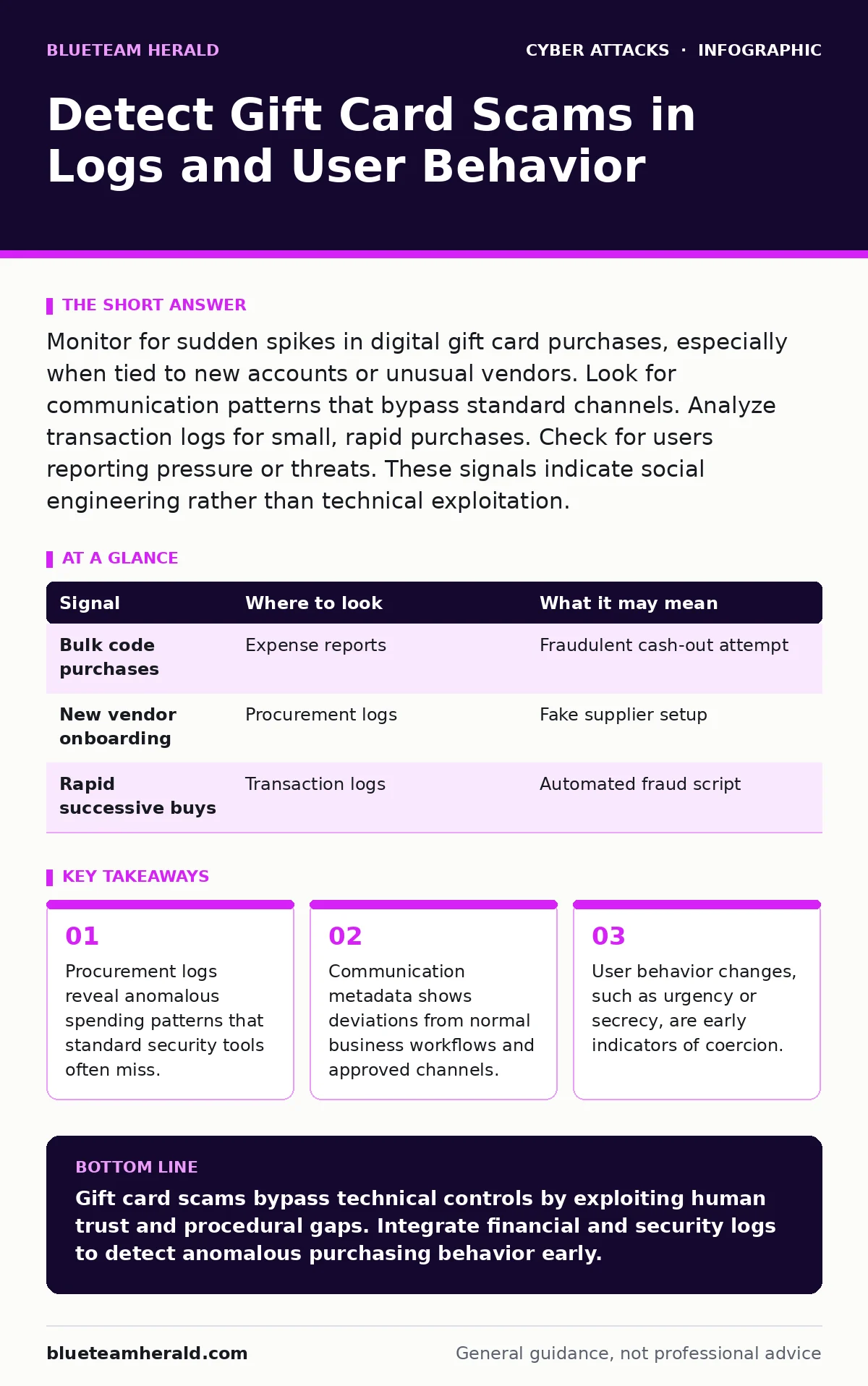
Monitor for sudden spikes in digital gift card purchases, especially when tied to new accounts or unusual vendors. Look for communication patterns that bypass standard channels. Analyze transaction logs for small, rapid purchases. Check for users reporting pressure or threats. These signals indicate social engineering rather than technical exploitation.
Procurement and Expense Logs
Gift card fraud rarely triggers traditional intrusion detection systems. The attack vector is human manipulation, not software exploitation. You must examine financial and procurement logs to find the evidence. Look for transactions involving digital retail codes or prepaid cards. These items are often treated as standard office supplies by automated systems.
Suppose an employee purchases 50 digital codes in a single transaction. The system records this as a valid expense. If the vendor is a major retailer, the transaction passes compliance checks. The anomaly lies in the volume and the item type. Standard users do not buy bulk gift cards. Security teams often ignore these logs because they lack technical indicators of compromise.
| Signal | Where to look | What it may mean |
|---|---|---|
| Bulk code purchases | Expense reports | Fraudulent cash-out attempt |
| New vendor onboarding | Procurement logs | Fake supplier setup |
| Rapid successive buys | Transaction logs | Automated fraud script |
Communication Metadata
Attackers rely on urgency and authority to bypass scrutiny. They often use email or instant messaging to deliver instructions. You must analyze the metadata of these communications. Check the sender address for subtle variations from known executives. Look for messages that request immediate action without allowing time for verification.
The content of the message matters less than the context. A message asking for gift card codes is suspicious regardless of the reason given. If the request comes via a channel outside the normal workflow, treat it as high risk. For example, a CEO requesting payment via text message is a deviation from standard protocol. This deviation is the primary signal you need to investigate.
User Behavior Indicators
Human behavior changes under coercion. Victims often act differently when they are being manipulated. You can detect these changes through endpoint monitoring and user activity logs. Look for users who spend unusual amounts of time on specific websites. Check for rapid copy-paste actions involving alphanumeric strings. These strings are often the gift card codes.
Victims may also delete browser history or clear chat logs after the transaction. This behavior indicates an attempt to hide the activity. Security teams should monitor for sudden spikes in clipboard activity. If a user copies long strings of characters and pastes them into a web form, this is a strong indicator of fraud. The user may not realize they are being exploited.
Endpoint and Network Activity
While the fraud is social, the execution often leaves technical traces. The victim’s device must connect to the retailer’s website to purchase or validate the codes. You can detect this by monitoring web proxy logs. Look for connections to major retail domains that are not part of normal business operations.
Suppose a finance employee visits a gaming retailer’s website. This is unusual for their role. If the visit coincides with a large expense report submission, the correlation is significant. Firewalls and proxy servers record these connections. You can use this data to identify users who are deviating from their typical browsing patterns. This method helps catch incidents before the funds are transferred.
Identity and Access Management
Gift card scams often involve account takeover or identity spoofing. The attacker may impersonate a senior executive or a vendor. You must review identity logs for signs of compromise. Look for logins from unusual locations or devices. Check for sudden changes in user permissions or access rights.
If an attacker gains access to an executive’s account, they can send convincing requests. The email headers will show the legitimate account was used. This makes the attack harder to detect. You must verify the identity of the requester through out-of-band communication. Do not trust the digital signature alone. The presence of a valid signature does not prove the user initiated the request.
See also: Business Email Compromise Example: How Attackers Bypass Trust
Common Blind Spots
Security teams often focus on technical indicators and miss the social engineering aspect. One major blind spot is the assumption that gift cards are only used for personal gain. Attackers use them as a liquid asset. They can be redeemed for cryptocurrency or other goods. This makes them difficult to trace and recover.
Another blind spot is the lack of integration between financial and security teams. Expense reports are often reviewed by finance, while security monitors network traffic. If these teams do not share data, the full picture remains hidden. You must establish a workflow that connects procurement anomalies with security alerts. This cross-functional approach is necessary to detect sophisticated campaigns.
Tooling and Detection Strategies
You need tools that can correlate data across different systems. Security Information and Event Management (SIEM) platforms are ideal for this. Configure rules to flag large purchases of digital goods. Integrate these alerts with identity management logs. This allows you to see if a compromised account is involved.
Email security gateways can help, but they are not sufficient. They may block obvious phishing attempts, but they cannot stop a legitimate employee from following a social engineering script. You must use User and Entity Behavior Analytics (UEBA) tools. These tools establish baselines for normal user activity and flag deviations. This proactive approach is more effective than reactive filtering.
Incident Response Coordination
When you detect a gift card scam, time is critical. The codes are often redeemed within minutes. You must have a clear incident response plan that includes financial fraud. Coordinate with the finance department to freeze the transaction. Contact the retailer to cancel the codes if possible.
Document the incident thoroughly. This includes the communication logs, transaction details, and user interviews. Use this data to update your detection rules. Each incident provides insights into new tactics. By continuously refining your detection capabilities, you reduce the window of opportunity for attackers. This iterative process strengthens your overall security posture.
Key takeaways
- Procurement logs reveal anomalous spending patterns that standard security tools often miss.
- Communication metadata shows deviations from normal business workflows and approved channels.
- User behavior changes, such as urgency or secrecy, are early indicators of coercion.
Gift card scams bypass technical controls by exploiting human trust and procedural gaps. Integrate financial and security logs to detect anomalous purchasing behavior early.
Frequently asked questions
How do I distinguish between a legitimate purchase and a scam?
Legitimate purchases follow standard procurement workflows and have prior approval. Scams often involve urgency, bypass standard channels, and involve unusual items like bulk gift cards.
Can email filters stop gift card phishing?
Email filters can block obvious phishing attempts, but they cannot stop social engineering from trusted accounts or legitimate employees under coercion. You must also monitor user behavior.
What is the role of UEBA in detecting these scams?
UEBA tools establish baselines for normal user activity and flag deviations, such as unusual browsing patterns or rapid copy-paste actions, which may indicate fraud.
How do I respond if an executive account is compromised?
Immediately reset the credentials, revoke active sessions, and notify the executive. Verify any pending requests through out-of-band communication channels.
How this guide was produced: written by the BlueTeam Herald editorial team with AI assistance, checked against the public references listed below, and reviewed when the facts change. See our editorial policy or report an error.