WebSocket Security Myths: 6 False Beliefs That Leave Apps Exposed
WebSocket connections often bypass traditional security controls because they maintain persistent state, allowing attackers to exploit logic flaws that stateless filters cannot detect.
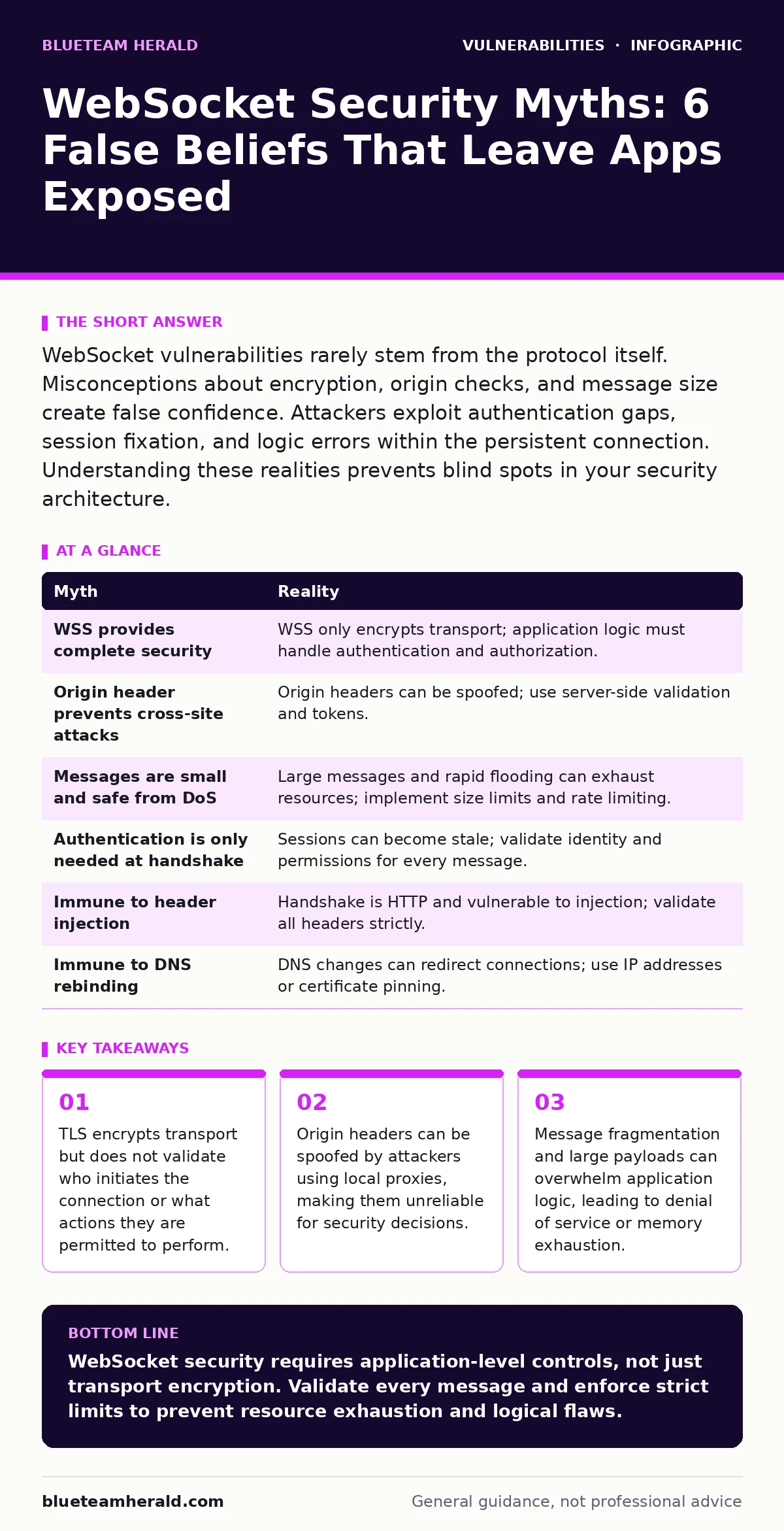
WebSocket vulnerabilities rarely stem from the protocol itself. Misconceptions about encryption, origin checks, and message size create false confidence. Attackers exploit authentication gaps, session fixation, and logic errors within the persistent connection. Understanding these realities prevents blind spots in your security architecture.
Myth: WebSocket connections are secure if they use WSS
Reality: Using WSS (WebSocket Secure) encrypts the data in transit, but it does not protect against logical vulnerabilities or authentication flaws. Encryption ensures that a third party cannot read the messages, but it does nothing to stop a malicious user who has legitimately connected to the server. If an attacker steals a valid session token, WSS will happily encrypt their malicious commands just as it encrypts legitimate ones. The protocol itself provides no mechanism for verifying the identity of the sender beyond what the application implements.
Imagine an application that uses WSS to transmit chat messages. An attacker intercepts the initial handshake, captures the session cookie, and then connects from their own machine. The connection is encrypted, so network monitors see only encrypted traffic. However, the application logic fails to re-verify the user's permissions for each message. The attacker sends commands that the application executes because it trusts the initial connection state. This is why security cannot rely solely on transport layer encryption. You must implement application-level authentication and authorization for every message.
Myth: The Origin header reliably prevents cross-site attacks
Reality: The Origin header indicates where a request originated, but it is easily spoofed. Attackers can use local proxies or simple scripts to set the Origin header to any value they choose. Relying on this header for security decisions is dangerous because it can be manipulated. Many developers assume that if the Origin matches their domain, the request is safe. This assumption fails when an attacker hosts a malicious page on a subdomain or uses a tool that forwards requests with a fake Origin. The WebSocket handshake is an HTTP upgrade request, and like any HTTP request, it can be crafted by the client.
Suppose you build a financial dashboard that accepts WebSocket connections only from your main domain. An attacker creates a page on a different domain and uses a proxy to forward WebSocket connections to your server, setting the Origin header to your domain. Your server accepts the connection because the Origin matches. The attacker can then send commands to your server on behalf of any user who visits their malicious page.
This is similar to how browser extension vulnerabilities can arise when extensions trust user-controlled data without proper validation. To mitigate this, you must implement server-side validation that does not rely solely on the Origin header. Use tokens or other cryptographic proofs that the client cannot forge.
Myth: WebSocket messages are small and cannot cause denial of service
Reality: WebSocket messages can be large, and the protocol supports fragmentation. Attackers can send large messages or many small messages rapidly to exhaust server resources. Unlike HTTP, where each request is independent, a WebSocket connection persists. This means an attacker can keep a connection open and flood it with data, consuming memory and CPU on the server. Many applications do not implement proper rate limiting or message size limits for WebSocket connections. They assume that the persistent nature of the connection prevents flooding. This is a critical error. An attacker can open multiple connections or keep one connection open and send continuous data.
Imagine a chat application that does not limit the size of incoming messages. An attacker opens a WebSocket connection and sends a 100-megabyte message. The server attempts to process this message, consuming significant memory. If the attacker opens 100 such connections, the server may run out of memory and crash.
This is a form of denial of service that is difficult to detect because it looks like legitimate traffic. You must implement strict message size limits and rate limiting. Consider the impact of attack vectors in CVSS when evaluating the severity of such flaws. A resource exhaustion flaw can be as damaging as a remote code execution flaw if it takes down the service.
Myth: Authentication is only needed during the handshake
Reality: The WebSocket handshake is a single HTTP request that upgrades the connection to WebSocket. Many applications authenticate the user during this handshake and then assume the connection remains authenticated. This is a dangerous assumption. If the user's session expires or their permissions change, the server may not know. The connection remains open, and the client can continue to send messages that the server processes as if they are from an authenticated user. This is known as session fixation or stale session usage. You must validate the user's identity and permissions for every message, not just during the initial connection.
Suppose a user logs in and opens a WebSocket connection. Later, the user logs out, but the WebSocket connection remains open. The application does not check the session status for subsequent messages. The attacker, who has captured the session token, sends commands through the existing connection. The server executes these commands because it does not re-verify the session. This is similar to how security misconfigurations can leave APIs vulnerable when they do not enforce token expiration. To prevent this, implement a mechanism to validate tokens on each message or use a heartbeat mechanism that re-validates the session periodically.
Myth: WebSocket connections are immune to header injection attacks
Reality: The WebSocket handshake is an HTTP request, and it is vulnerable to header injection attacks. Attackers can inject headers into the handshake request to manipulate server behavior. For example, an attacker might inject a Host header to redirect the connection to a different server or to bypass security controls. This is similar to host header injection vulnerabilities in HTTP applications. Many developers assume that because WebSocket is a different protocol, it is not affected by HTTP-level attacks. This is incorrect. The handshake phase is HTTP, and it inherits all the vulnerabilities of HTTP.
Imagine an application that uses the Host header to determine which backend server to connect to. An attacker injects a malicious Host header into the WebSocket handshake. The server connects to the attacker's server instead of the intended backend. The attacker can then intercept or modify the data flowing through the WebSocket connection. This is a serious vulnerability that can lead to data theft or manipulation. To prevent this, validate all headers in the handshake request and do not trust client-supplied data. Use allowlists for header values and reject any unexpected headers.
Myth: WebSockets are not affected by DNS rebinding
Reality: DNS rebinding attacks can target WebSocket connections just as they target HTTP connections. An attacker can control the DNS resolution for a domain and redirect it to a different IP address. If the WebSocket connection is established using a domain name, the attacker can redirect the connection to their own server. This allows the attacker to intercept the WebSocket traffic. Many developers assume that because the connection is persistent, it is not affected by DNS changes. This is incorrect. The initial handshake uses DNS, and if the DNS record changes, the connection may be redirected.
Suppose an application uses a WebSocket connection to communicate with a backend server. An attacker controls the DNS for the backend domain. The attacker changes the DNS record to point to their own server. When the client establishes the WebSocket connection, it connects to the attacker's server. The attacker can then intercept and modify the WebSocket messages. This is similar to how DNS rebinding can be used to bypass same-origin policy restrictions. To prevent this, use IP addresses instead of domain names for critical connections or implement certificate pinning to ensure that the client connects to the expected server.
Summary of WebSocket Security Myths
| Myth | Reality |
|---|---|
| WSS provides complete security | WSS only encrypts transport; application logic must handle authentication and authorization. |
| Origin header prevents cross-site attacks | Origin headers can be spoofed; use server-side validation and tokens. |
| Messages are small and safe from DoS | Large messages and rapid flooding can exhaust resources; implement size limits and rate limiting. |
| Authentication is only needed at handshake | Sessions can become stale; validate identity and permissions for every message. |
| Immune to header injection | Handshake is HTTP and vulnerable to injection; validate all headers strictly. |
| Immune to DNS rebinding | DNS changes can redirect connections; use IP addresses or certificate pinning. |
Key takeaways
- TLS encrypts transport but does not validate who initiates the connection or what actions they are permitted to perform.
- Origin headers can be spoofed by attackers using local proxies, making them unreliable for security decisions.
- Message fragmentation and large payloads can overwhelm application logic, leading to denial of service or memory exhaustion.
- Persistent connections bypass many traditional web filters that rely on request-response cycles for inspection.
WebSocket security requires application-level controls, not just transport encryption. Validate every message and enforce strict limits to prevent resource exhaustion and logical flaws.
Frequently asked questions
Do I need to use CSRF tokens for WebSocket connections?
Yes, if the WebSocket handshake is triggered by a user action that can be forged, you should use CSRF protection. The handshake is an HTTP request, and it can be triggered by a malicious site using a script tag or an image tag.
How do I rate limit WebSocket connections?
Implement rate limiting based on the number of messages per second or the total data volume per connection. Use server-side counters to track usage and disconnect clients that exceed the limits.
Can WebSockets be used to bypass CORS policies?
WebSockets do not follow the same CORS rules as HTTP requests. They use a different mechanism for origin checking, which is less strict. Do not rely on CORS to protect WebSocket endpoints.
Are WebSocket vulnerabilities covered by standard web application firewalls?
Many web application firewalls do not inspect WebSocket traffic deeply. They may block the handshake but allow the persistent connection to bypass inspection. You need specialized tools to monitor WebSocket traffic.
How this guide was produced: written by the BlueTeam Herald editorial team with AI assistance, checked against the public references listed below, and reviewed when the facts change. See our editorial policy or report an error.