Angler Phishing Explained: How Social Media Impersonation Works
Attackers hijack customer support profiles on social platforms to steal credentials, bypassing traditional email security filters entirely.
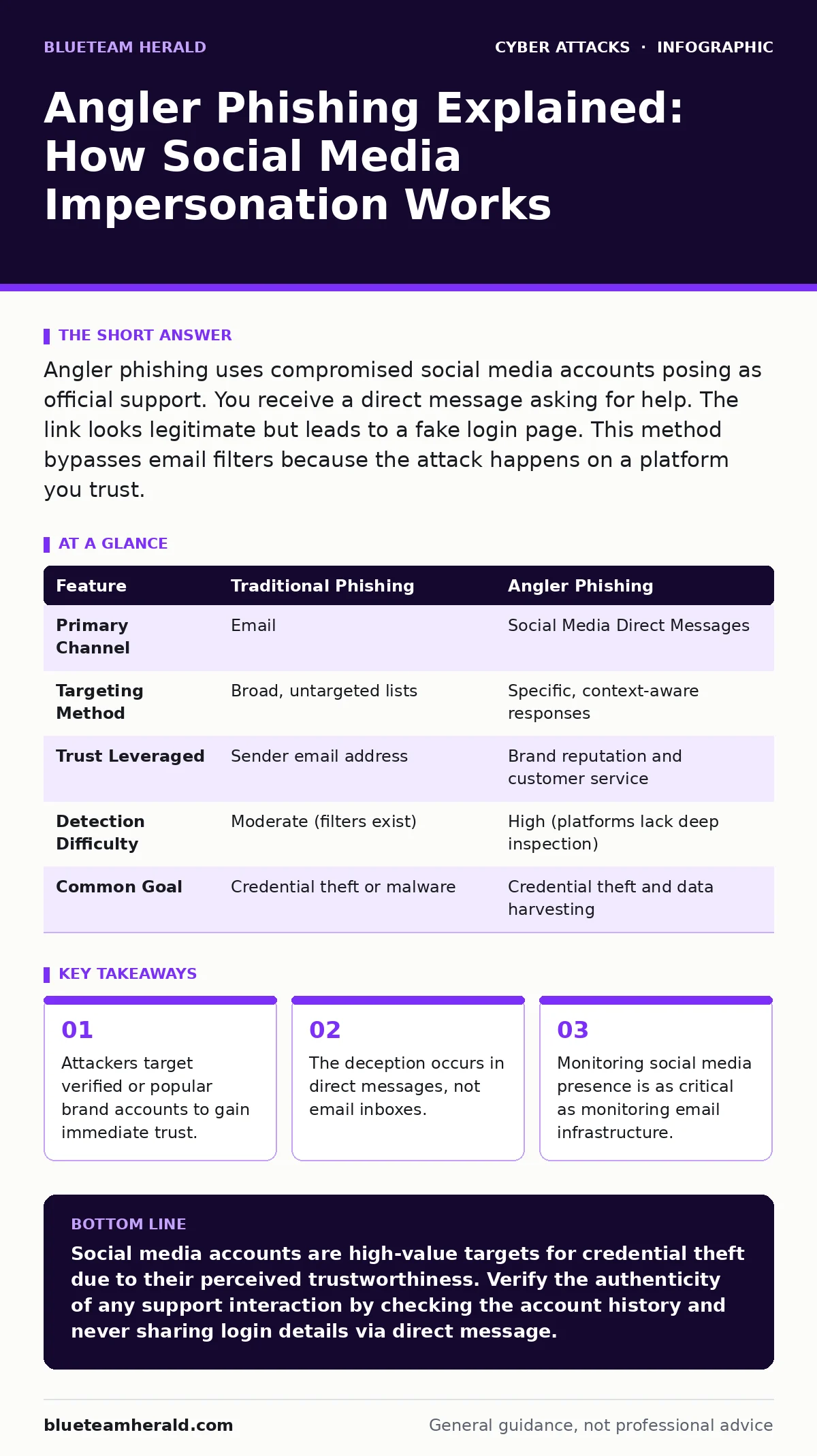
Angler phishing uses compromised social media accounts posing as official support. You receive a direct message asking for help. The link looks legitimate but leads to a fake login page. This method bypasses email filters because the attack happens on a platform you trust.
What exactly is angler phishing?
Angler phishing is a specific type of social engineering attack where adversaries take over customer service accounts on social media platforms. Instead of sending mass emails, the attacker waits for you to post a complaint or inquiry about a service. They then respond directly, offering help that requires you to click a malicious link. This approach exploits the inherent trust you place in brands responding to your concerns.
How does it differ from standard phishing?
Standard phishing relies on volume, sending thousands of emails in hopes one lands in an inbox. Angler phishing relies on precision and context. The attacker sees your specific problem and offers a tailored solution. This personalization makes the request feel organic rather than spammy. You are less likely to question a reply that addresses your exact issue.
Why do attackers choose social media over email?
Email security tools have decades of experience filtering malicious content. Social media platforms lack equivalent scrutiny for direct messages. Attackers know that corporate defenses focus heavily on the email gateway. By operating in the social layer, they bypass these established controls. This gap allows them to reach users who are otherwise well-protected.
How can you verify a support account is legitimate?
You must check the account history and engagement patterns manually. A legitimate support account will have years of consistent activity and a high volume of public interactions. Look for subtle misspellings in the bio or handle, which are common indicators of compromise. Do not rely solely on profile pictures or blue checkmarks, as these can be faked or stolen.
What happens when you click the link in a DM?
The link usually leads to a replica of the brand’s official login portal. This site looks identical to the real one, including logos and layout. When you enter your credentials, they are sent to the attacker’s server instead of the company. You may be redirected to the real site afterward, masking the theft. This seamless transition prevents you from realizing you have been compromised.
See also: Business Email Compromise Example: How Attackers Bypass Trust
Why is this harder to detect than CEO fraud?
CEO fraud targets high-value transfers from a few specific individuals. Angler phishing targets credential theft from the general public. The damage is distributed across many small accounts rather than one large financial loss. This fragmentation makes it difficult for organizations to notice the initial breach. The attack often goes unnoticed until many users report stolen data.
Can automated tools stop this type of attack?
Traditional email security cannot inspect social media direct messages. You need specialized monitoring for your social media presence. This involves tracking changes to account permissions and detecting unusual login locations. Some organizations use extended detection and response (XDR) platforms to correlate social media alerts with other security events. This holistic view helps identify the compromise faster.
How do you protect your organization’s social presence?
Implement strict access controls for all social media accounts. Use multi-factor authentication that is resistant to phishing, such as hardware keys. Regularly audit who has administrative access to these accounts. Remove access immediately when employees leave or change roles. This reduces the window of opportunity for an attacker to hijack the profile.
| Feature | Traditional Phishing | Angler Phishing |
|---|---|---|
| Primary Channel | Social Media Direct Messages | |
| Targeting Method | Broad, untargeted lists | Specific, context-aware responses |
| Trust Leveraged | Sender email address | Brand reputation and customer service |
| Detection Difficulty | Moderate (filters exist) | High (platforms lack deep inspection) |
| Common Goal | Credential theft or malware | Credential theft and data harvesting |
What should you do if you suspect a compromise?
Change the password for the compromised account immediately. Enable multi-factor authentication if it is not already active. Review recent login activity for unfamiliar devices or locations. Report the incident to the social media platform’s support team. This helps them secure the account and prevent further misuse.
How does this relate to smishing and other scams?
Smishing uses SMS messages to trick users into revealing information. Angler phishing uses social media interactions for the same goal. Both rely on the convenience and trust associated with personal communication channels. Understanding the mechanics of one helps you recognize the patterns in the other. They are variations of the same social engineering principle.
Key takeaways
- Attackers target verified or popular brand accounts to gain immediate trust.
- The deception occurs in direct messages, not email inboxes.
- Monitoring social media presence is as critical as monitoring email infrastructure.
Social media accounts are high-value targets for credential theft due to their perceived trustworthiness. Verify the authenticity of any support interaction by checking the account history and never sharing login details via direct message.
Frequently asked questions
Can I use bot protection to stop angler phishing?
Bot protection helps prevent automated attacks, but angler phishing is often conducted by humans. You need behavioral monitoring and strict access controls to mitigate this risk effectively.
Is whaling attacks similar to angler phishing?
Whaling targets senior executives with highly personalized emails. Angler phishing targets the general public on social media. Both use personalization, but the scale and platform differ significantly.
How do romance scams compare to this method?
Romance scams build long-term emotional relationships to extract money. Angler phishing uses short-term utility and brand trust to steal credentials. The motivation and timeline are distinct.
What role does extended detection and response (XDR) play?
XDR correlates data from email, network, and endpoint sources. It can help identify anomalies in social media account usage when integrated with identity management systems. This provides a broader view of potential compromises.
How this guide was produced: written by the BlueTeam Herald editorial team with AI assistance, checked against the public references listed below, and reviewed when the facts change. See our editorial policy or report an error.