Detect Romance Scams in Logs: Signs, Tools, and Blind Spots
Romance scams often bypass security controls by exploiting human trust rather than technical vulnerabilities, leaving subtle behavioral traces in communication logs.

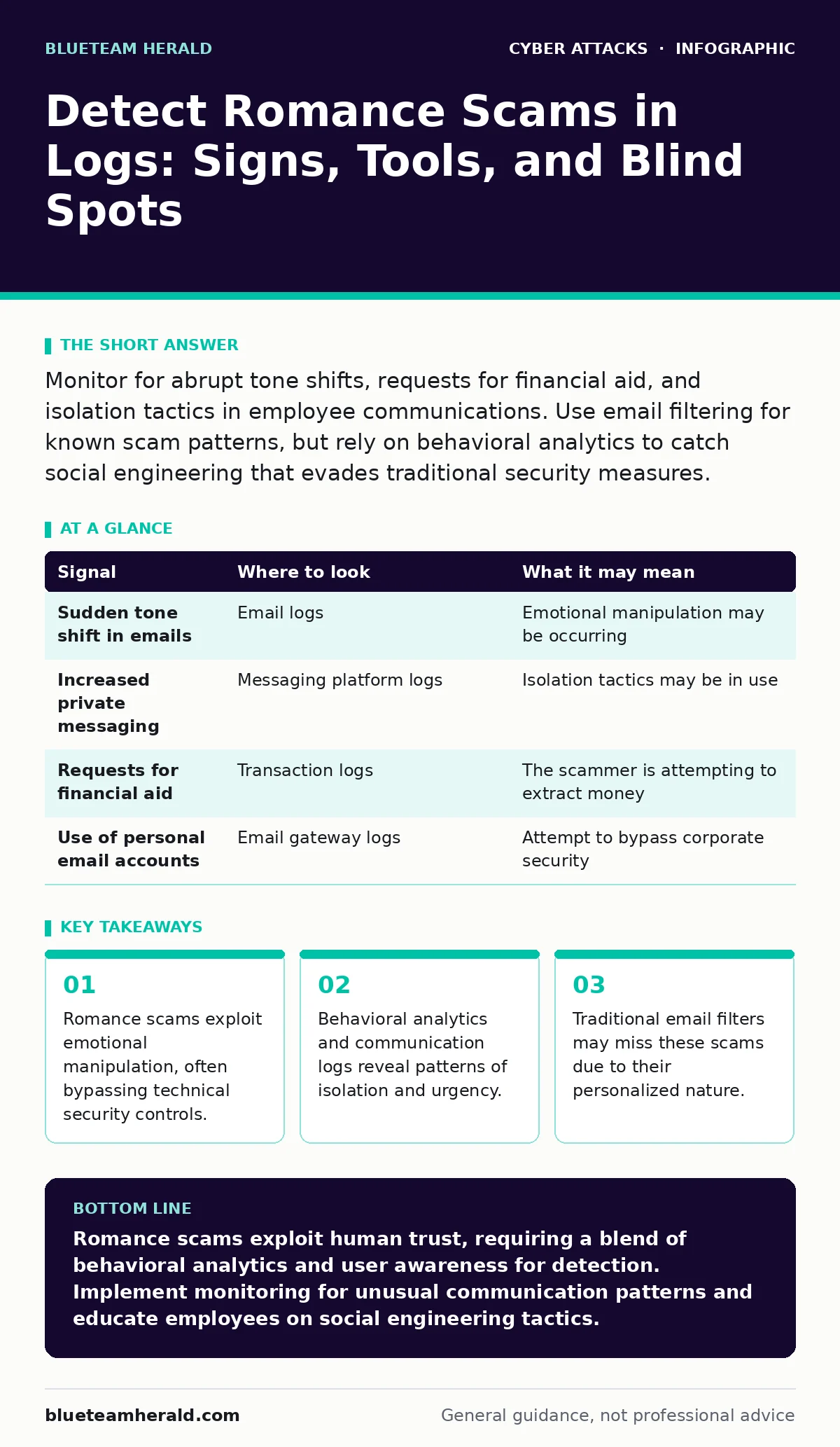
Monitor for abrupt tone shifts, requests for financial aid, and isolation tactics in employee communications. Use email filtering for known scam patterns, but rely on behavioral analytics to catch social engineering that evades traditional security measures.
The Human Vector in Security Logs
Romance scams represent a unique challenge for security teams because they target human psychology rather than software vulnerabilities. Unlike traditional cyber attacks that exploit code flaws, these scams rely on building trust over time. This makes them difficult to detect using standard intrusion detection systems. You must look beyond technical indicators to understand the social engineering aspect.
The initial contact often appears benign. A new connection on a professional platform or an email from a seemingly legitimate source can start the process. Security tools may flag the initial message as safe because it contains no malicious links or attachments. The danger lies in the gradual shift in communication patterns.
Behavioral Patterns in Communication Logs
As the scam progresses, the perpetrator manipulates the victim's emotions. This manipulation leaves traces in communication logs. You should look for sudden changes in tone, frequency, or content. A person who previously communicated professionally may start sharing personal details. This shift indicates a breach of professional boundaries.
Isolation tactics are common in romance scams. The scammer may encourage the victim to keep the relationship secret. This leads to private messaging channels being used more frequently. Security teams should monitor for unusual increases in private messaging activity. This does not mean every private message is suspicious, but a sudden spike warrants investigation.
Financial Indicators in Transaction Logs
The ultimate goal of a romance scam is financial gain. You will see requests for money, gift cards, or cryptocurrency transfers. These requests often come with a sense of urgency. The scammer may claim an emergency situation that requires immediate financial assistance. Transaction logs will show unusual payment patterns or recipients.
Look for payments to unknown entities or individuals. Cryptocurrency transactions are particularly difficult to trace. Security teams should monitor for any unusual financial activity, especially if it coincides with changes in communication patterns. Even if the payment method is legitimate, the context may indicate fraud.
| Signal | Where to look | What it may mean |
|---|---|---|
| Sudden tone shift in emails | Email logs | Emotional manipulation may be occurring |
| Increased private messaging | Messaging platform logs | Isolation tactics may be in use |
| Requests for financial aid | Transaction logs | The scammer is attempting to extract money |
| Use of personal email accounts | Email gateway logs | Attempt to bypass corporate security |
Technical Indicators in Network Traffic
While the scam is primarily social, technical indicators can still provide clues. Scammers may use compromised accounts or fake profiles. These accounts often have unusual login patterns. You should look for logins from unexpected locations or devices. This can indicate account takeover or the use of a bot network.
Network traffic analysis can reveal connections to known malicious domains. Even if the scammer does not send malicious links, they may communicate through compromised servers. Security tools that monitor DNS queries and HTTP requests can help identify these connections. Look for domains that are newly registered or have suspicious reputations.
The Role of Email Filtering and Phishing Detection
Traditional email filtering is designed to catch malicious content. Romance scams often evade these filters because the initial messages are clean. The scammer builds trust before introducing any malicious elements. This makes content-based filtering less effective. You need to rely on behavioral analysis and user training.
Phishing-resistant authentication can help prevent account takeover. If a scammer gains access to an employee's account, they can use it to contact others. Multi-factor authentication adds a layer of security that makes it harder for attackers to impersonate legitimate users. However, this does not prevent the scam if the victim willingly shares information.
See also: Business Email Compromise Example: How Attackers Bypass Trust
Blind Spots in Current Detection Methods
One major blind spot is the assumption that romance scams only target individuals. These scams can also target organizations. An employee may be manipulated into transferring company funds or sharing sensitive information. Security teams often focus on external threats, ignoring the internal social engineering risks.
Another blind spot is the lack of integration between different security tools. Email logs, messaging platform logs, and transaction logs are often siloed. This makes it difficult to see the full picture. You need a unified view of employee communications and financial transactions. Behavioral analytics platforms can help correlate data from different sources.
Cross-Referencing with Other Attack Vectors
Romance scams often overlap with other types of social engineering. For example, a scammer might use smishing to initiate contact. This involves sending text messages that appear to be from a legitimate source. Security teams should be aware of these cross-vector attacks. Monitoring SMS gateways can help detect early signs of a romance scam.
Similarly, whaling attacks target high-value individuals within an organization. A romance scam might be used to build trust with an executive before requesting a large financial transfer. Understanding the tactics used in whaling attacks can help you detect romance scams that target senior staff. See our guide on whaling attacks for more details on identifying these high-level threats.
Implementing a Holistic Defense Strategy
A holistic defense strategy combines technical controls with user awareness. Security teams should implement behavioral analytics to monitor for unusual patterns. This includes changes in communication tone, frequency, and content. Regular training sessions can help employees recognize the signs of social engineering.
It is also important to have clear policies for reporting suspicious activity. Employees should feel comfortable reporting unusual communications without fear of retribution. A culture of openness can help security teams detect and respond to romance scams more effectively. Remember, the goal is not to catch every scam, but to minimize the impact when one occurs.
Key takeaways
- Romance scams exploit emotional manipulation, often bypassing technical security controls.
- Behavioral analytics and communication logs reveal patterns of isolation and urgency.
- Traditional email filters may miss these scams due to their personalized nature.
Romance scams exploit human trust, requiring a blend of behavioral analytics and user awareness for detection. Implement monitoring for unusual communication patterns and educate employees on social engineering tactics.
Frequently asked questions
How do I distinguish between a legitimate personal relationship and a romance scam?
Look for signs of isolation, urgency, and requests for financial aid. Legitimate relationships do not typically involve immediate financial pressures or secrecy.
Can AI detect romance scams in communication logs?
AI can help identify unusual patterns in tone and frequency, but it may miss the nuanced emotional manipulation. Human review is still necessary.
What is the role of phishing-resistant authentication in preventing romance scams?
It prevents account takeover, making it harder for scammers to impersonate legitimate users. However, it does not prevent victims from willingly sharing information.
How do romance scams differ from CEO fraud?
Romance scams build emotional trust over time, while CEO fraud often involves impersonation of authority figures for immediate financial gain. See our guide on CEO fraud for more details.
How this guide was produced: written by the BlueTeam Herald editorial team with AI assistance, checked against the public references listed below, and reviewed when the facts change. See our editorial policy or report an error.