OAuth Token Abuse Explained: How Stolen Keys Compromise Your Cloud
Attackers rarely crack passwords; they steal active session tokens to bypass login screens and access cloud resources without triggering standard alerts.

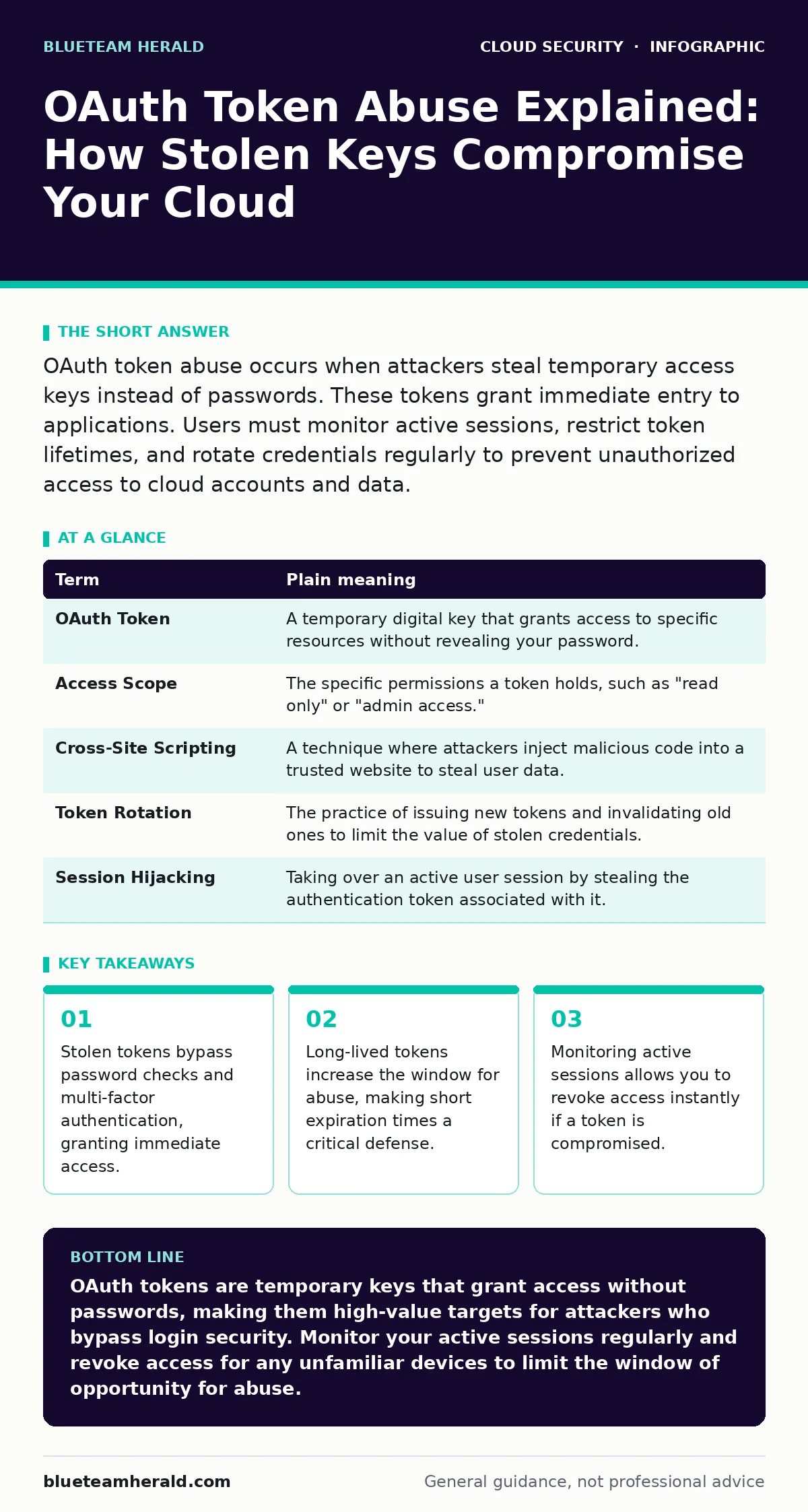
OAuth token abuse occurs when attackers steal temporary access keys instead of passwords. These tokens grant immediate entry to applications. Users must monitor active sessions, restrict token lifetimes, and rotate credentials regularly to prevent unauthorized access to cloud accounts and data.
The Hotel Key Card Analogy
Imagine you check into a hotel. The front desk verifies your identity with a passport and a credit card. This is your login process. Once verified, they hand you a plastic key card. This card is your OAuth token (Open Authorization token), a temporary credential that grants access to specific rooms. You do not need to show your passport every time you enter your room. The card works until it expires or you return it.
Now imagine a pickpocket steals your key card. They do not need your passport. They do not need to guess your PIN. They simply swipe the stolen card and enter your room. The door lock does not care how they got the card; it only cares that the card is valid. This is OAuth token abuse. The attacker uses a valid, stolen credential to bypass the initial identity verification entirely.
Understanding the Credential Types
To understand the risk, you must distinguish between the two types of credentials in modern cloud systems. Your password is like your passport. It proves who you are at the start of the interaction. It is static and requires careful storage. The OAuth token is like the key card. It is dynamic, temporary, and grants specific permissions.
When you log in to a cloud service, the system issues a token. This token contains information about your permissions and an expiration time. The application uses this token to talk to other services on your behalf. If an attacker steals the password, they must still pass multi-factor authentication. If they steal the token, they have already passed that gate. The token is the open door.
How Tokens Get Stolen
Attackers rarely break into secure servers to steal passwords directly. Instead, they look for tokens already in use. This often happens through cross-site scripting (XSS), a technique where an attacker injects malicious code into a website you trust. When you visit the site, the code runs in your browser and sends your active session tokens to the attacker.
Another common method is intercepting tokens transmitted over unsecured networks. If a website does not enforce HTTPS (Hypertext Transfer Protocol Secure), tokens may travel in plain text. Anyone on the same network can read them. Additionally, poorly configured applications may log tokens in browser developer tools or server logs, leaving them exposed to anyone with access to those logs.
| Term | Plain meaning |
|---|---|
| OAuth Token | A temporary digital key that grants access to specific resources without revealing your password. |
| Access Scope | The specific permissions a token holds, such as "read only" or "admin access." |
| Cross-Site Scripting | A technique where attackers inject malicious code into a trusted website to steal user data. |
| Token Rotation | The practice of issuing new tokens and invalidating old ones to limit the value of stolen credentials. |
| Session Hijacking | Taking over an active user session by stealing the authentication token associated with it. |
The Hidden Cost of Convenience
The primary driver of token abuse is convenience. Modern applications use Single Sign-On (SSO) to let you access multiple services with one login. This reduces friction for users but creates a high-value target. If an attacker steals the token for your central identity provider, they can generate new tokens for every connected service.
This is why cloud IAM policies (Identity and Access Management policies) matter. These policies define what a token can do. If a token has excessive permissions, a single stolen key can cause widespread damage. Attackers often look for tokens with administrative privileges to escalate their access. Understanding cloud privilege escalation helps you see how a low-level token can be used to gain control over entire cloud environments.
Safety Habits for Token Hygiene
You cannot prevent every attempt to steal a token, but you can limit the damage. First, always log out of shared or public computers. Logging out invalidates the token on that device. Second, monitor your active sessions. Most cloud platforms provide a list of devices and locations where you are currently logged in. If you see an unfamiliar device, revoke its access immediately.
Third, prefer applications that use short-lived tokens. A token that expires in fifteen minutes is much less valuable than one that lasts for a week. If you are developing applications, ensure you implement token rotation and bind tokens to specific user agents or IP addresses. This adds context to the token, making it harder for an attacker to use it from a different location.
Detecting the Invisible Breach
Because token abuse bypasses login screens, traditional login alerts may not trigger. You need to look for unusual activity within the session. Sudden spikes in data access, requests from unfamiliar geographic locations, or API calls outside of normal business hours are red flags.
Integrating cloud detection and response tools can help automate this monitoring. These tools analyze behavior patterns and flag anomalies. For example, if a token typically used for reading emails suddenly attempts to delete files, the system should alert you. Reviewing insecure cloud APIs is also vital, as poorly designed endpoints can leak tokens to unauthorized parties.
- Check your active sessions weekly and revoke any unrecognized devices.
- Enable multi-factor authentication, but remember it does not protect against stolen tokens.
- Use browser extensions that block cross-site scripting attacks to reduce exposure.
Beyond the Token
Securing tokens is only one layer. You must also ensure that the applications using them are secure. Service mesh security helps manage traffic between microservices, ensuring that tokens are not leaked during internal communication. Similarly, avoiding open security groups prevents unauthorized access to the infrastructure where tokens are generated.
Regular cloud penetration testing can reveal vulnerabilities in how your applications handle tokens. Testers attempt to steal and reuse tokens to identify weaknesses. Finally, ensure unsecured cloud databases are not storing tokens in plain text. If an attacker gains access to your database, they should not find usable credentials.
Key takeaways
- Stolen tokens bypass password checks and multi-factor authentication, granting immediate access.
- Long-lived tokens increase the window for abuse, making short expiration times a critical defense.
- Monitoring active sessions allows you to revoke access instantly if a token is compromised.
OAuth tokens are temporary keys that grant access without passwords, making them high-value targets for attackers who bypass login security. Monitor your active sessions regularly and revoke access for any unfamiliar devices to limit the window of opportunity for abuse.
Frequently asked questions
Does multi-factor authentication protect against OAuth token theft?
No. MFA protects the login process. Once a token is issued, MFA is no longer involved. A stolen token grants access regardless of MFA status.
How long should an OAuth token last?
Tokens should have the shortest lifespan necessary for the task. Short-lived tokens reduce the window of opportunity for an attacker to use a stolen credential.
Can I see which apps have access to my data?
Yes. Most cloud platforms and identity providers offer a dashboard where you can view connected applications and revoke their access tokens.
What is the difference between a password and a token?
A password proves your identity at login. A token proves you have already been authenticated and grants specific permissions for a limited time.
How this guide was produced: written by the BlueTeam Herald editorial team with AI assistance, checked against the public references listed below, and reviewed when the facts change. See our editorial policy or report an error.